
Tech Express | November 16, 2026: Apple Launches AI Health Tool That Answers Only From Medical Research
Apple launched an AI health study app grounded in medical research; Chinese universities warned over illegal VPN use; an Nvidia manager was indicted in Taiwan over chip smuggling. Google made Gemini 4 Hydrogen free, claiming fivefold fewer fabrications; H200 purchase notices vanished at a Chinese university. Samsung's Galaxy Claw leak shows Galaxy AI as a cross-app agent; Voyager 1 hits a light-day Wednesday; Lenovo's Duet 13 may launch in January; Germany sees 800,000 jobs lost to AI.
1. Apple Launches AI Health Tool With a Research Study
Apple announced on Sunday (Nov. 15) that it is launching the Apple Health AI Usage Study app, which the company says answers health questions only by drawing on trusted medical research and, if users allow it, their own health metrics and records.
Dr. Sumbul Desai, Apple's vice president of Health and Fitness, told ABC News that the goal is to create interactions that are "responsible, easy to understand, and can help someone navigate traditional care." Apple is collaborating with OpenEvidence, an AI tool used by doctors that is trained on sources such as medical journals, and uses its own technology to turn that research into easy-to-understand answers.
The study is open to U.S. adults ages 21 and older who have an Apple Intelligence-enabled iPhone (iPhone 15 Pro or later) running iOS 26 or later. Apple says questions are processed through privacy protections that strip identifying information before reaching OpenEvidence, which deletes question-and-response data within 24 hours and does not train its model on the queries. The app also includes safeguards for potentially dangerous situations and makes clear the study does not provide live medical monitoring or replace a health care professional.
2. Chinese Universities Warn Staff and Students Over Illegal VPN Use
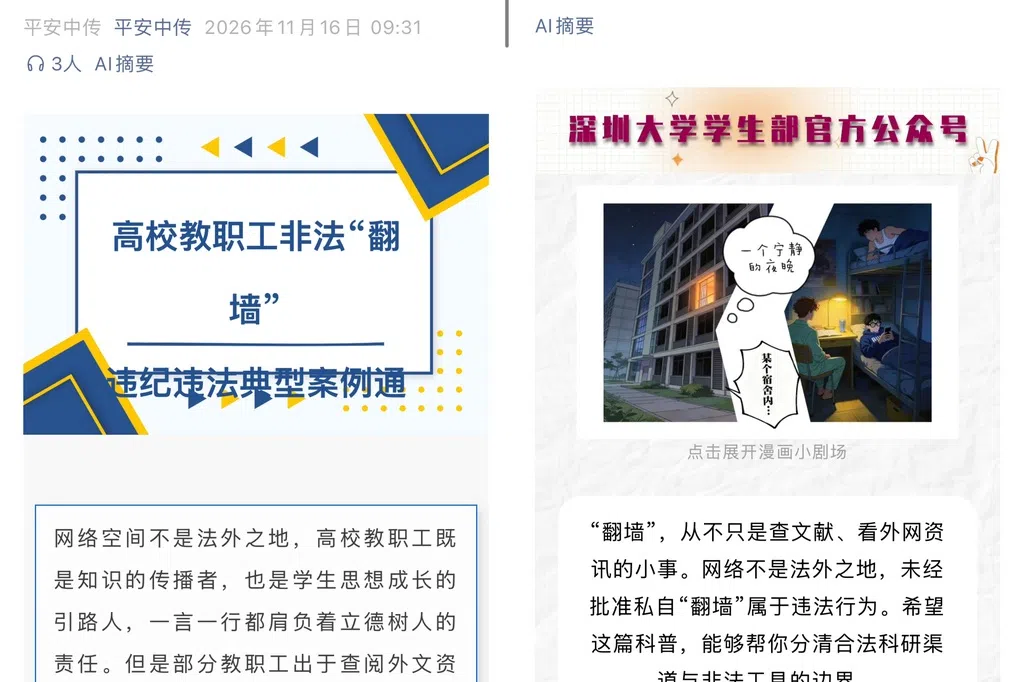
Communication University of China on Monday (Nov. 16) published a notice on its "Safe CUC" account listing typical cases of faculty and staff illegally using virtual private networks, warning that skipping over the law carries a heavy price. The notice said some staff used unapproved VPNs, network accelerators and proxy tools to bypass state network supervision and reach overseas websites for reasons ranging from consulting foreign-language materials to academic exchange and curiosity.
The cases cited include a university teacher who was criminally detained and dismissed for translating religious extremism from overseas, a young scholar who tried to give a foreign non-governmental organization confidential data from a university-enterprise project while publishing in an overseas journal, and a teacher who used an illegal VPN to post inappropriate remarks that were reprinted by foreign media and was warned and disciplined. The notice said the school requires those who need foreign literature to apply through officially approved channels.
Shenzhen University's student affairs office published a notice titled "Don't climb this wall" on Nov. 4, and Hunan University of Technology issued a similar reminder on Nov. 12. Shanghai University of Finance and Economics, Jilin Normal University, Jimei University, Jiangsu University, Chongqing Medical University and Zhengzhou University also issued reminders this month, while Sichuan's provincial education department published a warning on Oct. 26.
3. Nvidia Employee Charged in Taiwan Over AI Chip Smuggling
A manager surnamed Chang at U.S. chip giant Nvidia has been indicted in Taiwan on suspicion of helping smuggle artificial intelligence chips into mainland China, according to Bloomberg. The manager was arrested in July and charged in August with forgery and breach of trust, and is one of nine defendants in the case.
Prosecutors describe Chang as a central figure in a smuggling group accused of helping ship 74 servers loaded with Nvidia chips to mainland China and attempting to move another 56 servers. The servers were seized by Taiwan's Coast Guard Administration in May. Prosecutors also allege he helped a Taiwanese infrastructure supplier obtain Nvidia's approval to buy 130 servers with advanced chips even though the company lacked data center space and was funded by a mainland Chinese company, a fact he allegedly concealed.
People familiar with the matter said Nvidia representatives told Taiwanese officials the company disagreed with the allegations and believed the employee should not be under investigation, while officials replied that the case is handled by the Keelung District Prosecutors Office and they cannot interfere with judicial proceedings. Nvidia said it conducted a thorough investigation and found no evidence the employee knew of other companies' personnel moving chips, and that TSMC declined to get involved when approached for advice. The case is now in court; if convicted, Chang faces up to five years in prison.
4. Gemini 4 Hydrogen Goes Free as Google Claims Fivefold Cut in Fabrications
Google released Gemini 4 Hydrogen last Thursday. Tom's Guide called it possibly one of the biggest upgrades yet to Google's free AI chatbot: the new model is designed to be faster, more accurate and better at following instructions, and it edges out the pricier Gemini 4 Argon on the Artificial Analysis Intelligence Index with a score of 51 versus 50 at Hydrogen's default high reasoning setting.
Google says Hydrogen handles complicated requests and information spread across apps better and produces useful results without endless follow-up prompts, and that it reduces fabricated information more than fivefold compared with Gemini 3.8 Flash. Unlike Google's most powerful models, Hydrogen is available to free users, though they cannot necessarily select it manually: Google's automatic model selection decides when it is appropriate.
Tom's Guide listed five ways to use it: working through dense PDFs, spreadsheets and charts and turning them into organized, actionable reports while keeping follow-up questions in context; writing to detailed instructions on tone, length and format; pulling together information from Gmail, Google Drive and connected apps such as Dropbox and Airtable into a schedule or plan; building interactive tools such as a budget calculator or study guide from plain-English prompts; and refining that first version with ordinary language.
5. H200 Purchase Notices Vanish at Northwestern Polytechnical University
Chinese computing projects and equipment agreements involving Nvidia chips subject to U.S. export controls total more than 23 billion yuan, according to a Reuters tally, with some projects already under construction contracts, though Reuters could not confirm whether the chips had been delivered. Any supply disruption could delay projects and raise costs.
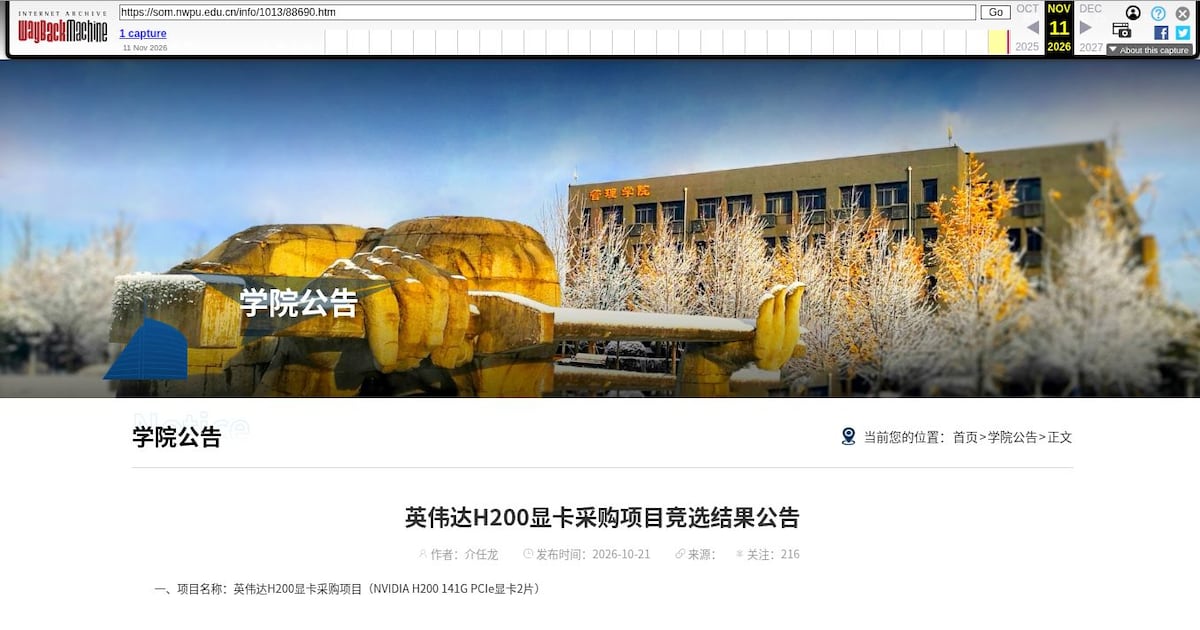
Meanwhile, purchase notices for Nvidia H200 chips from two schools at Northwestern Polytechnical University can no longer be viewed after the transactions were reported in the media. Using pages saved by the Internet Archive, Radio Free Asia found that the university's School of Management announced on Oct. 21 the purchase of two H200 141G PCIe accelerator cards at 437,350 yuan each, 874,700 yuan in total, from Shaanxi Bosuan Network Technology; the original link now returns a 404. Agence France-Presse reported that the School of Cybersecurity announced on Sept. 4 the purchase of two H200 cards for 796,000 yuan, a notice that was also unavailable from the university site as of Nov. 12.
A Chinese AI researcher told RFA that domestically made chips still lag Nvidia's H200 and Blackwell series in per-card peak performance for frontier large-model training and complex scientific computing, and that many national research institutes and universities are still queuing to buy Nvidia cards. A source said that after intense U.S. media coverage of the chip-trade controversy, Chinese authorities are reviewing planned delivery channels, and future Nvidia procurement notices may circulate internally rather than online.
6. Samsung's Galaxy Claw Leak Points to an AI "Personal Agent"
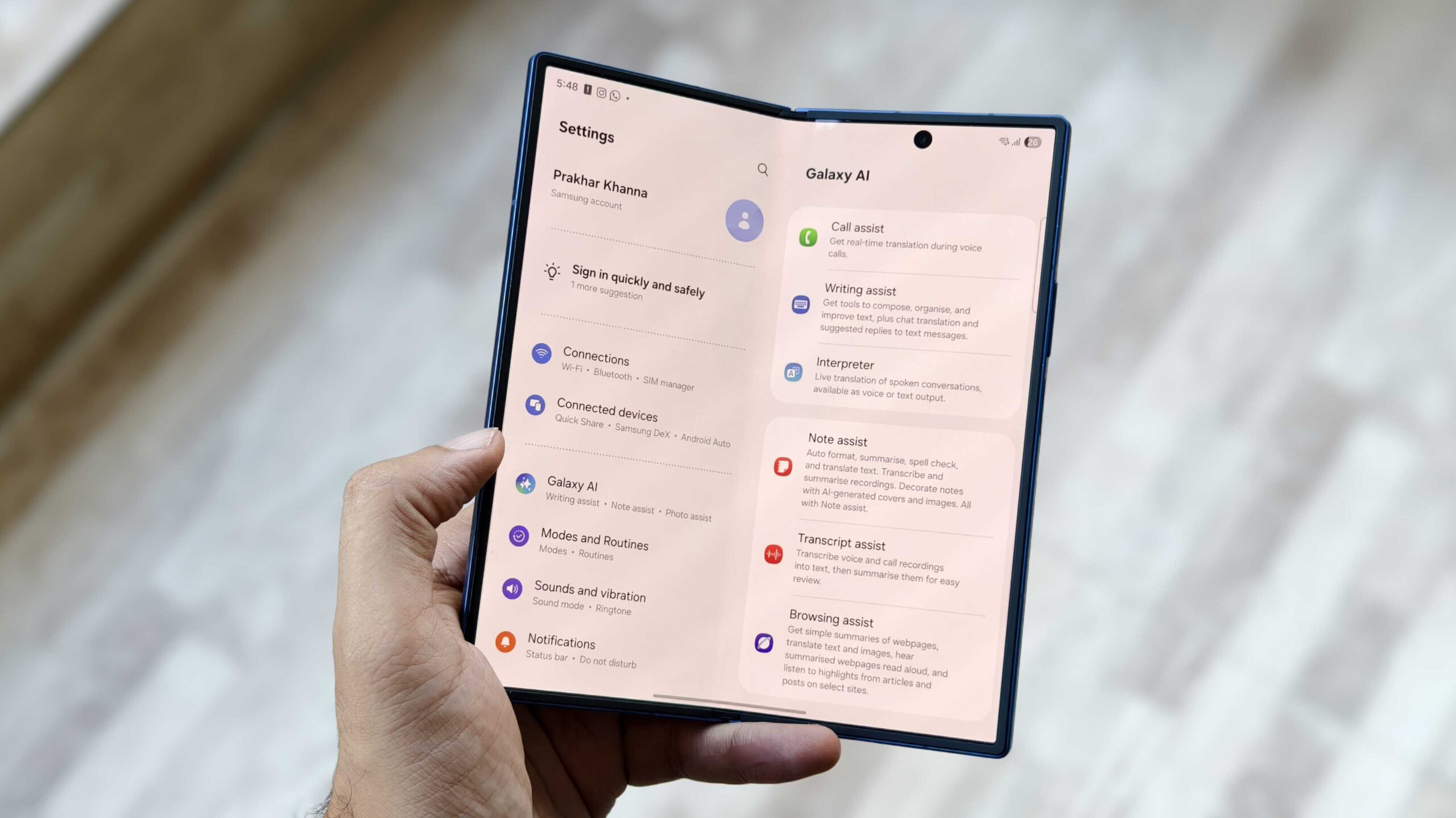
Android Authority found references to "Galaxy Claw" while digging through Samsung's Personal Agent Core app. At the center of the experience is what Samsung calls Personal Agent Core (PAC), described in the app as a system that helps Galaxy AI complete tasks by working with apps and tools across the device and connected services.
Connectors listed in the code include Calendar, Contacts, Gallery, Gmail, Messages, Notifications, Perplexity, Phone and Voice Recorder, and their descriptions suggest Galaxy AI could perform actions rather than just retrieve information: viewing and creating events, managing contacts, viewing and sending messages, searching the web, making calls and recording audio. The integrations would require permissions, and the app can request access to sensitive data such as contacts, photos, calendar events, messages and calls.
The code also reveals scheduled tasks with hourly, daily, weekdays, weekly and custom intervals, plus options to view history and the next run, rename, edit, delete, pause or run a task immediately. One string warns that runs may be delayed while battery saving is on, suggesting some on-device execution. Other components include a Daily Brief, a Device Cleaner, a Travel Planner and a dedicated widget. Android Authority cautioned that the reporting is based on work-in-progress code, that features may not ship, and that Samsung has not confirmed a launch timeline or device compatibility.
7. Voyager 1 Reaches a Light-Day From Earth
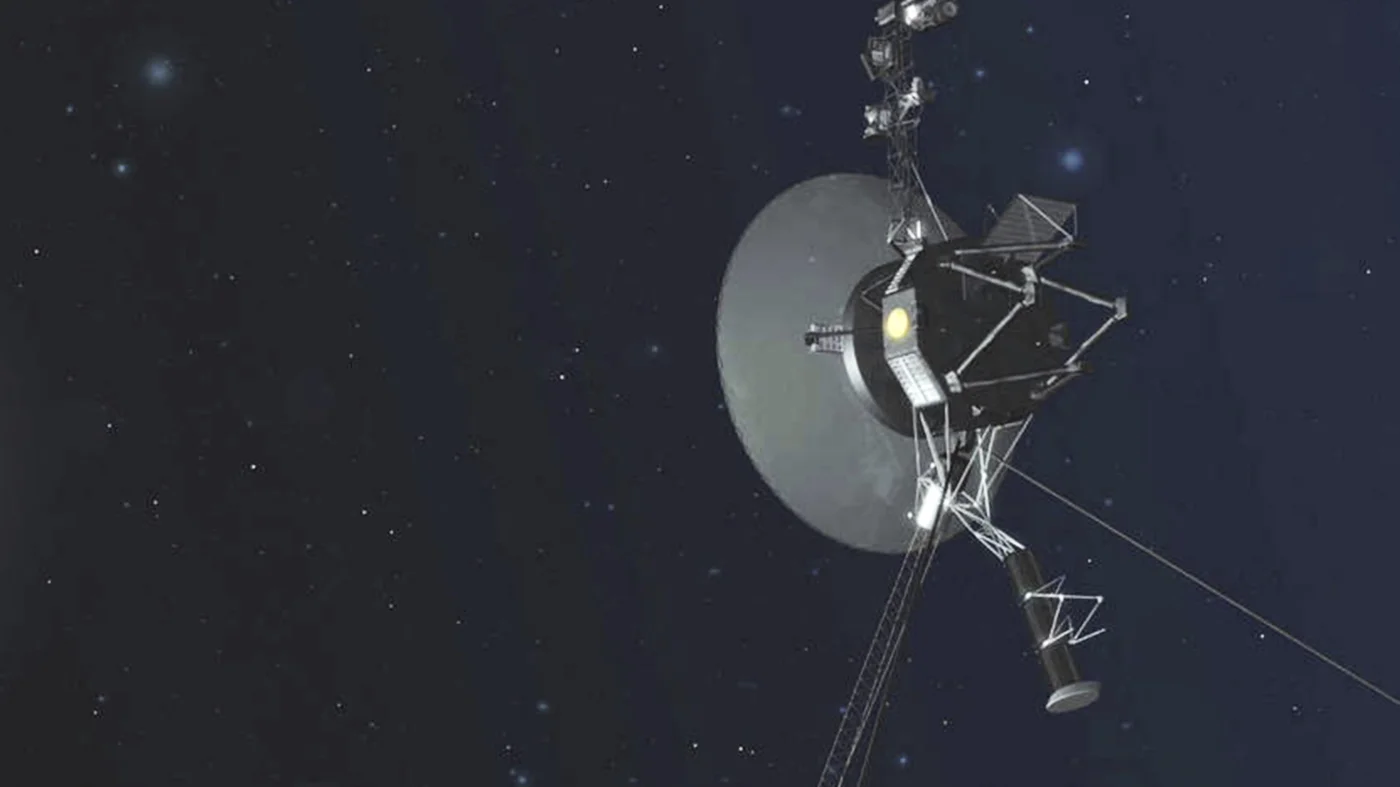
NASA's Voyager 1 has traveled farther than anything else humans have launched into space. On Wednesday it is set to reach a new milestone: a distance of one light-day from Earth, or more than 16 billion miles.
The spacecraft launched on Sept. 5, 1977, and has flown for nearly 50 years. It conducted flybys of Jupiter and Saturn, discovering a faint ring system at Jupiter in 1979 and taking detailed photos of Saturn's rings and moons in 1980. On Feb. 17, 1998, it overtook the U.S. probe Pioneer 10 to become the most distant human-made object, and in 2012 it reached the interstellar boundary. It and its twin Voyager 2 are the only spacecraft to have operated outside the heliosphere.
NASA is marking the occasion with "Shine Bright for Voyager's Light-Day," asking the public on Tuesday night to send the probe's call sign V-G-R into the sky in Morse code using a flashlight, phone light or anything that can blink. To save power, NASA earlier this year shut off Voyager 1's Low-energy Charged Particles experiment, leaving two science instruments running: one measuring magnetic fields and one listening for plasma waves. The probe carries the Golden Record, with 115 images, natural sounds and spoken greetings in 35 languages, and is estimated to reach light-day status at 5:16 a.m. ET on Wednesday after 49 years, two months and 11 days of travel.

8. Lenovo Googlebook Duet 13 Leak Points to January Launch
Leaker Evan Blass shared more images of the "Lenovo Googlebook Duet 13" and noted that it is "launching in January." 9to5Google said the branding builds on Lenovo's Chromebook Duet lineup, and the images confirm a 13-inch screen.
A top-down view shows the detachable keyboard with keys that have a bottom curvature, similar to an available Lenovo device, a trackpad that is on the smaller side, the word "Googlebook" below the Ctrl key, and a stylus. The keyboard has a physical switch on its right edge, the pen attaches magnetically and charges when docked on the top edge, and a pill-shaped cutout at the top-right edge might be a curiously placed USB-C port, since the power button is on the left edge, which also houses another USB-C connector at the bottom.
The removable back cover stand looks to be magnetic, with a diagonal fold and prominent Lenovo branding, and the Glowbar sits next to the camera on the rear. 9to5Google said a January launch would align with a CES 2027 announcement and would be the next big moment for Googlebooks after Google spent recent weeks on bug fixes and improvements.
9. Germany's Labor Chief Warns AI Could Erase 800,000 Jobs in 15 Years
Andrea Nahles, head of Germany's Federal Employment Agency, told the business daily Handelsblatt that AI will reshape the labor market. "We expect that around 800,000 jobs in Germany could disappear because of artificial intelligence in the next 15 years," she said, adding that a similar number of new jobs should be created over the same period.
Nahles said some sectors will be hit harder, such as business service providers and analytical roles in insurance and banking. She also stressed that not all job losses should be blamed on AI, since the weak economy plays a major role, while trades that are harder to automate have held up well. "Even people without vocational training or specialist skills still have opportunities, because sometimes it simply doesn't pay to replace them with AI," she said, adding that it is wrong to assume only highly qualified workers are affected: "In principle, no one is immune anymore."
Nahles is worried about current unemployment: since 2022 the number of unemployed in Germany has risen by 580,000, or 24%. But she believes the biggest problem five years from now will "definitely be a shortage of skilled workers," as an aging population shrinks the workforce by about 500,000 people a year while net immigration has fallen to a multi-year low. She called for attracting skilled workers from outside the EU and setting up the promised "work and residence agency," saying Germany "must become more modern, more digital and more efficient."
10. China VC Money Flows Back to Semiconductors as Embodied AI Cools
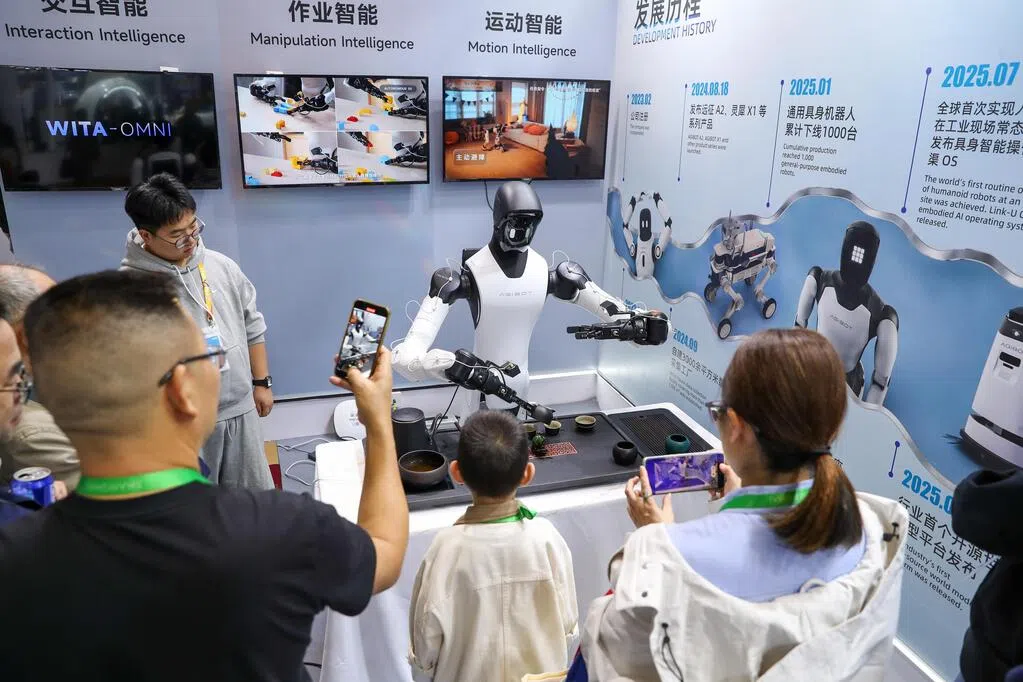
As investment in embodied AI cools, Chinese venture capital is shifting back toward semiconductors. Citing third-party statistics, the STAR Market Daily reported on Sunday (Nov. 15) that 33 financing deals worth 10.105 billion yuan were recorded in the embodied AI sector in October, compared with 60 deals worth 11.028 billion yuan in September, a 45% month-on-month drop in deal count and an 8.4% decline in value.
Caixin said the same day that the primary market for robotics had turned cold abruptly in September. Dozens of robotics companies had been racing toward Hong Kong or mainland listings, with many valuations doubling within months and top players frequently exceeding 10 billion or even 20 billion yuan. But after autumn brought a series of negative developments, including listed candidates reporting each other's financial problems, questions over related-party transactions at new robot data-collection centers, and a broad pullback in global tech stocks, listings slowed. Since Unitree, no new humanoid robot company has listed in A-shares or Hong Kong.
Against that backdrop, primary-market money is looking for a new main theme, and semiconductors are cited by more market participants. Data from the ChinaVenture Institute showed 631 semiconductor investment deals worth 109.243 billion yuan in the third quarter, up 52.42% in number and 91.20% in value year on year. Cailian Press data showed 11.1 billion yuan of integrated-circuit financing in the single week from Oct. 31 to Nov. 6, more than half of all disclosed domestic financing in that period.
More News
- Finance Evening: Dow Sinks 561 Points as Nvidia Erases Gains and Anthropic Prices IPO at $83
- Maple Express | November 18, 2026 — Toronto police foil murder plot in towing probe; Chow begins second term
- Maple Express | November 18, 2026: Toronto police disrupt murder plot tied to tow-truck industry
- AI Weekly | Compute Moves Behind Licenses, and AI Starts Paying Interest on Its Capex
- Global Express | November 18, 2026: Xi Greets Trump at Shenzhen Airport Ahead of Trilateral Talks
Comments (0)
View More
 -54%
HP USB-C Dock G5 — Three Displays Through One Cable! $151.76 CAD (53% Off)
 -43%
Samsung Odyssey 27" QHD QD-OLED Gaming Monitor — 180Hz and 0.03ms for $399.99 CAD (43% Off)
 -26%
TP-Link Deco M5 Mesh WiFi Router — 2,000 Sq. Ft. From One Unit! $129 CAD (26% Off)
 -51%
Sony ULT WEAR Over-Ear Noise Cancelling Headphones — ULT Bass & 30-Hour Battery at Half Price! $174.99 CAD (50% Off)
 Tech Express
 | November 18, 2026 — Nvidia Chair Says Board Has No Plans to Reinstate Jensen Huang
 Finance Morning
Nvidia Results Lift Asia: KOSPI Reclaims 5,000, Hong Kong Slips, A-Shares Turn Higher
-54%HP USB-C Dock G5 — Three Displays Through One Cable! $151.76 CAD (53% Off)
Amazon
-43%Samsung Odyssey 27" QHD QD-OLED Gaming Monitor — 180Hz and 0.03ms for $399.99 CAD (43% Off)
Best Buy
-26%TP-Link Deco M5 Mesh WiFi Router — 2,000 Sq. Ft. From One Unit! $129 CAD (26% Off)
Amazon
-51%Sony ULT WEAR Over-Ear Noise Cancelling Headphones — ULT Bass & 30-Hour Battery at Half Price! $174.99 CAD (50% Off)
Best Buy
Tech ExpressTech Express | November 18, 2026 — Nvidia Chair Says Board Has No Plans to Reinstate Jensen Huang
Finance Morning