
Tech Express | November 19, 2026 — Grand Theft Auto VI Arrives to 99/100 Reviews After a 13-Year Wait
GTA VI launches to 99/100 reviews and 15.8 million pre-orders; Microsoft nears a $500 million OpenAI model deal with ByteDance as a House panel demands answers; Altman warns of chip oversupply; Tencent says US chip rules will slow China's models; Trump hints Blackwell sales to China in two to three years; AMD takes 81.3% of US Amazon CPU sales; RTX Spark mini PCs launch; a star is seen swallowing its companion; Musk calls himself a China superfan; WIPO reports record filings.
1. Grand Theft Auto VI Launches to Rave Reviews After a 13-Year Wait
Grand Theft Auto VI went on sale worldwide on Thursday, arriving on PlayStation 5 and Xbox Series consoles from midnight and drawing some of the strongest reviews in the history of the medium. Metacritic's aggregate score stood at 99 out of 100 across more than 150 reviews.
IGN critic Luke Reilly called it "the single most impressive video game I have ever played," while PCMag's Jordan Minor wrote that accepting GTA 6 is not real "makes it all the more astonishing how much the game is very real." The story follows Jason Duval and Lucia Caminos, a Bonnie-and-Clyde-style pair, across the fictional state of Leonida and its coastal metropolis Vice City.
Developed by New York-based Rockstar Games at an estimated cost of more than $1bn, the title is the first new instalment since Grand Theft Auto V in 2013. It was originally scheduled for 2025 and delayed twice for polishing. Market intelligence platform Sensor Tower estimates pre-orders exceeded 15.8 million units as of November 17, generating $1.54bn.
2. Microsoft Nears Deal to Sell OpenAI Model Access to ByteDance, House Panel Demands Answers
The US House select committee on China asked Microsoft on Wednesday (November 18) to brief lawmakers on reports that it provides artificial intelligence services to Chinese tech company ByteDance. Tech outlet The Information reported that Microsoft is close to a commercial agreement worth up to $500 million that would let ByteDance call OpenAI's large models through Microsoft's Azure cloud.
The report said Microsoft is also approaching several Chinese companies, including Alibaba. OpenAI formally restricts most Chinese firms from accessing its technology, but Microsoft, as a key partner, holds independent commercial rights to distribute OpenAI technology and has not applied the same limits.
Committee chair John Moolenaar, a Michigan Republican, said it was unacceptable for Microsoft — a major Pentagon defence contractor — to sell core AI services to ByteDance, warning that leading US tech giants should not "bet on both sides" in the US-China AI race. Microsoft said it takes preventing AI misuse seriously and follows its terms of service and applicable law, but does not comment on confidential customer negotiations.

3. Altman Warns of Near-Term Chip Oversupply
OpenAI chief executive Sam Altman has warned that many chipmakers are staking their sales targets on AI labs such as OpenAI and Anthropic, whose actual purchasing remains limited, creating a risk of short-term oversupply, according to a report carried by Mydrivers on Thursday (November 19).
Altman said manufacturers planning capacity assume most of their output will go to leading AI companies, but OpenAI's data-centre footprint and procurement budget have a ceiling and cannot absorb every vendor's capacity, meaning demand is being counted more than once. He maintained that the long-term growth case for compute and data centres still holds, with the risk concentrated in a near-term mismatch between supply and demand.
Orders across the supply chain remain hot: AMD's Helios compute systems are already supplying several leading AI firms and the company expects revenue growth above 80% in 2027; more than 75% of Micron's fiscal 2027 capacity is under long-term contracts; optical module maker Coherent's 2027 capacity is essentially booked, with customers already reserving 2028 output. Yet debt pressure is building at compute infrastructure operators: CoreWeave plans $37-39 billion of capital spending in 2026 after $846 million of interest expense and a $709 million net loss in the third quarter, while IREN's net debt jumped from $216 million to $4.43 billion and its shares fell 42.39% in a month.

4. Tencent's Martin Lau Says New US Chip Rules Will Slow China's Next Models
Tencent president Martin Lau acknowledged on Wednesday (November 18) that new US export controls on AI chips will affect every Chinese tech company, saying China will "need longer in the short term to develop next-generation models." Speaking on the company's third-quarter earnings call, he said Chinese firms will increasingly turn to domestic semiconductors to limit the long-term impact of the rules.
The US Commerce Department published the new regulation on Monday (November 16), restricting exports of advanced AI chips made by Nvidia and others to data centres in Singapore, Malaysia, Thailand, Indonesia and Brazil that are designated high-risk for chip diversion. Overseas data centres providing substantial computing power to China-headquartered companies must obtain US export licences within 90 days or face further restrictions, with applications reviewed case by case.
China's foreign ministry called the move "typical economic coercion and long-arm jurisdiction" on Tuesday (November 17), while the commerce ministry urged Washington to return to consultation and said Beijing would take countermeasures if it did not. Tencent separately reported third-quarter revenue up 8% to 207.3 billion yuan, about 1.5% below the analyst average, with operating profit down 7% — its first profit decline in years — and a second consecutive quarter of negative free cash flow exceeding 69 billion yuan.
5. Trump Suggests Blackwell Chips Could Be Sold to China in Two or Three Years
President Donald Trump said the United States may allow Nvidia to sell its Blackwell chips to China in two or three years, once they are no longer the most advanced on the market. Speaking to Fox News during the APEC summit in Shenzhen, Trump said, according to Bloomberg on Thursday (November 19): "In two or three years, if I'm still in office, I'll say, go ahead, you can sell Blackwell chips now, because by then they'll have other products." His second term ends in January 2029.
Trump noted that Nvidia is already developing a generation beyond Blackwell, and that Blackwell remains very advanced but could be obsolete within a year. Nvidia had long sought US approval to sell the chip to China, but the administration had refused, allowing only the less capable H200 processor.
Nvidia's stance on the China market has shifted since former chief executive Jensen Huang resigned last week amid a personal controversy. Interim chief executive Kress said on the November 17 earnings call that the company had stopped shipping Hopper data-centre chips approved for the US market to mainland China, after selling $2.4 billion of Hopper data-centre products there last quarter, and that forecasts no longer include that revenue. Nvidia also said it would form a board committee dedicated to national security and export controls. Republican senator Banks and Democratic senator Warren are pushing an AI Overwatch Act to block advanced chips, including Blackwell, from going to China; the bill is in final negotiations over the annual defence bill.
6. AMD Takes 81.3% of US Amazon CPU Sales as Arrow Lake Slides 76.5%
AMD's share of processor sales on Amazon in the United States climbed to 81.3% in October, widening its lead over Intel, whose share shrank to 18.7%, according to the latest hardware sales report from research firm TechEpiphany.
The biggest surprise was a reverse trend of buyers choosing older parts over new ones. Sales of Intel's new Arrow Lake processors (LGA1851) fell from 4,050 units in August to 950 in October, a 76.5% drop that left just 2.7% of the market, while the previous-generation Raptor Lake Refresh (LGA1700) rose 50% from 3,000 to 4,500 units. Intel's overall volume fell 16.7%, from 7,800 to 6,500 units.
AMD saw a similar twist: its forward-looking AM5 platform slipped 11.4%, while the long-serving AM4 platform grew 12% to 13,100 units, or 37.8% of AMD's total. The report attributes Arrow Lake's weak reception to its requirement for DDR5 memory and expensive new motherboards — for mainstream buyers, the performance gain does not offset the cost of moving to a new platform.

7. Nvidia's First RTX Spark Mini PCs Go on Sale Today With Up to 128GB of Memory
After RTX Spark laptops arrived earlier this year, Nvidia's RTX Spark N1X chip is now available in desktops from Asus, Dell and MSI starting today (November 19). More RTX Spark desktops are coming later from Acer, Gigabyte and HP, while Microsoft's Surface RTX Spark Dev Box is slated to ship this month.
The mini PCs pack a 6,144-core Nvidia Blackwell RTX GPU, a 20-core Nvidia Grace CPU and up to 128GB of memory. The hardware comes at a price: Asus's ProArt GR1X starts at $4,499 for a configuration with 64GB of memory and 1TB of storage.
Like the RTX Spark laptops positioned against the MacBook Pro and the DGX Spark desktop Nvidia launched last year, the new machines are alternatives to the Mac Mini or Mac Studio for developers running local AI models and RTX-accelerated software, including AI features in Adobe Premiere and Photoshop and new DLSS 4.5 Ray Reconstruction support in Blender 5.3. Nvidia says they can serve as a "dedicated Windows PC for local models and always-on agents," deliver "up to 1 petaflop of AI performance," and offer native CUDA support plus Linux development tools through Windows Subsystem for Linux.

8. Astronomers Witness a Star Swallowing Its Companion for the First Time
Astronomers may have directly witnessed a star engulfing its companion for the first time, according to a new study. The subject is a red giant designated WNTR23bzdiq, about 2.5 million light-years away in the Andromeda galaxy, roughly seven times heftier and 350 times wider than the sun.
"It's like throwing a bucket of water in a large ocean," lead author Viraj Karambelkar, an astrophysicist at Columbia University, told Space.com, explaining why such events are so hard to catch. Using NASA's now-defunct NEOWISE space telescope and the WINTER telescope at Palomar Observatory in California, the team saw the star brighten in 2023, and archival records showed its luminosity had been rising since 2018.
Near the end of 2025 the star produced a giant eruption, and the James Webb Space Telescope observed it just 47 days later. The researchers propose that a companion about 70% of the sun's mass rammed into the giant's core, ejecting material equal to about 0.1 to 0.2 solar masses. "I was absolutely flabbergasted when we saw this," Karambelkar said. He cautioned that the two stars may instead survive in a much shorter orbit, and that continued monitoring is needed. The findings were published November 18 in the journal Nature.

9. Musk Calls Himself a China 'Superfan' and Vows More Output in China
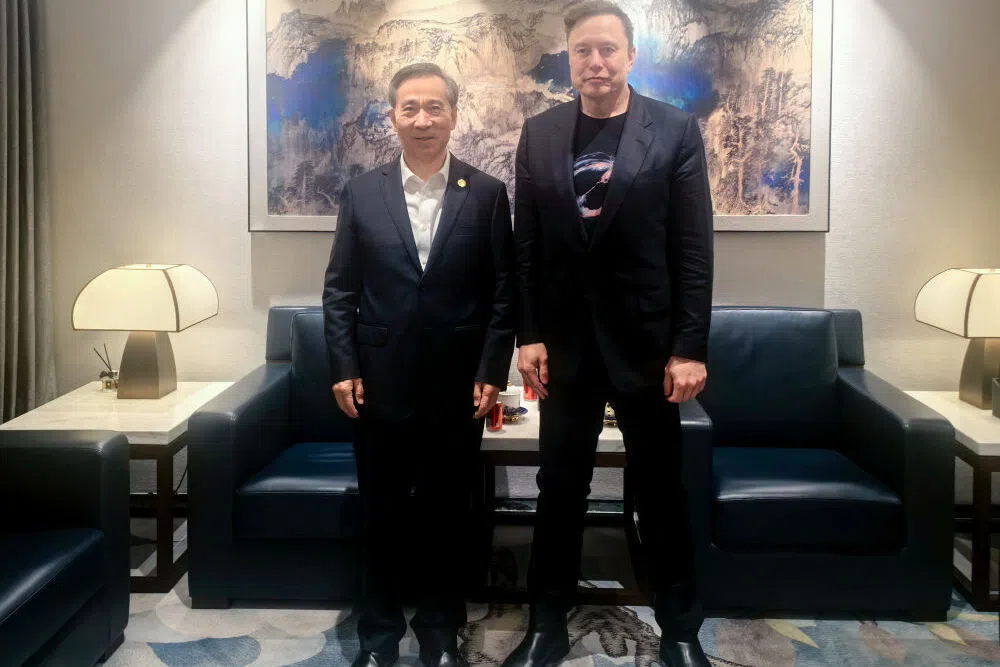
Musk met Ren Hongbin, chairman of the China Council for the Promotion of International Trade, in Shenzhen on Thursday (November 19). During the talks Musk said he often tells people in the United States and elsewhere that unless they visit in person, they cannot truly understand China.
He described himself as a "superfan" of China, praising its scenery, its cultural achievements and especially its high-speed rail network. He also spoke with his young son, who accompanied him, asking "Do you love China?" and joking after the boy nodded that all his toys are made in China, that the country is his "toy paradise" and that he looks forward to every visit.
Musk said the more the US and China cooperate, the better off both will be, and that Tesla will keep raising output in China, without giving targets or a timeline. It was his first public visit to Shenzhen; on arrival he posted on X about whether the "Thucydides Trap" can be avoided. Tesla's Shanghai plant, which began production in late 2019, now has annual capacity above 950,000 vehicles and sources 98% of parts locally. Reuters reported the plant delivered 810,900 Model 3 and Model Y vehicles in the first 10 months of the year, up 21.4% year on year.
10. Global Patent Filings Hit Record 3.94 Million in 2025 as China Stays First
Global patent applications reached 3.94 million in 2025, up 6% year on year to a record high and the fastest growth since 2016, the World Intellectual Property Organization reported on November 18, likely helped by a surge in AI-related filings.
China filed 1.91 million applications, up 6%, retaining first place. The United States came second with 489,700, down 3%, while Japan was third with 466,300, up 11% — rare double-digit growth after years of flat activity. Japan's patent office received 358,300 applications in 2025, up 17%, its biggest increase in the 53 years since 1972.
India reached 105,100 applications, up 38%, passing the 100,000 mark for the first time and posting a seventh straight year of double-digit growth. WIPO said several intellectual property offices report more filings from individuals, and examiners increasingly encounter documents suspected of being AI-generated or AI-assisted; Britain's IP office is tracking growth in "AI-assisted applications" filed without an agent. As of 2024, computer technology accounted for nearly 14% of all filings, the largest share of any field.
More News
- Finance Evening | Dow Plunges 1,101 Points as Anthropic Climbs 17% in Debut
- Maple Express | November 19, 2026 — Chow Reshuffles City Hall Team, Hands Housing to Erskine-Smith
- Maple Express | November 19, 2026 — Two Toronto fugitives in the top three of Canada's most wanted list
- Global Express | November 19, 2026: Kerch Bridge Hit Again as Trump, Xi and Putin Meet in Shenzhen
- Finance Morning | Anthropic's $81.3bn IPO Is the Biggest Ever as Taiwan Stocks Tumble 4.4%
Comments (0)
View More
 -34%
SUNUV UV LED Nail Lamp — 33% Off, $39.99
 -46%
Amazon Echo Show 15 — 45% Off, $274.99
 -31%
MANSCAPED The Beard Hedger Trimmer — 30% Off, $90.99
 -50%
STANLEY Quencher H2.0 20oz Tumbler — 50% Off, $23
 Maple Express
 | November 19, 2026 — Chow Reshuffles City Hall Team, Hands Housing to Erskine-Smith
 Deal Collection
Black Friday 2026: 20 Amazon Devices Picks
-34%SUNUV UV LED Nail Lamp — 33% Off, $39.99
Amazon
-46%Amazon Echo Show 15 — 45% Off, $274.99
Amazon
-31%MANSCAPED The Beard Hedger Trimmer — 30% Off, $90.99
Amazon
-50%STANLEY Quencher H2.0 20oz Tumbler — 50% Off, $23
Amazon
Maple ExpressMaple Express | November 19, 2026 — Chow Reshuffles City Hall Team, Hands Housing to Erskine-Smith
Deal Collection