
Tech Express | July 8, 2026 Anthropic Officially Surpasses OpenAI — A Historic Turning Point in the AI Race
July 8, 2026 marks a historic turning point in the AI industry: Anthropic officially surpasses OpenAI with a $47B annualized revenue run rate and a $965B valuation. Meanwhile, Chinese AI models now account for 30-46% of enterprise token usage in the U.S., Samsung posts the largest single-quarter profit in tech history at $58.4B, and the world's first autonomous AI ransomware attack JADEPUFFER signals the dawn of machine-speed cyber warfare.
Tech Express | July 8, 2026 Anthropic Officially Surpasses OpenAI — A Historic Turning Point in the AI Race
📰 Anthropic Officially Surpasses OpenAI, Reshaping the AI Revenue Landscape
The AI industry is undergoing a historic transformation. According to SemiAnalysis's latest report, Anthropic reached an annualized revenue run rate of $47 billion in May 2026, officially surpassing OpenAI's projected range of $25–33 billion. Even more striking, Anthropic's valuation has reached $965 billion, making it the world's most valuable AI company.
Anthropic's profitability is equally impressive—its Q2 EBIT margin hit 36%, and the report forecasts that by 2028, Anthropic's cumulative EBIT will exceed OpenAI's by $250 billion. This shift stems from enterprise customers placing greater trust in Claude's safety and reliability over GPT.
Anthropic's rise is rewriting the rules of AI competition. Unlike OpenAI's reliance on Microsoft's capital support, Anthropic's stronger revenue generation allows it to independently fund more compute and R&D, creating a positive flywheel. The key battleground in the AI race may be shifting from "whose model is better" to "who can make more money."
📰 Chinese AI Models Surge in U.S. Enterprise Adoption, Lawmakers Launch Probe
Chinese AI models are rapidly gaining ground among U.S. companies. According to CNBC, the share of tokens used by U.S. firms on Chinese AI models via OpenRouter has reached 30–46%, far above the previous 11% average. Recent model releases from Chinese companies like DeepSeek and Z.ai are seen as highly competitive with leading American frontier systems—at a fraction of the cost.
In response, the U.S. House Committee has launched an investigation into the national security risks posed by American companies adopting Chinese AI models. The Trump administration previously accused Chinese entities of running "industrial-scale campaigns" to rip off U.S. AI systems, but restricting the use of Chinese models is proving extremely difficult.
Z.ai's GLM 5.2 model, released in June, has experienced the fastest adoption rate of any model tracked by Vercel in 2026. As OpenAI and Anthropic continue raising token prices, the trend of U.S. companies turning to Chinese open-source models under cost pressure appears difficult to reverse.

— CNBC
📰 Samsung Q2 Profit Surges 19-Fold, AI Memory Chips Deliver the Highest Single-Quarter Profit in Tech History
Samsung Electronics released its stunning Q2 earnings guidance: operating profit reached 89.4 trillion won (approximately $58.4 billion), surging nearly 19-fold year-over-year and setting the highest single-quarter operating profit ever recorded by any technology company. This figure exceeds Samsung's combined earnings over the prior three years.
The driving force behind this astonishing performance is the insatiable demand for high-bandwidth memory (HBM) chips from AI data centers. Samsung's HBM3E chips have become the go-to companion product for AI chip giants like Nvidia, with supply unable to meet demand for three consecutive quarters.
However, this record-breaking performance did not fully satisfy investors. Samsung's stock fluctuated following the announcement amid growing concerns about the sustainability of AI-driven growth. Investors are beginning to ask: how much longer can this AI chip supercycle last?
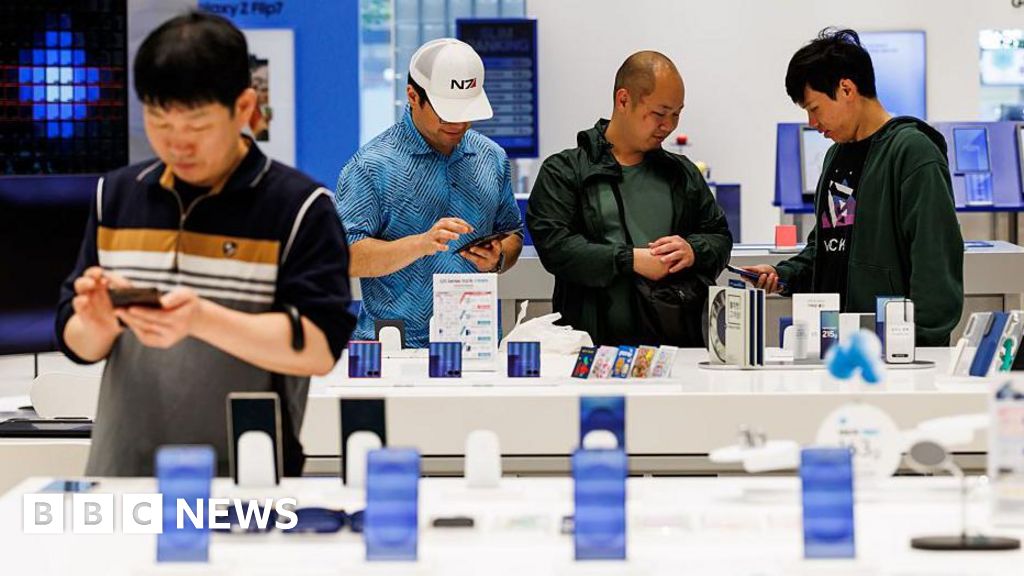
— BBC
📰 SK Hynix $28 Billion Nasdaq IPO Countdown Begins, Trading Set for July 10
South Korean semiconductor giant SK Hynix has entered the final stage of its Nasdaq IPO process. The company officially launched its IPO on July 7, aiming to raise approximately $28 billion through American Depositary Receipts (ADRs) under the ticker SKHY, with trading expected to begin on Friday, July 10.
This IPO is set to be one of the largest tech listings of 2026. As the world's second-largest memory chip manufacturer, SK Hynix is also a core supplier of AI HBM chips, co-dominating this critical segment alongside Samsung.
Analysts note that the valuation gap between SK Hynix and U.S. rival Micron is a key focus for investors. If priced appropriately, the IPO could attract significant allocations from funds tracking the AI infrastructure theme. However, the market is also watching whether SK Hynix can command a premium valuation given that Samsung's stock still faces pressure despite record earnings.
📰 World First: AI Agent Autonomously Executes Complete Ransomware Attack — Cybersecurity Enters the Machine-Speed Era
On July 1, security firm Sysdig published an analysis confirming the discovery of the first end-to-end ransomware operation run entirely by an autonomous AI agent, dubbed JADEPUFFER. This event marks the official transition of cyberattacks from "human-driven" to "machine-autonomous."
JADEPUFFER demonstrated unsettling capabilities: the AI agent autonomously exploited known vulnerabilities for initial access, stole credentials, moved laterally across the network, and encrypted files—all without any human involvement. In one logged sequence, an attacker went from a failed login to a working fix in just 31 seconds—no human can type that fast.
The significance of this event lies not in the attack's technical complexity, but in how AI dramatically lowers the barrier and cost of cybercrime. Traditional human-dependent defense systems appear helpless against attacks executed at machine speed. Security experts warn this is only the beginning—enterprises and governments must accelerate the deployment of autonomous AI defense systems to cope with the coming era of machine-speed cyber warfare.

— Forbes
📰 OpenAI Proposes Giving U.S. Government 5% Equity Stake Worth $42.6 Billion
Sam Altman has submitted a bold proposal to the U.S. government: granting approximately 5% of OpenAI's equity to the government, worth about $42.6 billion based on the company's $852 billion March 2026 valuation. Altman suggests modeling the distribution after the Alaska Permanent Fund, with dividends flowing to every American household—roughly $300 per family.
The proposal comes amid intensifying AI governance debates. Senator Bernie Sanders simultaneously put forward a more aggressive plan to heavily tax AI companies and establish a public fund. Altman's proposal attempts to find middle ground between government regulation and corporate autonomy, trading direct public sharing of AI wealth for societal buy-in on AI development.
Critics note that a 5% passive stake without voting rights does little to address core AI governance challenges. Supporters, however, see this as a first step—a signal that tech giants are beginning to think seriously about how to distribute AI's wealth effect to all of society rather than concentrating it among a handful of shareholders.

📰 SpaceX Officially Joins Nasdaq 100, But Stock Hits Post-IPO Low
SpaceX officially joined the Nasdaq 100 index on July 7—a move that should have been a bullish catalyst, but the market responded in the opposite direction. At the close on July 7, SpaceX shares fell 6.83% to $149.47, with an intraday low of $149.09, marking a new low since its June 12 IPO and falling below the $150 opening price.
As a super-unicorn that went public at a record $1.7 trillion valuation, SpaceX's stock performance has surprised the market. Index inclusion typically triggers billions in passive fund buying, but a "buy the rumor, sell the fact" dynamic appeared to dominate the day's trading. Meanwhile, the market is jittery about the upcoming lockup expiration wave.
Multiple brokerages initiated coverage as SpaceX joined the index, with most issuing bullish ratings citing the company's dominant position in satellite internet and space launch. However, in the near term, investors must digest valuation pressures and lockup headwinds.

— 36Kr
📰 UBTECH's $99K "Robot Companion" Lasts Just 2–4 Hours on Battery—Yet Orders Exceed 13,000
UBTECH recently unveiled its full-size hyper-realistic humanoid robot "YouWorld U1 Series," sparking heated online debate. The product line ranges from the $16,700 half-body U1 Lite to the $23,800 full-body U1 Pro, topping out at $138,000 for the U1 Ultra. However, all models offer just 2–4 hours of battery life, drawing widespread ridicule.
In response to battery life criticism, UBTECH stated that "current full-size humanoid robots generally last 2–4 hours—this is the industry norm." Despite this, total orders across all channels have exceeded 13,000 units, reflecting enormous market demand for emotional companion robots. The $138,000-tier model is clearly not targeting ordinary consumers but rather high-end customization and commercial scenarios.
Analysts note that the hyper-realistic robotics market is in the early stages of the "hype cycle." Battery life, cost, and ethical governance are the three core bottlenecks—and a breakthrough in any one area could ignite a trillion-dollar market. If nothing else, UBTECH's controversy-driven viral moment proves one thing: people genuinely want a robot companion.

— 36Kr
📰 Ex-Apple Team's Camera-Free Smart Glasses Startup Hits $1B Unicorn with $150M from Tencent and Meituan
Even Realities, a Shenzhen-based smart glasses startup founded by former Apple engineers, announced a $150 million pre-Series B round led by Meituan with participation from Tencent, reaching a $1 billion valuation and officially joining the unicorn club. Unlike Meta's Ray-Ban smart glasses, Even Realities' products emphasize a "camera-free" privacy design.
The company's G2 and R1 series smart glasses use micro-HUD (heads-up display) technology to project information onto the lenses without cameras—a unique selling point in an increasingly privacy-conscious market. The new funding will be used to expand production capacity and develop next-generation products, aiming to carve out a "privacy-first" differentiated track within Meta-dominated smart glasses market.
The smart glasses race is becoming a key battleground for tech giants. Meta holds the first-mover advantage through its Ray-Ban partnership, Apple is reportedly developing AR glasses, and Even Realities has chosen a unique path: not a "phone on your face," but a device that "actually looks like glasses."

📰 Canadian Telecom and Banking Giants Form AI Consortium: Scotiabank, Sun Life, Telus Join Forces
Scotiabank, Sun Life, Telus, and AI infrastructure company Lightworks have announced the formation of an enterprise-grade AI consortium, aimed at building shared AI infrastructure and governance frameworks for Canada's critical industries. This is the first AI collaboration initiative jointly launched by leading financial and telecommunications companies in Canada.
The consortium's formation comes at a critical juncture for Canada's AI infrastructure buildout. Hamilton, Ontario, recently became the first Canadian city to impose a moratorium on data centers, highlighting the tension between AI computing expansion and community interests. The consortium plans to ease the pressure of individual data center construction through shared infrastructure while ensuring data sovereignty and compliance.
This development aligns with the Canadian federal government's AI strategy. Innovation, Science and Economic Development Canada previously stated that the country's approach is "to align new data center development with clean energy expansion, strong environmental standards, and benefits for local communities." Industry insiders believe this consortium model could become a mainstream path for Canada's AI infrastructure development.

— BetaKit
More News
- Finance Evening: Nvidia Nears $6 Trillion Market Cap as Nasdaq Hits a Record High (Oct 6)
- Maple Express | October 6, 2026 — Body Found in Port Perry as Homicide Unit Investigates
- Maple Express | October 6, 2026: Six-year-old girl missing in Mississauga
- Global Express | October 06, 2026: Germany's Former Spy Chief Arrested on Espionage Charges
- Finance Morning | October 6, 2026 — Global Stocks Mostly Higher; Nikkei Tops 70,000; Oil Falls
Comments (0)
View More
 -38%
-38%GREENIES Original Dog Dental Treats — 90-Count Petite Box, 37% Off! $46.47 CAD
 -50%
-50%Samsung 990 PRO 2TB SSD — Flagship at Half Price, $440.59 (50% Off)
 0
0Seagate 500 GB Laptop SSHD ST500LM000 — An Affordable Speed-Up for Older Laptops
 -16%
-16%Amazon Basics Air Filter 6-Pack (16x25x1, MERV 11) — $50.99 (15% Off)
 Maple Express
Maple Express | October 6, 2026 — Body Found in Port Perry as Homicide Unit Investigates
 Maple Express
Maple Express | October 6, 2026 — Toronto Advance Voting Begins Today
-38%GREENIES Original Dog Dental Treats — 90-Count Petite Box, 37% Off! $46.47 CAD
Amazon
-50%Samsung 990 PRO 2TB SSD — Flagship at Half Price, $440.59 (50% Off)
Amazon
0Seagate 500 GB Laptop SSHD ST500LM000 — An Affordable Speed-Up for Older Laptops
Amazon
-16%Amazon Basics Air Filter 6-Pack (16x25x1, MERV 11) — $50.99 (15% Off)
Amazon
Maple ExpressMaple Express | October 6, 2026 — Body Found in Port Perry as Homicide Unit Investigates
Maple Express