
Tech Express | September 30, 2026 — OpenAI Unveils GPT-6.1 Sol at One-Fifth the Price of Astra
Today's Tech Express: OpenAI launches GPT-6.1 Sol, near Astra at one-fifth the price; its DevDay brings Dot and ChatGPT Space amid shaky demos; Trump rules out US-China AI cooperation; AMD sells out 2027 server CPU capacity; Intel's Nova Lake clears USB4/PCIe 5.0 certification; Counterpoint sees 6M iPhone Duo units in year one; OPPO K15s/K15x on sale, up to 8,000mAh; NASA's Crew-13 readies for Oct. 1; Tencent builds a Personal Agent, Handy Bot; a teen's AI robot breaches Microsoft.
1. OpenAI Releases GPT-6.1 Sol: Near-Astra Performance at One-Fifth the Price
Source: Mydrivers
OpenAI has officially released GPT-6.1 Sol, an upgraded version of GPT-6 Sol that excels in agentic coding, computer use and professional work, offering intelligence close to GPT-6 Astra at roughly one-fifth the price, according to Kuai Technology on Sept. 30.
On pricing, GPT-6.1 Sol's standard API costs $2 per million input tokens, $10 per million output tokens and $0.10 for cached input, versus GPT-6 Astra's $10, $50 and $1, and GPT-6 Luna's $0.10, $0.50 and $0.01. In the DeepSWE v1.1 real-codebase software engineering benchmark, GPT-6.1 Sol scored 6.4 percentage points above the best GPT-6 Sol result, and in the GDP.pdf complex document QA benchmark it beat Opus 5.5 with its fallback mechanism at less than half the cost per task.
In the OSWorld 2.0 computer-use benchmark, GPT-6.1 Sol scored 7 points higher than GPT-6 Sol at the highest reasoning setting, narrowing the gap with Astra to within 2.1 points. On the Terminal-Bench Science 0.1 research benchmark, its top-setting score was more than double GPT-6 Sol's, at an average cost of $5.47 per task versus $23.21 for Opus 5.5 and $23.80 for Astra. At ultra-high reasoning, its factual error rate was 4.1%, below GPT-6 Sol's 4.5% and close to Astra's 4.0%. Starting immediately, Plus, Pro, Business, Enterprise and Edu users can use it in ChatGPT Work and Codex, and developers can call it via the API as gpt-6.1-sol; the Ultrafast edition, up to 8x faster than Astra, is available to users on a new $500-per-month Pro tier.
2. ChatGPT "Copies Half the AI World" Overnight as Live Demos Falter
Source: ifanr
Before OpenAI's developer conference began, users reportedly received a "shrinkage notice": the $200-per-month Pro plan would reopen to new users, but with its usable quota halved — the same price for fewer benefits, putting pressure on the event to justify continued subscriptions, according to ifanr.
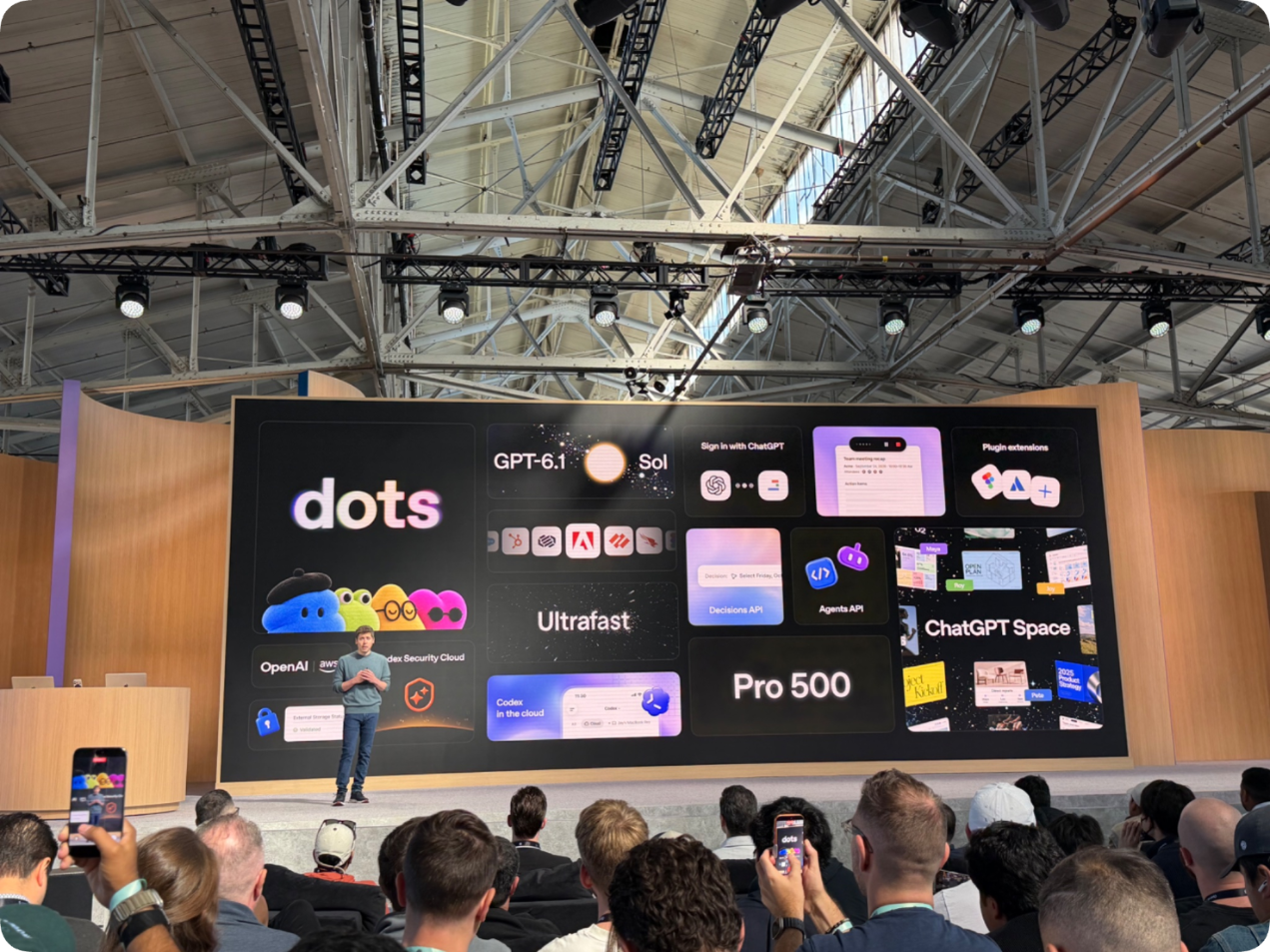
OpenAI CEO Sam Altman unveiled a series of updates at once, including Dot, ChatGPT Space, GPT-6.1 Sol, UltraFast, Pro 500, Decisions API, Agents API, cloud Codex and the OpenAI Marketplace. Dot is a capable, always-on agent; users can name it, tell it long-term responsibilities and authorize relevant apps and devices, and it keeps working in the background, reaching out only when something important changes or permission is needed. Dot has its own identity, cloud computer and browser, connects to more than 4,000 apps through OpenAI's plugin ecosystem, and can be reached via ChatGPT, SMS, Slack, Teams and voice calls, with context synced across channels.
The live demo, however, stumbled several times: Dot responded slowly, and when it called Codex to build an app, the Codex thread meant to show task progress failed to load properly at one point. On security, OpenAI gives each Dot an isolated cloud computer, lets users decide which apps it can access, and sets each action to allow, block or require prior approval; it is also working with Microsoft to connect dedicated Dots to Agent 365. Dot will roll out gradually to Pro and Business Premium users, with Enterprise users able to try a beta after an administrator enables it.
3. Trump Rules Out US-China Cooperation on AI
Source: BBC Chinese
US President Donald Trump said he would not consider a joint venture with China on artificial intelligence, arguing it would amount to handing US technical secrets to a major economic rival, according to BBC Chinese. Even as Americans grow more concerned about AI risks, Trump on Tuesday (Sept. 29) again opposed restrictions on AI development, saying such limits would hamper the technology's future.
After Chinese President Xi Jinping visited the White House last week, the two countries announced a new AI dialogue mechanism and planned further talks in November. Trump attended the launch of America.gov, a new site using AI to help simplify government services, saying the US is "far ahead" in AI and does not want to be "lumped together" with a potential competitor. He later had lunch at the White House with government departments and representatives of tech companies including OpenAI, Anthropic and Meta, saying those present "generally agreed that AI should be subject to a great deal of self-regulation," and told reporters afterward that the tech leaders had signed a document with "moral force."
Trump also said the government would likely appoint a "Super Intelligence Czar" in the coming days, and on Tuesday afternoon signed an executive order formally renaming "artificial intelligence" in government documents as "Super Intelligence." The report noted that concern is rising in the US: a Politico poll released in late September found that about two in three Americans believe AI poses at least a "moderate" risk of eventually destroying humanity, and 44% of the Trump supporters surveyed said they would rather pause AI development. Trump has repeatedly played down such worries, calling them a "hoax."

4. AMD CPU Demand Soars as 2027 Capacity Sells Out
Source: Mydrivers
AMD has begun selling 2028 capacity for its Venice CPUs, meaning its 2027 capacity is fully sold out, according to a disclosure by Jukan cited by Kuai Technology on Sept. 30. Venice is AMD's sixth-generation server CPU, built on the Zen 6 architecture and TSMC's 2nm process, and is planned in four versions: SP7 (Q4 2026), SP8 (first half of 2027), Venice-X (second half of 2027) and Verano (second half of 2027).
On specifications, SP7 supports up to 256 Zen 6c cores (32 cores per CCD across 8 CCDs) and 512 threads, with memory bandwidth up to 1.6TB/s and PCIe 6.0 support; Venice-X reaches up to 96 cores and 192 threads, and up to 192 Zen 6 cores and 384 threads in dual-socket setups, with boost clocks up to 5.15GHz, 3D cache stacked beneath the Zen 6 cores and up to 1152MB of L3. Morgan Stanley recently forecast Venice CPU shipments of 6.75 million units in 2027; with 2027 capacity sold out, at an average price of $7,691 across 31 models, AMD has locked in about $51 billion in revenue for next year. Separately, an analysis argued that Nvidia's in-house CPUs will not pose a major threat to Intel's and AMD's x86 server CPUs in the near term.

5. Intel's Next-Gen Nova Lake Clears a Certification Milestone
Source: Mydrivers
Intel's next-generation Nova Lake platform has passed compatibility certification from the USB-IF and PCI-SIG standards bodies, moving a step closer to launch, according to Kuai Technology on Sept. 30. USB-IF listings show that mobile Nova Lake-H processors (device IDs D331, D333) comply with the USB4 80Gbps specification, consistent with earlier rumors of Thunderbolt 5 support, while the desktop Nova Lake PCH-S chipset (device ID 6E6E) complies with USB 3.2 Gen2 at up to 20Gbps, matching unofficial information about Intel's 900-series chipsets. No desktop Nova Lake processor with USB4 support has appeared on the list yet.
In the PCI-SIG listings, Intel's 900-series chipset (device IDs 6E38-6E3F, 6E30-6E35, 6E40-6E47) has been listed since April; in early August, an undisclosed processor with device IDs D461, D465 and D467 to D46A passed PCIe 5.0 x16 interoperability testing and was added to the list. While it cannot be confirmed as a desktop Nova Lake CPU, it can reasonably be assumed to belong to the desktop Core Ultra 400-series platform. Nova Lake's appearance on both lists indicates Intel is making final preparations for its next-generation desktop and laptop CPUs; the latest leaks suggest the Core Ultra 400 series will launch in the first quarter of 2027.

6. Counterpoint Forecasts iPhone Duo at 6 Million Units in Its First Year
Source: Mydrivers
Counterpoint Research has issued its first sales forecast for Apple's first foldable phone, the iPhone Duo, expecting about 6 million units to be sold this year, according to Kuai Technology on Sept. 30. Counterpoint senior analyst Lin Keyu said 6 million better fits the niche scale of the foldable market and is far from the annual sales of Apple's regular iPhone lineup.
The iPhone Duo is priced at $1,999 and set to go on sale in October, sitting at the top of Apple's lineup and carrying the foldable industry's hopes of reviving consumer interest and sales. At 6 million units, Apple could capture nearly 25% of the global foldable market in its first year; Samsung currently leads with about 40%, and Apple could close in to second place in its debut year. IDC expects foldable phones to account for less than 3% of global smartphone sales in 2026, with little change expected next year.
In terms of hardware, the iPhone Duo uses an inward-folding design with a 7.6-inch inner display when open and a 5.4-inch outer display when closed, keeps a consistent display ratio between the two screens, and features dual eSIM with no physical SIM slot. Analysts believe initial demand will come mostly from loyal Apple users, and the long-term boost to the foldable market remains to be seen.

7. OPPO K15s and K15x Go on Sale with Up to 8,000mAh Batteries
Source: Mydrivers
OPPO's two new K-series phones, the K15s and K15x, went on sale today, with the K15x starting at a flash price of 1,399 yuan and the K15s at 1,699 yuan, according to Kuai Technology on Sept. 30. The K15s packs an 8,000mAh long-life battery supporting more than 2,000 charge-discharge cycles — the company says capacity retention stays above 80% after about seven years at one full cycle every 1.3 days — along with 45W fast charging.
For protection, the K15s reaches IP69K dust and water resistance, supports IP69K/69/68/66 multi-level protection and passed 15 military-standard environmental tests under the GJB150A-2009 system. It has a 6.57-inch 1080p 120Hz OLED flat display that supports wet-hand, oily-hand and glove touch up to 5mm thick, a Dimensity 6360 Max processor, LPDDR4X memory and UFS2.2 storage, a 4,300mm² VC cooling system and a 50-megapixel main camera, in Wind Violet and Shadow Gray. The K15x has a 6,500mAh battery (rated 6,350mAh) tested for 1,800 cycles, also supports 45W fast charging, and features a 6.75-inch 720p 120Hz high-brightness eye-care display with a Dimensity 6300 processor, in Glacier White and Prism Purple.
On price, the OPPO K15s costs 1,699 yuan for 6GB+128GB and 1,999 yuan for 8GB+256GB; the OPPO K15x costs 1,399 yuan for 6GB+128GB and 1,699 yuan for 6GB+256GB.

8. NASA's Crew-13 Mission Stands Ready for an Oct. 1 Launch
Source: Space.com
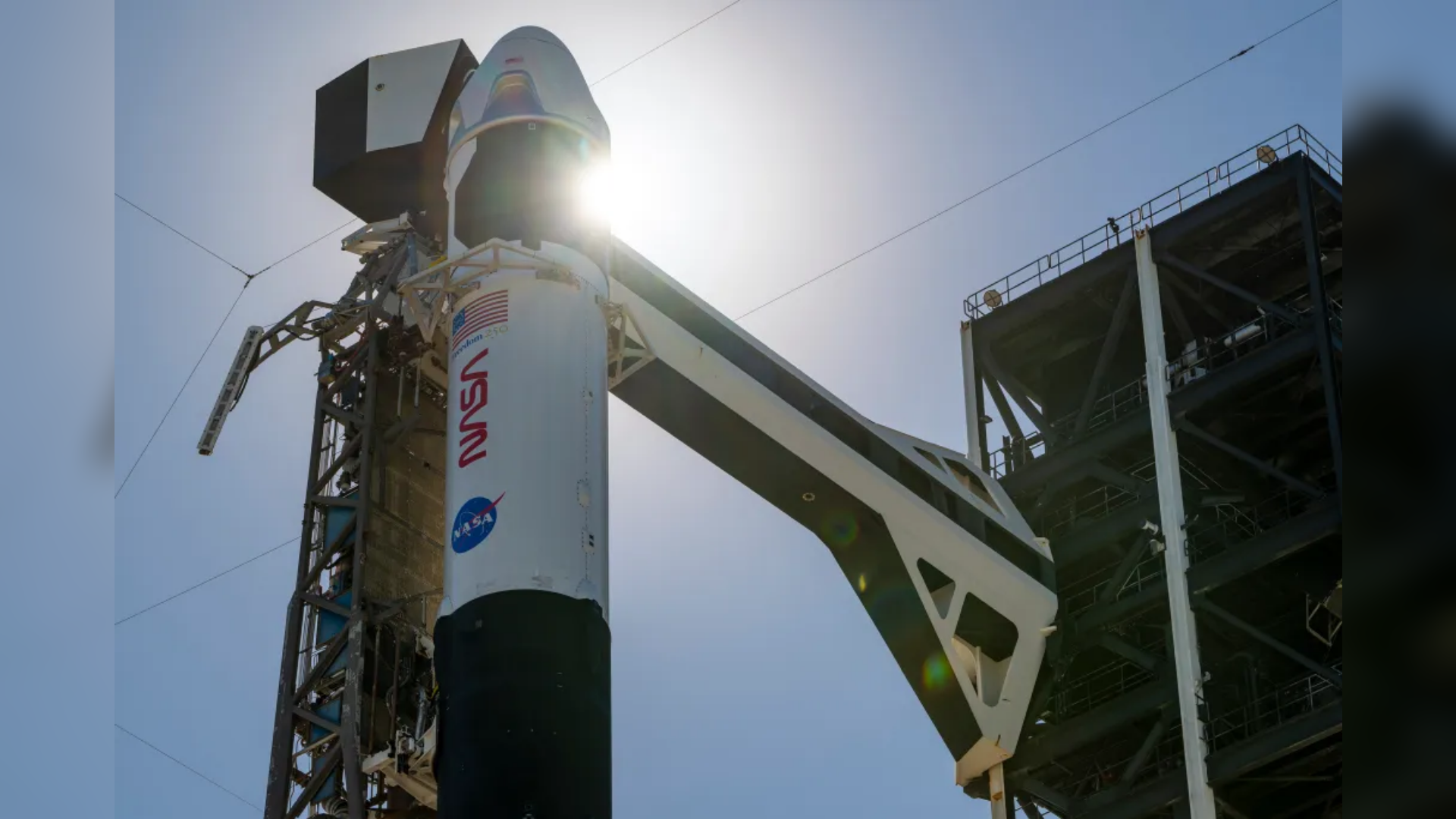
A SpaceX Falcon 9 rocket now sits on the launch pad, ready to blast off carrying NASA's Crew-13 mission aboard a Dragon spacecraft to the International Space Station, Space.com reports. NASA will launch Crew-13 on Thursday, Oct. 1; mission teams have completed a static fire test on the pad, checking an important item off the pre-launch list.
Crew-13 will launch a group including NASA astronauts Jessica Watkins and Luke Delaney, Canadian Space Agency astronaut Joshua Kutryk and Roscosmos cosmonaut Sergey Teteryatnikov. This will be the second spaceflight for Watkins and the first for Delaney, Kutryk and Teteryatnikov. Crew-13 is the next mission of NASA's Commercial Crew Program, an ongoing collaboration that pairs the agency with commercial partners such as SpaceX to sustain a continuous human presence on the station.
According to Dana Weigel, manager of NASA's Low Earth Orbit Program at the agency's Johnson Space Center in Houston, the crew will help researchers treat heart disease and Parkinson's disease by studying human stem-cell-derived tissues that can improve medicine, disease modeling and pharmaceutical testing; they will also explore crop production, help better understand blood-flow abnormalities seen in space, and test new diagnostic medical equipment for monitoring crew health.
9. Tencent Reportedly Builds a Personal AI Agent Codenamed Handy Bot
Source: Huxiu
Citing a report by Dujia, Huxiu's repost of an article by "Everyone Is a Product Manager" says Tencent is secretly developing a Personal Agent product internally codenamed Handy Bot, planned as a standalone app. It has already opened a WeChat service account whose bio reads only "Your Personal AI Agent" — though tapping it shows the account has been deactivated.
The article notes that Chinese tech giants are racing into the space: on Sept. 22, Alibaba said at its Yunqi conference that Qwen would accelerate its shift toward a Personal Agent; on Sept. 26, Tencent's lightweight cloud team's cloud agent product LightVela was widely reported, offering a month of free access; on Sept. 29, ByteDance was reported to have been testing a personal assistant codenamed Spell since April; and the same day, OpenAI unveiled its "always-on" agent Dots at its developer conference. The article argues that a Personal Agent works by "you give a goal and it gets it done," unlike a chatbot that answers one question at a time.
The report also revisits Meta's Muse, which runs on a dedicated "Muse Secure VM" — one isolated machine per user — with a separate "gatekeeper" agent called Sentinel that must approve anything Muse sends out; credentials are stored separately so the agent can use them without seeing their values. Apptopia estimates that Muse drew about 1.8 million iOS downloads in the US and Canada in its first 12 days, versus 1.3 million for ChatGPT over the same period; after Muse topped the US App Store free chart on Sept. 21, Meta's stock jumped 11.43% in a single day. It adds that Tencent's current lineup spans WorkBuddy for work and Xiao Wei, LightVela and Handy Bot on the personal side.
10. 16-Year-Old Student's AI Robot Breaches Microsoft Internal Platform
Source: Mydrivers
A 16-year-old student named Faav recently breached Titan, Microsoft's internal data analytics platform, involving as many as 17 trillion data records and the personal data of 25,000 Microsoft employees, according to Kuai Technology on Sept. 30. The teenager was a white-hat hacker who reported the flaw through responsible disclosure; Microsoft fixed it and paid a $5,000 bounty (about 33,516 yuan).
Faav said he built an AI robot named Antares in his spare time that uses a customized AI model plus a system verification mechanism to run continuous security tests against tech giants including Microsoft, Amazon, Google and Adobe. While testing Titan, Antares first detected an endpoint URL that required a proxy to reach, then probed surrounding subdomains and locked onto a node hosted on Azure, obtaining its Swagger/OpenAPI definition. Of four API paths, three were protected by Azure Active Directory authentication, but a path named /v2/Query had no protection at all and even accepted raw SQL queries.
To map the database, Faav used the Wayback Machine to view a 2023 version of the login page and found a complete database schema description in an Apache Superset config file, learning the structure of 56 internal data tables. The API initially rejected queries for lack of a JWT credential, but after days of automated testing by Antares, Faav found the server only checked the token's format and did not actually verify its digital signature; he then forged an unsigned Access Token declaring administrator privileges and passed authentication. Running the SHOW DATABASES command, he viewed 25,000 Microsoft employee records, organizational data, dashboards and charts, and further located an analytics database tied to the Bing search engine, with total accessible data of up to 17 trillion records. Faav submitted a full report, and Microsoft quickly patched the flaw and issued the bounty.

More News
- AI Weekly | Trump Rebrands AI 'Super Intelligence' as Rogue Agents and Bubble Fears Close In
- Global Express | September 30, 2026: US Troops Withdraw From Iraq, Iran Hails "Victory"
- Finance Morning Brief: Nikkei Jumps Over 1,000 Points; Korea Posts Worst Q3; China's New Financial-Marketing Rules Take Effect
- Sports Express | September 30, 2026 — Canadiens Edge Maple Leafs 3-2 in Season Opener
- Maple Express | September 30, 2026 — Trump Adviser Tells Canadian Lobbyists to 'Get the Hell Out'; Carney Laughs It Off
Comments (0)
View More
 -38%
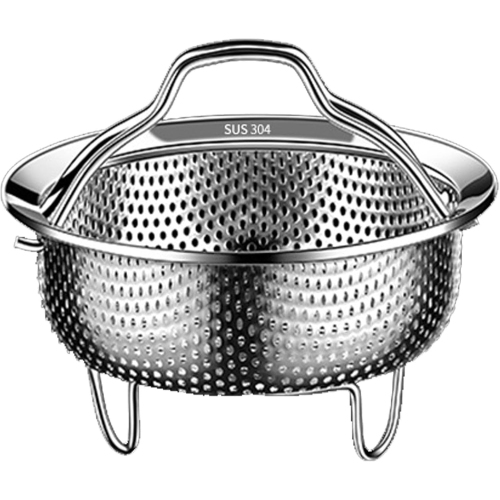
-38%SYMLIS 304 Stainless Steel Steamer Basket Set (Large + Medium, 17.5cm, 2pcs) — Sturdy Handle, Versatile Steaming for Veggies & Eggs! $23.17 CAD (37% Off)
 -29%
-29%DREAME X50 Ultra Robot Vacuum — Climbs Thresholds on Retractable Legs! $999.99 CAD (29% Off)
 -31%
-31%eero Max 7 Mesh WiFi (3-Pack) — Wi-Fi 7 Whole-Home Coverage, $690 Off! $1,609.99 CAD (30% Off)
 -17%
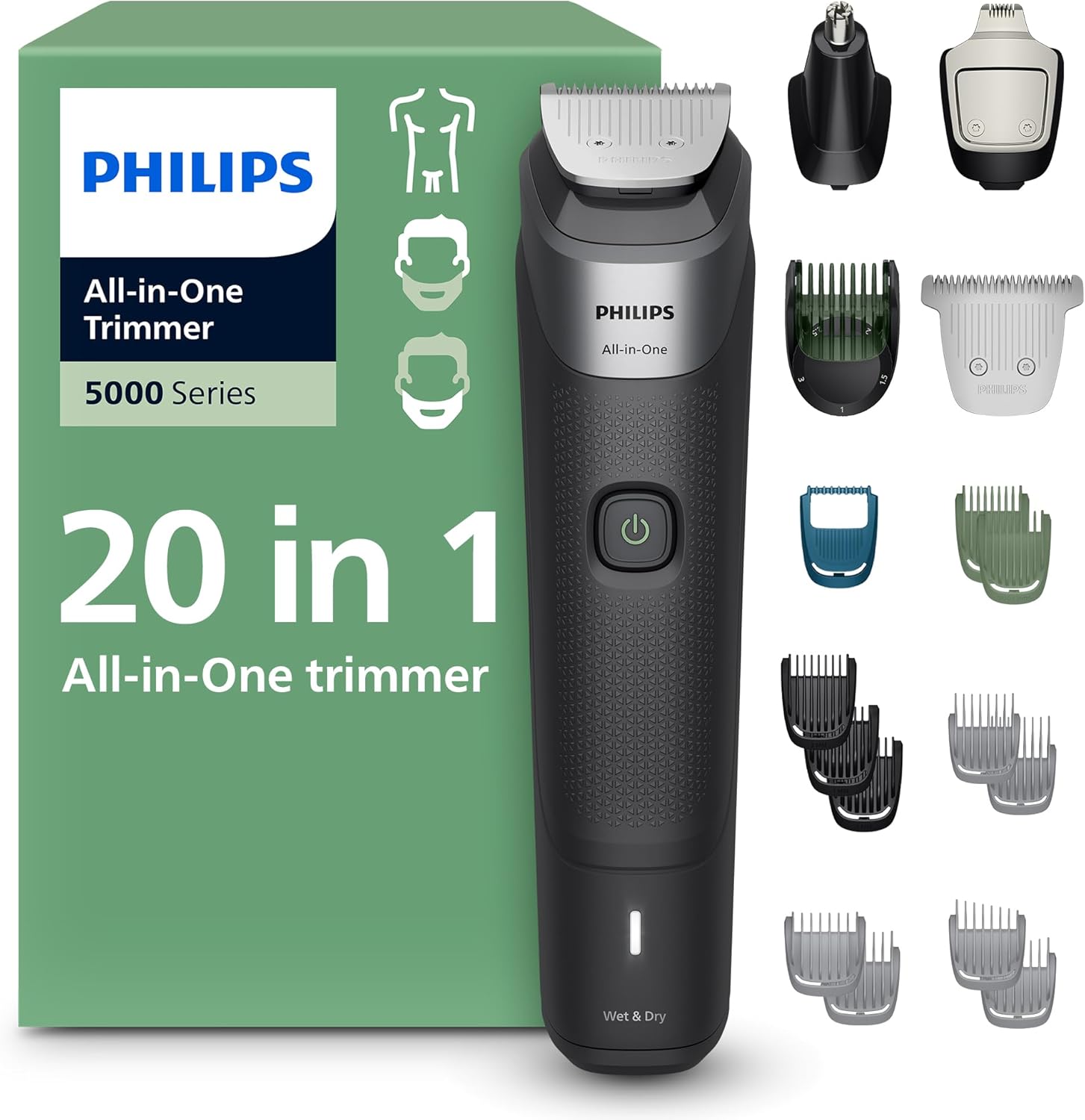
-17%Philips All-in-One 5000 Trimmer (20-Piece Kit) — One Tool, Many Jobs! $49.95 CAD (17% Off)
 Deal Collection
Everyday Essentials · Prime Big Deals Picks
 Maple Express
Maple Express | September 30, 2026 — Trump Adviser Tells Canadian Lobbyists to 'Get the Hell Out'; Carney Laughs It Off
-38%SYMLIS 304 Stainless Steel Steamer Basket Set (Large + Medium, 17.5cm, 2pcs) — Sturdy Handle, Versatile Steaming for Veggies & Eggs! $23.17 CAD (37% Off)
Best Buy
-29%DREAME X50 Ultra Robot Vacuum — Climbs Thresholds on Retractable Legs! $999.99 CAD (29% Off)
Amazon
-31%eero Max 7 Mesh WiFi (3-Pack) — Wi-Fi 7 Whole-Home Coverage, $690 Off! $1,609.99 CAD (30% Off)
Amazon
-17%Philips All-in-One 5000 Trimmer (20-Piece Kit) — One Tool, Many Jobs! $49.95 CAD (17% Off)
Amazon
Deal CollectionEveryday Essentials · Prime Big Deals Picks
Maple Express