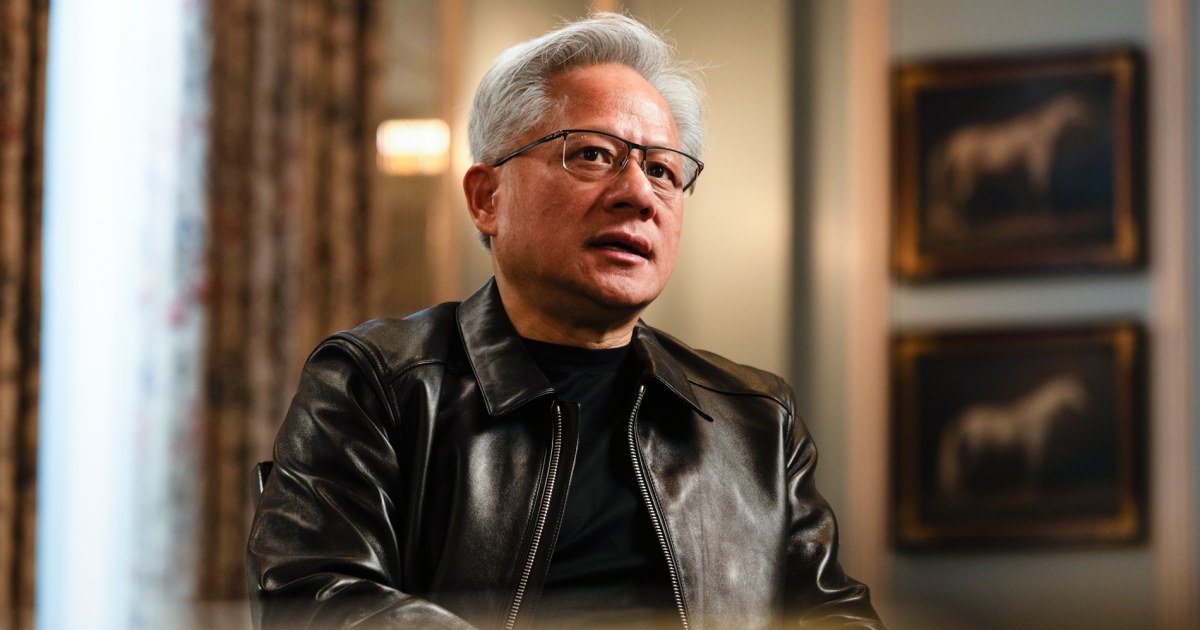
Dow Surges 1,100 Points as Nvidia Slips 4.2%; Carney Taps Bridgewater Executive for Canada's C$25 Billion Fund
The Dow jumped over 1,100 points and the S&P 500 rose 2.35%, but Nvidia fell 4.2%, losing almost $200 billion after a probe into CEO Jensen Huang; Trump said the FBI is looking into it and Beijing denied the spy claim. Carney named Bridgewater's co-CIO to run Canada's C$25 billion fund, traders cut December hike odds to 40% after a third month of job losses, and the Real-Time Rail launched. October CPI lands Tuesday without an annual rate; Brent settled 5.85% lower.
Source: NBC News, The Globe and Mail, CNBC, Yahoo Finance Canada, Financial Post, Toronto Star, Kiplinger, The Economic Times, Yahoo Finance (Reuters)
📊 North American Markets Today
| Index / Commodity | Close | Change | % Change |
|---|---|---|---|
| S&P 500 | 7,549.94 | +173.08 | +2.35% |
| Nasdaq | 25,253.14 | +673.72 | +2.74% |
| Dow Jones | 52,389.75 | +1,104.02 | +2.15% |
| TSX (Toronto) | 36,446.26 | +657.17 | +1.84% |
| CAD/USD | 1.4116 | -0.00 | -0.08% |
| WTI Crude | 86.38 | -0.47 | -0.54% |
| Gold | 4,149.50 | +35.00 | +0.85% |
1. Dow Jumps More Than 1,100 Points, but Nvidia Falls 4.2% on CEO Probe
U.S. stocks rallied broadly on Monday. The Dow Jones Industrial Average rose more than 1,100 points, the S&P 500 gained 2.3% and the Nasdaq 100, which tracks the biggest tech names on the Nasdaq, jumped 3.4%. NBC News noted that a more than 4% intraday drop in oil prices, on news that U.S.–Iran talks were continuing, gave stocks an additional push.
Nvidia was the lone exception. Its shares fell 4.2% after the company said it had opened an investigation into CEO Jensen Huang's relationship with a woman U.S. intelligence agencies have described as a Chinese spy. The decline wiped out almost $200 billion in market value and made Nvidia the biggest loser on both the Dow and the S&P 500, while peers including AMD, Qualcomm, TSMC and Intel rose with the broader market.
In a note to employees, Huang admitted he had been unfaithful to his wife. "To my colleagues at NVIDIA... you deserve better from me," he wrote. The Financial Times and The New York Times reported that the woman is Chinese businesswoman Alice Huang; the two Huangs are unrelated. Nvidia said the probe will be overseen by independent directors and counsel, and that the board treats U.S. national and economic security as paramount. A spokesperson said Huang is "committed to continuing to lead NVIDIA as CEO without interruption."
2. Trump Says FBI Is Looking Into Huang; Beijing Denies "Spy" Claim
President Donald Trump said Monday that the FBI is investigating Nvidia CEO Jensen Huang's affair with a woman alleged to be a Chinese government agent, but that the executive has little to worry about. "I know the FBI is looking into it in terms of something else, and I think that he'll be in good shape," Trump told a White House briefing.
Trump said he spoke with Huang that day "just to see if he's feeling all right," and that Huang told him he had "absolutely no idea that the person in question was a spy." Trump is due to meet Chinese leader Xi Jinping next week in Shenzhen at the APEC summit, but was non-committal about raising the matter: "No, I don't think so. I mean, maybe. I'm sure President XI will ask me about it."
Chinese Foreign Ministry spokesperson Guo Jiakun said Monday that "the so-called Chinese spy allegation is unsubstantiated. It is nothing but smears against China." Nvidia announced Sunday an independent investigation into reports that Huang was the "target of a foreign intelligence effort." Huang said in a public letter: "I support the investigation and will co-operate fully. I love our country and our company." Nvidia stock has shed roughly 11% of its value since last Wednesday.

3. Goldman CEO Says AI Infrastructure Financing Demand Remains Strong
Goldman Sachs CEO David Solomon told CNBC on Monday that financing demand for AI infrastructure remains strong even as investors reassess the risks of the massive build-out. He said the bank has been "very active" in AI capital markets deals in recent weeks and expects that to continue.
"There's still very strong demand for investments in the AI infrastructure build and the technology around the growth of AI," Solomon told CNBC's Leslie Picker. He acknowledged that political change will "create recalibrations and ups and downs," but said he still deeply believes in AI's long-term trajectory for productivity.
AI-linked stocks have tumbled in recent weeks, with the selloff intensifying after Democrats scored sweeping midterm victories. Solomon pushed back on political resistance to data centre construction, arguing the infrastructure is essential to the U.S. economy and can be built responsibly. "We certainly don't want this infrastructure going to places outside the U.S." Goldman is among the banks leading Anthropic's potential IPO, and Solomon called the market environment "still pretty constructive."

4. Carney Names Bridgewater Co-CIO to Run C$25 Billion Sovereign Fund
Prime Minister Mark Carney on Monday appointed Bridgewater Associates co-chief investment officer Karen Karniol-Tambour as chief executive of the Canada Strong Fund, the country's new sovereign wealth fund. The C$25-billion fund will be professionally managed at arm's length from government, with its own board of directors.
"Ms. Karniol-Tambour brings the experience and ambition to lead this mission – making investments that strengthen our economy and build lasting wealth for Canadians," Carney said in a statement. "As we build a stronger, more independent Canada, we are ensuring Canadians have a direct stake in its success."
A Canadian citizen who studied at Princeton's School of Public and International Affairs, Karniol-Tambour joined Bridgewater in 2006 as an investment associate, became head of investment research in 2013 leading more than 150 professionals, and was named co-CIO and a member of the executive committee in 2023. She was on Fortune's 40 Under 40 list in 2019 and has appeared on Barron's 100 Most Influential Women in U.S. Finance for seven consecutive years. Jordan Eizenga of Deloitte said the hire signals the fund "will not be a passive investor."

5. Weak Jobs Data Pushes Bond Market to Cut Bank of Canada Hike Bets
Canada's bond market is scaling back wagers on further rate hikes. Pricing for a second consecutive Bank of Canada increase on Dec. 9 has fallen to almost 40% from what had been a coin flip, after Friday's jobs report showed the economy shed positions for a third straight month and the unemployment rate rose to 6.7% from 6.5%.
The October report badly undershot expectations for a gain of 15,000 jobs and a steady jobless rate. "This is not the environment to be moving into a tightening cycle, in our view," David Rosenberg, president of Rosenberg Research & Associates, wrote in a Monday note. "At least the markets agree because the data has caused a modest pricing-out of Bank of Canada rate-hike expectations."
The Bank of Canada had already delivered one hike, and markets had been debating whether it would move again back-to-back on Dec. 9. Three months of job losses have made that path considerably less certain.

6. Canada Launches Real-Time Rail With 24/7 Instant Payments
Payments Canada announced Monday the launch of the country's Real-Time Rail (RTR), a national system that lets participating banks, credit unions and payment service providers exchange, clear and settle payments for customers in real time, 24 hours a day, every day of the year, using data-rich messaging.
"A stronger, more productive economy relies on modern financial infrastructure that can match our ambition," said François-Philippe Champagne, Minister of Finance and National Revenue. Payments Canada CEO Susan E. Hawkins called it "the beginning of a new era for payments in our country," while Bank of Canada Governor Tiff Macklem said the central bank will oversee the system so it operates safely and reliably.
The C.D. Howe Institute projects the RTR will generate up to $14.5 billion in cost savings over the next decade and $16 billion in economic gains, rising to $27 billion as new features are added. Canada is the first G7 country to launch a real-time payment system with mandatory centralized fraud services from day one, and the rail is expected to reach more than nine in 10 Canadians within its first year.

7. October CPI Lands Tuesday, but the Annual Rate Won't Be Published
The U.S. Bureau of Labor Statistics will release the October consumer price index at 8:30 a.m. Eastern on Tuesday, Nov. 10 – the last inflation reading before the Federal Reserve's Dec. 9 decision. But this report comes with a twist: because price data was not collected in October 2025 during the government shutdown, the BLS cannot calculate and will not publish a year-over-year rate this month, putting the focus squarely on monthly changes.
The Fed raised rates in mid-September for the first time in three years, then held in late October. September CPI rose 3.7% year over year, driven mainly by gasoline and fuel. Forecasters expect a much smaller monthly increase in October: Wells Fargo sees headline CPI at 0.28% and core at 0.21% and expects one more Fed hike in December; UBS economist Alan Detmeister projects 0.26% headline against a 0.29% Bloomberg consensus and 0.23% core; Barclays' Pooja Sriram forecasts 0.2% for both, with a 25-basis-point December hike as her base case.
David Payne, staff economist at The Kiplinger Letter, expects annual CPI to end the year at 4% and core at 2.7%, warning that energy costs are likely to stay elevated while the Middle East situation remains unresolved.
8. Japan Spent a Record $50 Billion in One Day to Defend the Yen
Japan deployed a record amount of money to prop up the yen. Data showed Tokyo spent $50.36 billion buying yen on a single day in July, when the currency had fallen to a 40-year low against the dollar – a record for a single day of Japanese intervention.
Taken together with other operations, Japan's interventions totalled $97.19 billion, including coordinated action with the United States and South Korea. The scale underscores the urgency with which the Japanese government has moved to arrest the yen's decline.
9. Oil Tumbles as Brent Settles 5.85% Lower
Crude fell sharply on Monday. Brent futures settled down $5.75, or 5.85%, at $92.57 a barrel – the lowest since late August – and kept sliding after settlement to trade more than $7 lower. U.S. West Texas Intermediate settled down $3.98, or 4.38%, at $86.85, before falling more than $5 in post-settlement trade.
The trigger was Trump's Sunday comment that he is highly unlikely to order fresh strikes on Iran as long as talks to end the conflict progress. Yet both sides reported shipping hit in or near the Strait of Hormuz: the Houthis claimed an attack Sunday on Aramco's headquarters in Riyadh, and the Saudi-led coalition said Monday it destroyed a Houthi missile-component factory and a chemical plant. "This seems to have encouraged sellers on the prospects for peace even while the actual fighting is not slowing down," TACenergy analysts wrote.
Supply flows are also shifting. Iraqi Foreign Minister Fuad Hussein told Al Jazeera on Sunday that Iraq and the U.S. had reached understandings allowing Iraqi crude exports through the strait via a shipping lane near Oman. Brent plunged 16% last week, its steepest weekly drop since the start of the COVID-19 pandemic, and some analysts say the global market is showing signs of returning to excess supply as high prices curb demand.

10. PepsiCo to Cut About 1,000 North American Jobs
PepsiCo is cutting about 1,000 jobs across North America as it tries to turn around lagging sales at home. "We have a clear ambition for PepsiCo North America: to build a stronger, more future-fit business that delivers industry-leading growth," Ram Krishnan, CEO of PepsiCo North America, wrote in a Monday letter to employees obtained by CNBC. "To do that, we need to be faster, more connected, and more capable."
The cuts are due over the next week as the company streamlines operations and better connects teams across its North American business. PepsiCo employed about 306,000 people worldwide, including roughly 125,000 in the United States, as of Dec. 27, according to a company filing.
PepsiCo cut its full-year earnings outlook in October, citing weakness in its home market. In the third quarter, North American beverage volumes shrank 2% while the North American food unit was flat. CFO Steve Schmitt said on the earnings call that the turnaround is taking longer than expected. The stock rose slightly in afternoon trading but is down nearly 1% this year, well behind the S&P 500's gain of nearly 11%.

More News
- Maple Express Evening | November 9, 2026 — Stellantis to sell Brampton assembly plant
- Maple Express | November 9, 2026: 17 arrested in Ontario-wide child exploitation probe
- Immigration | November 09, 2026 Canada unveils 2027–2029 immigration plan: 380,000 PRs a year
- Global Express | November 9, 2026: Kraków Shooting Suspect Dies in Hospital, Polish Police Say
- Finance Morning | Nov 9: Nvidia Probes CEO Jensen Huang as Taiwan Leads Asia
Comments (0)
View More
 -14%
Apple Pencil (USB-C) — Magnetic Storage, Tilt Sensitivity, Great for Notes and Sketching! $93.98 CAD (14% Off)
 -31%
Energizer CR2450 3V Lithium Coin Batteries, 2-Pack — $6.94 CAD (31% Off)
 -34%
LEGO Bluey Bluey's Family House 11203 — 382 Pieces, 6 Characters, Ages 4+! $59.97 CAD (33% Off)
 -31%
RAINSMORE 18L Hiking Backpack — 2L Insulated Bladder + Rain Cover Included! $38.66 CAD (31% Off)
 Maple Express
 Evening | November 9, 2026 — Stellantis to sell Brampton assembly plant
 Sports Express
 | November 9, 2026 — Leafs blanked 4-0 by Devils, winless in six
-14%Apple Pencil (USB-C) — Magnetic Storage, Tilt Sensitivity, Great for Notes and Sketching! $93.98 CAD (14% Off)
Amazon
-31%Energizer CR2450 3V Lithium Coin Batteries, 2-Pack — $6.94 CAD (31% Off)
Amazon
-34%LEGO Bluey Bluey's Family House 11203 — 382 Pieces, 6 Characters, Ages 4+! $59.97 CAD (33% Off)
Amazon
-31%RAINSMORE 18L Hiking Backpack — 2L Insulated Bladder + Rain Cover Included! $38.66 CAD (31% Off)
Amazon
Maple ExpressMaple Express Evening | November 9, 2026 — Stellantis to sell Brampton assembly plant
Sports Express