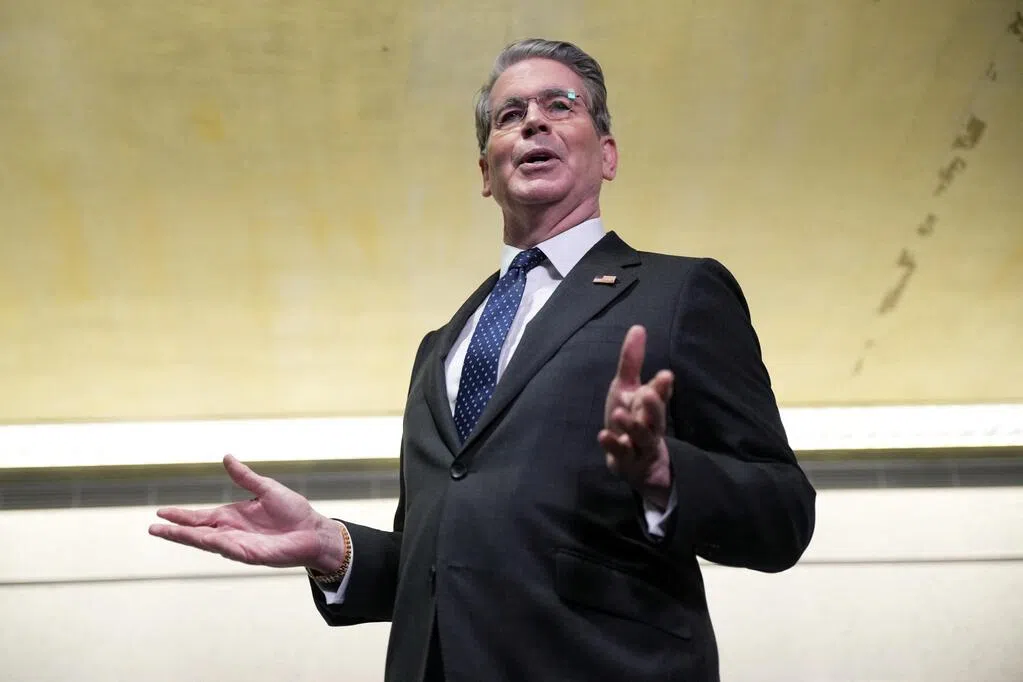
Finance Morning | Xi Arrives in Washington for State Visit; China, U.S. Reach Consensus in 8th Trade Talks
Finance Morning, Sept 24: Xi arrives in Washington for a state visit; China-U.S. 8th trade talks reach multiple consensus points, with He Lifeng and Bessent holding their first AI dialogue; Sanan Optoelectronics' controller detained; regulators curb out-of-region deposits at small banks; Asian stocks slide before the Xi-Trump summit, A-shares slump, Korea closed; Treasury-yield surge drags U.S. stocks lower, Brent tops $100, October hike odds rise to 75%; Australia's jobless rate rises to 4.6%.
📊 Today's Asian Markets
| Index | Close | Change | Change % |
|---|---|---|---|
| Shanghai Composite | 3888.37 | -63.76 | -1.61% |
| Shenzhen Component | 13316.97 | -406.73 | -2.96% |
| ChiNext | 3288.95 | -90.66 | -2.68% |
| Hang Seng | 24761.13 | -326.67 | -1.30% |
| Nikkei 225 | 65513.99 | +495.04 | +0.76% |
| KOSPI | 7080.92 | +63.01 | +0.90% |
| Taiwan Weighted | 48024.60 | +224.40 | +0.47% |
Note: South Korea's market was closed for the Chuseok holiday; KOSPI reflects its most recent close.
Xi Arrives in Washington for State Visit
Source: Caixin
On the afternoon of September 23 local time, President Xi Jinping arrived in Washington aboard a special plane to pay a state visit to the United States at the invitation of U.S. President Donald Trump. When Xi and his wife Peng Liyuan arrived at Andrews Air Force Base, they were warmly greeted by Trump and his wife Melania.
China, U.S. Reach Consensus in 8th Trade Talks
Source: East Money
Ministry of Commerce spokesperson He Yadong said the two countries' trade teams recently held the eighth round of China-U.S. economic and trade consultations in the United States. Guided by the important consensus of the two heads of state and the principles of mutual respect, peaceful coexistence and win-win cooperation, the two sides held candid, in-depth and constructive exchanges on issues of common concern — including implementing existing trade consensus, reciprocal tariff arrangements, the establishment of trade and investment councils, and an extension of the joint arrangement of the Kuala Lumpur talks — and reached multiple points of consensus.
Vice Premier He Lifeng and U.S. Treasury Secretary Scott Bessent, as the lead officials of the two sides, held their first dialogue on artificial intelligence under the China-U.S. economic and trade consultation mechanism. Going forward, China will maintain close communication with the U.S. on follow-up work within the mechanism.
Sanan Optoelectronics' Controller Lin Xiucheng Detained
Source: 21st Century Business Herald
Sanan Optoelectronics announced on September 24 that it had received notice from the family of its actual controller, Lin Xiucheng, that Lin has been criminally detained by public security authorities on suspicion of the crimes of misappropriating company property and misappropriating funds. The company said its production and operations remain normal. It noted that Lin has held no position in the company since July 10, 2017, that the matter is unrelated to the company and will not have a material impact on its operations. The company said it has a sound organizational structure and governance system and will continue to operate in compliance with the law.
As of the September 24 close, Sanan Optoelectronics shares fell 2.81%, giving it a market value of 62.213 billion yuan.
Tighter "Localization" Rules Push Small Banks to Trim Out-of-Region Deposits
Source: The Beijing News
The Beijing News' Beike Finance has learned that some small regional banks are steadily winding down their existing out-of-region deposits. An insider at a private bank told Beike Finance, "We are now basically reducing out-of-province deposits and increasing in-province ones on a quarterly basis," adding that the bank plans to phase out out-of-region deposits gradually and complete the process by the end of 2027.
People familiar with the matter said financial regulators have become stricter this year about the localized operations of private banks and regional commercial banks. In July, some regional commercial banks and private banks received regulatory guidance setting out criteria for determining local customers: at least three of five factors — ID card address, place of habitual residence, main business location, mobile phone number registration and device location. Banks were also told not to add out-of-region business and to settle all existing business by the end of 2027, without extending maturities through rollovers or restructuring.
The guidance was not a "one-size-fits-all" measure but required existing out-of-region deposits to be absorbed naturally, with a sufficient transition period, the insider said. Regulators had already banned out-of-region deposit-taking by regional commercial banks in 2021, but some banks still retain existing business.
Asian Stocks Fall on Concerns Ahead of Xi-Trump Summit
Source: Lianhe Zaobao
Asian stocks fell on Thursday (September 24) as markets were unnerved by the crucial summit between U.S. President Donald Trump and Chinese President Xi Jinping due to be held in Washington. According to AFP, markets reacted coolly even though U.S. Treasury Secretary Scott Bessent announced that the U.S. and China had agreed to extend their trade truce by two months.
At the close, China's CSI 300 index fell 1.7%, with the Shanghai Composite also posting its biggest one-day drop in a month. Hong Kong's Hang Seng Index also fell, while markets in Sydney, Taipei, Jakarta, Bangkok, Manila and Singapore all declined. South Korea's KOSPI was closed for a holiday.
The long-running trade war between the world's two largest economies remains the focus. The two sides have maintained a tariff truce for nearly a year, due to expire on November 10, without a lasting agreement. Bessent said Washington and Beijing agreed to extend the truce by two months, to January 10 next year; the deal followed marathon talks between Bessent and Chinese Vice Premier He Lifeng in New York on Sunday (20) and in Washington on Wednesday (23). Two sources told AFP that hopes for a commercial deal have dimmed because Xi's delegation includes no Chinese corporate executives. By contrast, U.S. tech leaders, including heads of major AI companies, are expected to attend a Thursday dinner for Xi. Capital.com senior financial market analyst Kyle Rodda said market participants are looking for signs of cooperation, aiming to manage AI risks without adding regulatory risk in the field.
Nikkei Rises 0.76% for Fourth Straight Gain
Source: Kyodo News
On September 24, after Japan's long holidays ended, the Nikkei index posted its fourth consecutive trading day of gains. It closed at 65,513.99, up 495.04 points, or 0.76%, from last Friday. High-tech shares, including AI-related names, led the advance. The index rose more than 1,200 points intraday at one point, reclaiming the 66,000 mark.
The TOPIX fell 15.84 points to 4,075.30, down 0.39%, with full-day volume of 2.49306 billion shares. Helped by gains in U.S. AI and semiconductor stocks during Japan's holidays, related Tokyo shares attracted buying. Expectations of easing Middle East tensions pushed U.S. crude futures slightly lower, another positive factor. On the other hand, rising long-term interest rates weighed on the market, with concerns about higher corporate financing costs prompting selling, trimming the Nikkei's gains late in the session.

Australia's August Unemployment Rises to 4.6%; RBA May Hike Next Week
Source: eeo.com.cn
Data released by the Australian Bureau of Statistics on the 24th showed that, seasonally adjusted, the country's unemployment rate rose to 4.6% in August 2026 from 4.5% in July. Employment rose 0.3%, or 39,500, month on month, exceeding market expectations of a 20,000 increase.
Analysts said the labor market data does not affect rate-hike expectations and that the Reserve Bank of Australia may raise rates by 25 basis points next week. ANZ senior economist Jasmine Zheng said that although the employment gain looks strong on the surface, the new data overall still reflects a labor market that is gradually loosening, and she expects the RBA to raise rates by 25 basis points next week. In addition, although labor market tightness is easing, inflationary pressure persists, and higher oil prices add upside risk to the inflation outlook; given this, the RBA may raise rates by 25 basis points in September and again in November 2026.
Rising Treasury Yields Weigh on Markets; U.S. Stock Indices Fall
Source: East Money
In the early hours of September 24 Beijing time, the three major U.S. stock indices closed lower. The Dow Jones Industrial Average closed at 51,511.59, down 0.68%; the Nasdaq closed at 26,936.04, down 1.13%; the S&P 500 closed at 7,706.03, down 0.75%. Inflation worries drove Treasury yields higher, and rising Treasury yields pressured stocks.
The Philadelphia Semiconductor Index fell 1.23%. GlobalFoundries, Broadcom and Teradyne each dropped more than 2%, while AMD, TSMC, Lam Research and Intel each fell more than 1%. Memory-chip stocks were mixed: Western Digital rose 1.96% and Seagate gained 0.44%, while Micron fell 2.22%, SK Hynix dropped 3.12% and SanDisk fell 3.73%. The Wind U.S. Mega-Cap Tech Seven index fell 1.18%, with Google down 3.58% to lead decliners.
On Treasury yields, as of 5:25 p.m. U.S. Eastern Time, the 20-year yield stood at 5.458%, up 12.02 basis points; the 30-year at 5.397%, up 9.50 basis points; the 10-year at 5.112%, up 15.08 basis points; the 5-year at 4.996%, up 16.10 basis points; and the 2-year at 4.889%, up 13.55 basis points.
European Stocks Fall as Brent Crude Tops $100
Source: Sina Finance
European stocks fell for the first time in three sessions, as pressure from rising oil prices and bond yields outweighed the boost from better-than-expected economic data. The pan-European Stoxx 600 closed down 0.4%, with energy stocks leading gains and auto and insurance stocks among the worst performers.
Brent crude rose above $100 a barrel, set to end a five-session losing streak and pushing European government bond yields higher. The global benchmark had fallen earlier in the day after U.S. President Donald Trump signaled optimism about talks between the U.S. and Iranian representatives.
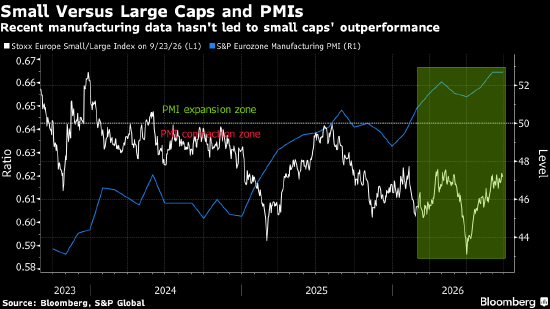
Earlier data showed euro zone private-sector activity expanding at its fastest pace in more than three years as services unexpectedly improved. The S&P Global September composite PMI rose to 53.1, while analysts surveyed by Bloomberg had expected slower growth.
What's the Benefit of a Hawkish Fed Pushing the Dollar Up?
Source: Sina Finance
Recent U.S. economic data have all beaten expectations. With the economy so strong, inflation is hard to tame — compounded by recurring Middle East oil-price swings and disruptions around the Strait of Hormuz. Fed Governor Barr said "inflation risks are rising and employment risks are easing," while Goolsbee went further, calling the energy shock a "persistent source of inflation." So this round of hawkishness is essentially strong economic data plus sticky inflation, pushing officials to move the odds of an October rate hike from 53% all the way to 75%.
The article argues the Fed is serving "inflation-fighting," and a stronger dollar is a natural tool for that; Treasury Secretary Bessent has long been a believer in a "strong dollar." The article also notes the U.S. national debt has topped $40 trillion and still requires large-scale issuance, so a strong dollar and high yields are what attract global buyers, otherwise borrowing costs would spiral. A strong dollar brings overseas capital back to the U.S., supporting stocks, fiscal financing and corporate funding.
As for gold, the article says central-bank gold buying and allocation demand still support prices, but high real U.S. Treasury yields clearly weigh on liquidity, leaving little clear upward momentum. In the short term, a likely Fed hike combined with geopolitical conflict pushing up energy inflation would keep real yields rising, further pressuring precious metals; gold may repeatedly test the $4,300 (940 yuan) support, and a break below could see it fall toward $4,200 (920 yuan).
More News
- Global Express | September 24, 2026 Ethiopia and Tigray Accuse Each Other of Offensives as Fears of New War Grow
- Tech Express | September 24, 2026: Meta Unveils $1,299 VR Glasses in AI Agent Push
- Sports Express | September 24, 2026: US Senate Advances Controversial Protect College Sports Act
- Maple Express | September 24, 2026 — Kenneth Law Sentencing Hearing Continues as More Victims' Families Speak
- Finance Evening | US Stocks Slide as 10-Year Treasury Yield Hits Highest Since 2007
Comments (0)
View More
 0
0Hilroy Studio Coil Sketch Book, 9" x 12", 30 Sheets — A 4.7-Star Everyday Sketch Pad
 -52%
-52%ONEREED Kids Knit Winter Gloves, 6 Pairs — Under $2 a Pair! $11.99 CAD (52% Off)
 -37%
-37%LEGO Ideas Mineral Collection 21362 — 880-Piece Display Set with 6 Gems! $50.98 CAD (36% Off)
 -44%
-44%RELLECIGA Women's High-Waisted Bike & Swim Shorts — Tummy Control, No Roll-Down! $15.95 CAD (43% Off)
 University Guide
What to Study at UofT: Strong Subjects and the Tiers of Admission Difficulty
 Maple Express
Maple Express | September 23, 2026 — Wife of Belleville officer shot outside synagogue speaks out
0Hilroy Studio Coil Sketch Book, 9" x 12", 30 Sheets — A 4.7-Star Everyday Sketch Pad
Amazon
-52%ONEREED Kids Knit Winter Gloves, 6 Pairs — Under $2 a Pair! $11.99 CAD (52% Off)
Amazon
-37%LEGO Ideas Mineral Collection 21362 — 880-Piece Display Set with 6 Gems! $50.98 CAD (36% Off)
Amazon
-44%RELLECIGA Women's High-Waisted Bike & Swim Shorts — Tummy Control, No Roll-Down! $15.95 CAD (43% Off)
Amazon
University GuideWhat to Study at UofT: Strong Subjects and the Tiers of Admission Difficulty
Maple Express