
Immigration | September 01, 2026 Canada Raises Study Permit Funds Requirement
This week: Canada's study permit funds requirement rises to $23,448 on September 1 (outside Quebec). Express Entry draw #438 issued 562 ITAs at CRS 697. Canada stopped new Hong Kong 'lifeboat' applications August 31. Many Americans are applying for Canadian citizenship amid the trade war. Alberta invited 743 PNP candidates, Newfoundland and Labrador 140, BC 16 entrepreneurs, and student citizenship applicants can get expedited processing.
1. Canada Raises Study Permit Funds Requirement, Effective September 1
Source: CIC News
International students planning to study outside Quebec will need to prove they have more money to be approved for a Canadian study permit, with the new rule taking effect on September 1, 2026. Immigration, Refugees and Citizenship Canada (IRCC) updated its "Study permit – Proof of financial support" webpage on August 28 with the new cost-of-living amounts.
Under the new standard, a single applicant with no dependants must show $23,448, an increase of $553; two people need $29,192, up $690; and three people need $35,888, up $848. The more family members, the larger the increase—a family of seven needs $62,054, up $1,465, with each additional family member adding $6,318.
These amounts are set at 75% of Statistics Canada's Low Income Cut-Off (LICO) and are updated annually to reflect the cost of living. Applications submitted before September 1 will be assessed under the old amounts in effect at the time they were received. Since July 2026, IRCC also requires officers to assess the source of a study permit applicant's funds in all cases, not just "high-risk" ones. Quebec has separate, higher requirements.
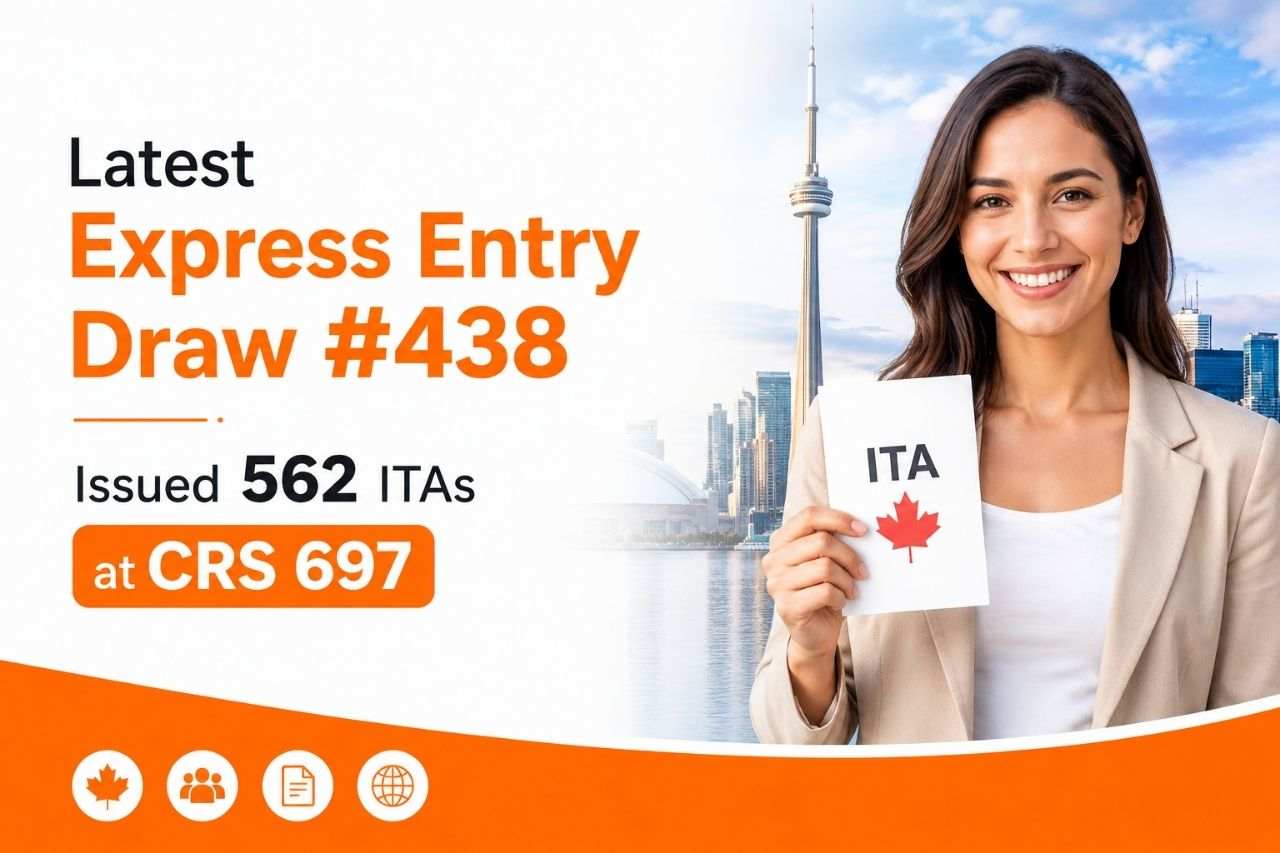
2. Express Entry Draw #438 Issues 562 ITAs at CRS 697
Source: ImmigCanada
Immigration candidates in the Express Entry pool who hold a Provincial Nominee Program (PNP) nomination were the target of draw #438, held on August 31, 2026. Immigration, Refugees and Citizenship Canada (IRCC) issued 562 Invitations to Apply (ITAs) in this round.
The minimum Comprehensive Ranking System (CRS) score required was 697. Candidates with a provincial nomination receive 600 additional CRS points, which is why PNP-specific draws typically have much higher cut-offs than other category-based rounds. This round targeted only candidates with a provincial or territorial nomination and did not cover all Express Entry programs.
For tie-breaking, candidates with a CRS of 697 had to have submitted their Express Entry profiles before April 12, 2026, at 4:32:26 UTC to be included. Recipients of an ITA have 60 calendar days to submit a complete permanent residence application.
3. Canada Stops Accepting Hong Kong "Lifeboat" Immigration Applications from August 31
Source: Hong Kong Free Press
People hoping to obtain Canadian permanent residence through the Hong Kong "lifeboat" scheme should note that the program stopped accepting new applications on August 31, 2026. Immigration, Refugees and Citizenship Canada (IRCC) announced the change in a statement last Friday.
Launched in 2021, the program was Canada's permanent residence pathway for Hongkongers created after the national security law. It offered two streams: Stream A for those who graduated from a Canadian post-secondary institution within the three years before applying, and Stream B for those with one year of Canadian work experience under the work permit program. IRCC said applications received on or before August 31 will continue to be processed.
According to IRCC, the program received about 48,560 applications, of which 13,370 have been granted permanent residence, leaving about 35,000 still waiting. Those who have already applied can continue to live and work in Canada while their application is processed; the related open work permit program will remain in place until May 2029.

4. As the US-Canada Trade War Escalates, Many Americans Apply for Canadian Citizenship
Source: CIC News
As trade relations between the United States and Canada remain tense, a growing number of Americans are applying for Canadian citizenship. According to CIC News this week, tens of thousands of Americans are applying to become fully recognized Canadian citizens every month.
The trend is tied to a December 15, 2025 update to Canada's citizenship law, which removed the first-generation limit on citizenship by descent—meaning anyone born before that date with a direct line to a Canadian ancestor is also a Canadian citizen. The queue for proof of citizenship has grown from 70,400 in May to 121,800 in August 2026, an increase of 51,400 people in three months.
According to a report, applications from US citizens in January 2026 alone outnumbered the combined total from the next nine source countries. Between 1840 and 1930, roughly 900,000 French Canadians migrated from Quebec to New England, and their descendants now all qualify for Canadian citizenship. Both countries permit dual nationality, and Canada taxes based on residency rather than citizenship.
5. Alberta Invites 743 Provincial Nomination Candidates
Source: CIC News
Immigration candidates seeking a provincial nomination from Alberta can look to the results of two Alberta Advantage Immigration Program (AAIP) draws held between August 14 and 19. The two rounds invited a total of 767 candidates to apply for provincial nomination.
Of these, the August 14 Alberta Opportunity Stream draw invited 743 candidates with a minimum score of 58, while the August 19 Dedicated Health Care Pathway (non-Express Entry) invited 24 candidates with a minimum score of 60. The latter marked the lowest invitation count for that pathway in 2026 so far.
As of August 25, the AAIP has issued no fewer than 11,982 invitations to apply for provincial nomination this year and has issued 4,560 nominations, against a total of 6,603 nomination spaces for the year, leaving 2,043 spaces remaining.

6. Newfoundland and Labrador Issues 140 Provincial Immigration Invitations
Source: CIC News
Immigration candidates applying through the Newfoundland and Labrador Provincial Nominee Program (NLPNP) or the Atlantic Immigration Program (AIP) can look to the province's latest draw on August 26. The round selected 140 foreign nationals, marking the province's 12th selection round of 2026.
Of these, 94 were invited through the NLPNP and can submit applications for provincial nomination, while 46 were invited through the AIP and can submit applications for endorsement. This round saw the highest number of AIP invitations since March 6, while the NLPNP total was the lowest since July 28, when 400 candidates were invited.
As of August 25, the province has issued 2,459 invitations this year, 84% of them to NLPNP candidates. Invited candidates have 60 days to submit a complete application for provincial nomination or endorsement.
7. BC Entrepreneur Immigration Draw Issues 16 Invitations
Source: CIC News
Entrepreneurs hoping to start a business or acquire and expand an existing one in British Columbia can look to the August 25 draw of the BC Provincial Nominee Program (BCPNP) Entrepreneur Immigration category. The round issued 16 invitations, marking the province's 21st draw of the year and its ninth focused exclusively on entrepreneurs.
The invitations were split between two streams: the Base Stream issued 11 invitations and the Regional Stream issued 5, both with a minimum score of 116. The Regional Stream's invitation count was the highest of any such draw in 2026.
The Base Stream requires a minimum personal net worth of $600,000 and a minimum investment of $200,000, while the Regional Stream requires $300,000 in net worth and $100,000 in investment, and the business must be located outside the Metro Vancouver Regional District. BC has invited no fewer than 104 entrepreneurs through its 2026 draws.

8. Citizenship Applicants Planning to Study in Canada Get Expedited Processing
Source: CIC News
Students who have obtained—or are applying for—Canadian citizenship through ancestry and plan to study in Canada can now access expedited processing of their proof of citizenship applications. According to CIC News this week, eligible applicants may receive their citizenship certificate in time for their starting semester.
Since the first-generation limit was removed on December 15, 2025, proof of citizenship applications have surged, with standard processing times now at 25 months and most American applicants waiting more than two years. However, IRCC reserves an "urgent processing" route for a limited number of situations, including education (attending a school, college or university); applicants must show proof of plans to study in Canada and actively request expedited processing.
Canadian citizens generally pay domestic tuition rather than international rates, saving thousands of dollars a year, and can work unlimited hours while studying—whereas international students on a study permit are capped at 24 hours of off-campus work per week. Schools need a citizenship certificate on file before applying the domestic rate, so applicants should submit early and confirm their school's policy.
More News
- Finance Evening: Dow Jumps 500 Points as Canada's PBO Cuts 2026 Growth Forecast to 0.9%
- Maple Express | October 20, 2026: Alberta referendum immigration questions pass, Carney says no constitutional change needed
- Maple Express | October 20, 2026 — 33 military members still in hospital after Wainwright base fire
- Global Express | October 20, 2026 — Drone Strikes Across Sudan Kill More Than 160 in Days
- Finance Morning: Asia Stocks Slide, KOSPI Down 3.73%; China Leaves LPR Unchanged for 17th Month
Comments (0)
View More
 -19%
-19%Cottonelle Ultra Soft Toilet Paper, 12 Mega Rolls (= 48 Regular) — 2,928 Sheets for $12.99 (19% Off)
 -11%
-11%High Sierra 1.5 GPM All-Metal Showerhead — Clog-Proof Single Nozzle! $55.60 CAD (11% Off)
 -32%
-32%Purina Tidy Cats Breeze Zeolite Litter Pellets, 21 lb Box (6 × 3.5 lb) — Unscented & 99.9% Dust Free! $92.43 CAD (32% Off)
 -33%
-33%Globlazer C66 6-Level Cat Tree — 17.7" Platform for Big Cats! $89.99 CAD (32% Off)
 Finance Evening
Finance Evening: Dow Jumps 500 Points as Canada's PBO Cuts 2026 Growth Forecast to 0.9%
 Tech Express
Tech Express | October 20, 2026 — DeepSeek Joins Huawei Chip Design, Eyes Ascend 950DT Pretraining by Year-End
-19%Cottonelle Ultra Soft Toilet Paper, 12 Mega Rolls (= 48 Regular) — 2,928 Sheets for $12.99 (19% Off)
Amazon
-11%High Sierra 1.5 GPM All-Metal Showerhead — Clog-Proof Single Nozzle! $55.60 CAD (11% Off)
Amazon
-32%Purina Tidy Cats Breeze Zeolite Litter Pellets, 21 lb Box (6 × 3.5 lb) — Unscented & 99.9% Dust Free! $92.43 CAD (32% Off)
Amazon
-33%Globlazer C66 6-Level Cat Tree — 17.7" Platform for Big Cats! $89.99 CAD (32% Off)
Amazon
Finance EveningFinance Evening: Dow Jumps 500 Points as Canada's PBO Cuts 2026 Growth Forecast to 0.9%
Tech Express