Finance Weekly | Central Banks Turn Hawkish as Oil Tops $100
This week's narrative was a hawkish turn by major central banks as Middle East tensions pushed oil above $100 and inflation ran hot: the ECB hiked to 2.5%, markets priced a 90% chance of a Fed hike, and Japan's 10-year yield hit 3%. Stocks and bonds fell, with the Dow down 628 points. China's central bank steadied liquidity and extended its gold-buying streak to 22 months, while Canada's banks pledged C$70-billion capital commitments.
This week's defining narrative was a synchronized hawkish turn by major central banks, driven by escalating Middle East tensions that pushed oil above $100 a barrel and hotter-than-expected inflation data. The European Central Bank raised rates to 2.5%, its highest since March 2025, markets priced a 90% chance of a Federal Reserve hike next week, and Japan's 10-year bond yield returned to 3%. Global stocks and bonds fell under pressure. Meanwhile, China's central bank used overnight reverse repos to steady liquidity and extended its gold-buying streak to 22 months, while Canada's banks pledged C$70-billion-scale capital commitments. Here are ten deep dives into the key trends across five major markets.
Fed hike odds surge to 90% as core inflation runs hot
Source: Yahoo Finance
August's U.S. inflation data became the week's most important inflection point for global markets. Stripping out volatile food and energy prices, the core Consumer Price Index rose 0.3% month over month, above the 0.2% consensus; headline CPI rose 3.4% year over year and 0.4% month over month, both in line with expectations. That upside core surprise, combined with oil back at $100 a barrel, sharply lifted bets that the Federal Reserve will raise rates at next Wednesday's (September 16) meeting.
According to CME FedWatch, markets now price a 90% chance of a hike at the Fed's policy meeting. Stephen Brown, North America chief economist at Capital Economics, said the upside core surprise means "the Fed looks set to hike next week." Hawks such as Cleveland Fed president Beth Hammack and Dallas Fed president Lorie Logan argue inflation is broad-based and will not fall on its own without higher rates. On September 3, Fed governor Chris Waller had said he would support holding steady if August showed cooling inflation and core prices at 0.2%, but would "consider a rate hike" if inflation came in hot.
RSM chief economist Joseph Brusuelas expects the Fed to hike at least twice more over the next year after next week. Core PCE inflation is estimated at 0.27% month over month, implying an annual pace rising from 3.3% in July to 3.4%.
Outlook: A confirmed Fed hike would strengthen the dollar and push Treasury yields higher, further pressuring global risk assets. Next week's meeting is the near-term pricing anchor, but the real risk is oil-driven inflation persistence forcing central banks to stay restrictive for longer.
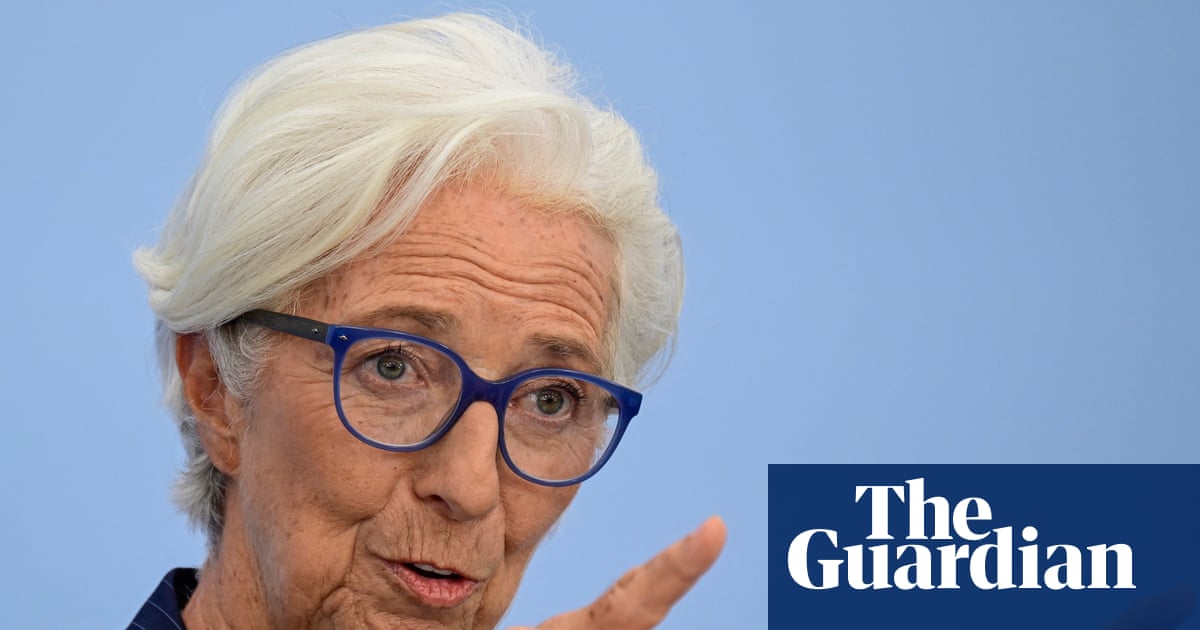
ECB raises rates to 2.5%
Source: The Guardian
The European Central Bank raised its main rate from 2.25% to 2.5% this week, the highest level since March 2025, while warning that renewed fighting in the Middle East is fuelling eurozone inflation. The hawkish signal exceeded expectations and rattled European stocks and bonds.
The central bank lifted its 2026 eurozone growth forecast to 0.9% (from 0.8% in June) and now expects inflation to average 3% this year. Brent crude passed $105 a barrel, UK gas prices rose above 203p per therm (highest since December 2022), and the Dutch TTF gas price topped €80 per megawatt hour for the first time since January 2023. Energy costs are the main driver of the price surge.
Government borrowing costs soared: the UK 10-year gilt yield hit 5.36% (highest since August 2007), Germany's 30-year yield 5.08% and 10-year 3.45%, and France's 10-year 4.344%. President Christine Lagarde said "we believe inflation will be longer lasting than we had anticipated," noting food inflation (now 1.2%) could rise on higher oil and gas prices. She also warned gas prices could climb further on supply disruptions or an unusually cold winter — EU gas stores are only 67% full, well below the 84% five-year average.
Outlook: With the ECB labelling the inflation shock as "longer lasting," the tightening stance will persist even with modest growth. Energy-supply fragility — low storage plus geopolitical risk — is the biggest uncertainty in the months ahead.
Japan's 10-year yield touches 3% again as corporate prices accelerate
Source: Xinhua Finance
Japanese government bond yields rose across maturities on the 11th, driven by higher U.S. long-term rates and mounting domestic inflation pressure. The new 10-year JGB yield, a benchmark for long-term rates, briefly touched 3%, hitting the level again within the month after reaching 3% on September 1 — a near 30-year high.
The U.S. was the main driver. U.S. August producer prices rose 5.4% year over year, above expectations, while Middle East tensions pushed up global oil prices and intensified worries about global inflation. The U.S. 10-year Treasury yield closed at 4.969% on the 10th, its highest since October 2023, pulling Japanese yields higher.
Domestic price pressure is also building. Data released by the Bank of Japan on the 11th showed the August corporate goods price index rose 7.6% year over year, above expectations, further fuelling selling of JGBs and lifting yields.
Outlook: With the 10-year yield back at 3% and corporate prices rising fast, expectations of a Bank of Japan policy shift are building. If the BOJ follows the Fed and ECB in turning hawkish, a stronger yen and unwinding of carry trades could ripple through Asian and global risk assets.
Dow falls 628 points as oil and rates squeeze stocks
Source: Yahoo Finance
Wall Street slid this week under multiple pressures. An escalating North American trade war on top of renewed Middle East fighting sapped risk appetite. At Tuesday's close, the Dow Jones Industrial Average fell 1.2% (628 points) to 52,786, the S&P 500 slipped 0.6% to 7,673, and the Nasdaq dipped 0.3% to 26,421, extending the indexes' losing streak.
Oil and rates were the key drags. West Texas Intermediate crude rose 2.4% to $93.65 a barrel, while Brent touched $99.45, approaching the $100 psychological mark. The 2-year Treasury yield rose to 4.396%, the 10-year to 4.794% and the 30-year to 5.251%. E*TRADE's Chris Larkin noted that with geopolitical tensions and oil prices rising, markets find it hard to focus beyond the inflation discussion.
After a blowout August jobs report, markets priced roughly a 60% chance of a hike next week (60.4% on CME FedWatch, up from 44.4% a month ago). Intel jumped 9.1% after announcing a 10% price increase, AMD gained 5.9%, while Amgen slumped 10.1% after rival Novartis reported a failed cardiovascular drug trial.
Outlook: The double squeeze of rates and oil pushed stocks into risk-off mode. Near-term focus is on inflation data ahead of the September 16 Fed meeting; hotter prints would add to the equity pullback.

AI is losing its stranglehold on the U.S. stock market
Source: CNBC
A key volatility metric options traders watch is reversing, signalling that the U.S. bond market is now usurping AI optimism as the primary driver of equities. The spread between big-tech volatility and broad-market volatility — measured by the gap between Cboe's VIXEQ and VIX — blew out to record highs this summer as AI giants swung hundreds of billions of dollars in market cap daily. The trend is now reversing, with VIX hitting its highest relative to VIXEQ since April.
At the same time, Treasuries are selling off with the 10-year yield approaching 5%, crude futures are back above $100 for the first time since May, and the energy sector ETF XLE is up 43% this year — overtaking technology as the best-performing sector. Nations Indexes president Scott Nations said the reversal stems from "resurgent inflation fueled by higher oil prices, the Fed's response at its September 16th meeting, and other political and geopolitical concerns."
Implied volatility in Micron fell from a high of 112 to 58, and SpaceX from 122 to 56, as the end of earnings season also removed a natural catalyst for event-driven volatility.
Outlook: As single-stock AI narratives give way to macro and policy drivers, the market's pricing anchor is shifting from growth stocks to rates and inflation. If the 10-year yield holds above 5%, richly valued AI names face greater multiple compression, potentially improving market breadth.

China's central bank runs overnight reverse repos for four straight days
Source: Zhejiang Online
The People's Bank of China announced it will conduct overnight reverse repo operations for four consecutive working days from the 14th to the 17th, with a daily ceiling of 600 billion yuan. The tool — introduced in late June and first used mid-month in August — again covers the key window around the tax payment period.
September 15 is the unified deadline for this month's main tax filings, and tax payments tend to tighten interbank liquidity. Chief researcher Dong Ximiao noted the overnight reverse repo's very short tenor and four-day operation cover the key window around the tax period, precisely matching banks' short-term liquidity needs while avoiding the excess funds a 7-day tool could leave idle, and helping stabilise the short-end rate DR001.
The operation sets only a ceiling rather than a fixed amount, adjusting flexibly to market demand. Analyst Wang Qing called it a "peak-shaving and valley-filling" approach, with the 600 billion yuan as an upper limit and actual volumes adjusted dynamically. CITIC Securities chief economist Ming Ming said overnight funds are the mainstay of the interbank market and the short-end rate is the cornerstone of the rate system.
Outlook: Overnight reverse repos are neither reserve-ratio cuts nor rate cuts; their role is smoothing short-term liquidity and anchoring the short-end rate. The tool's regularisation marks a shift in China's monetary framework from quantity-based to price-based, making short-end rate stability a key window into policy direction.
China's central bank extends gold-buying streak to 22 months
Source: The Beijing News
Data released by the central bank on September 7 showed China's gold reserves at 76.73 million ounces (about 2,386.57 tonnes) at end-August, up 650,000 ounces (about 20.22 tonnes) month over month. The buying streak began in November 2024 and has now run for 22 consecutive months, with monthly additions of 160,000, 260,000, 320,000, 480,000, 640,000 and 650,000 ounces since March — an accelerating pace.
World Gold Council data showed second-quarter global gold demand of 1,269 tonnes and first-half demand of 2,522 tonnes (up 2% year over year), with a record demand value of $380 billion. Central-bank purchases rebounded to 289 tonnes in Q2, a four-year high. Gold topped $4,600 an ounce in August before slipping 3% in a single day after Fed chair Kevin Warsh's hawkish Jackson Hole remarks.
Against a backdrop of geopolitical turmoil, a "great gold relocation" is underway: the Dutch central bank moved about 86 tonnes of gold from New York and Ottawa to London between March and August; France's central bank completed the replacement of 129 tonnes stored in New York in April; and Germany repatriated 300 tonnes from the U.S. between 2013 and 2017, with growing domestic calls to bring back more.
Outlook: The long-term central-bank buying trend has not reversed despite the price pullback, and storage security is becoming a key consideration. As geopolitical risk and financial uncertainty rise, the global reallocation of gold reserves is likely to continue, providing structural support for prices.
Enflame Technology debuts on Shanghai's STAR Market, up 188%
Source: 21st Century Business Herald
Enflame Technology (Suiyuan Keji) listed on the Shanghai Stock Exchange's STAR Market on September 11, issuing 43.0352 million shares at 142.18 yuan each. The stock opened at 410 yuan on its debut, up 188.37% from the offer price, with a market value above 170 billion yuan.
Founded in 2018, Enflame focuses on cloud AI chips and has developed four generations of architecture and five cloud AI chips, building a full portfolio spanning AI chips, accelerator cards and modules, intelligent computing systems and clusters, and AI computing software platforms. The IPO aims to raise 6 billion yuan for the development and commercialisation of fifth- and sixth-generation AI chips.
Revenue grew from 301 million yuan in 2023 to 722 million yuan in 2024 and 990 million yuan in 2025, a compound growth rate of 81.32%; first-half 2026 revenue hit 1.12 billion yuan, up 279.08% year over year. The company is not yet profitable but expects to reach consolidated profitability in 2026 or 2027. AI accelerator cards and modules are the core commercial driver, generating 856 million yuan (86.83% of revenue) in 2025 with sales of 64,900 units, up 197.81%.
Outlook: Enflame's strong debut reflects intense market expectations for domestic AI chips. But its lack of profitability is a reminder that the rich valuation must be backed by sustained R&D breakthroughs and commercial scale-up, keeping volatility risk in view.
BMO pledges C$70 billion for energy, defence and AI
Source: Toronto Star
Ahead of the Toronto investment summit opening Monday, Bank of Montreal announced it will pump up to C$70 billion into critical Canadian economic sectors over the next decade — a major signal of Canadian banks stepping up domestic investment amid the trade war.
BMO's plan, announced Friday morning, will back projects in electricity, energy and transportation infrastructure, mining and critical minerals, AI computing, defence and security, and oil and gas. The bank said it will mobilise capital through bank financing, debt-capital-markets activity and public-equity raising, "to support national priorities while helping Canadian businesses compete."
The Toronto summit opens with at least 167 project opportunities and a $1-trillion capital goal. CIBC committed $2 billion on Thursday to defence-sector SMEs, and RBC announced a $1.4-billion fund this week to invest in Canadian tech firms. Canada's Big Six banks have faced pressure to focus more domestically since the trade war began; in June the federal banking regulator lowered the domestic stability buffer to release excess capital.
Outlook: The large bank pledges provide ammunition for Canada's economic transformation, but delivery and the balance between profitability and national-security goals remain to be seen. The summit will be a key test of "made-in-Canada" capital mobilisation.

Canada sheds nearly 42,000 jobs as the loonie slides to 72 US cents
Source: Yahoo Finance Canada
Canada's economy shed almost 42,000 jobs in August, an unexpectedly weak print. After the data was released on September 4, the Canadian dollar weakened immediately, with USD/CAD rising to about 1.3862 (up roughly 0.5% on the day). By the Bank of Canada's close, one loonie bought just $0.7225 US — the weakest of the week.
The losses were broad: business and support services cut 20,000 positions, public administration shed 8,800, and natural resources and utilities also lost jobs. Manufacturing was the lone bright spot, adding 22,000 jobs, mostly in Ontario. The unemployment rate held at 6.4%, but the employment rate slipped to 60.8% and wage growth cooled to 2.0% year over year — the slowest since 2017 outside the pandemic. Meanwhile the Bank of Canada held its policy rate at 2.25% and warned that new U.S. tariffs add uncertainty to the recovery.
By contrast, the U.S. added 162,000 jobs in August, far above expectations, with unemployment at 4.1%. The divergence pressures the loonie as money flows toward the stronger U.S. growth story.
Outlook: The weak jobs data raises market bets on future Bank of Canada cuts (next decision October 28), but it also sharpens the dilemma of a weak loonie plus imported inflation. For households, a softer currency means pricier U.S. travel and cross-border shopping.

More News
- Maple Express | September 13, 2026 — Carney's Investment Summit Opens in Toronto as Protests Loom
- Maple Express | September 13, 2026 Report: Carney explores making Canada an 'associate member' of the EU
- Global Express | September 13, 2026 Iran Says Commercial Vessel Struck in Strait of Hormuz
- Tech Express | September 13, 2026: iPhone 18 Pro Sells Out in Pre-Order
- Sports Express | September 13, 2026 Rybakina Defeats Sabalenka to Win First US Open
Comments (0)
View More
 -34%
-34%LEGO Disney Lucky & Penny 101 Dalmatians — 268 Pieces! $19.97 CAD (33% Off)
 -15%
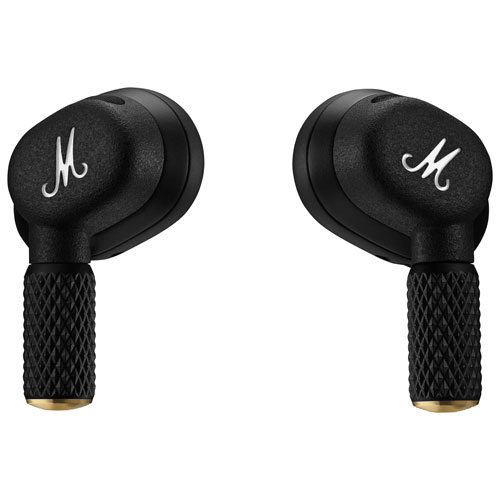
-15%Marshall Motif II ANC True Wireless Earbuds — Signature Sound, 30H Battery! $229.99 CAD (15% Off)
 -26%
-26%TP-Link UB500 Bluetooth 5.3 Adapter — Add Bluetooth to Any PC! $11.98 CAD (25% Off)
 -24%
-24%Royale Velour Facial Tissue, 6 Boxes — Velvety Soft 3-Ply! $7.98 CAD (24% Off)
 Global Express
Global Express | September 13, 2026 Iran Says Commercial Vessel Struck in Strait of Hormuz
 Maple Express
Maple Express | September 13, 2026 Canadian boxing legend George Chuvalo dead at 89
-34%LEGO Disney Lucky & Penny 101 Dalmatians — 268 Pieces! $19.97 CAD (33% Off)
Amazon
-15%Marshall Motif II ANC True Wireless Earbuds — Signature Sound, 30H Battery! $229.99 CAD (15% Off)
Best Buy
-26%TP-Link UB500 Bluetooth 5.3 Adapter — Add Bluetooth to Any PC! $11.98 CAD (25% Off)
Amazon
-24%Royale Velour Facial Tissue, 6 Boxes — Velvety Soft 3-Ply! $7.98 CAD (24% Off)
Amazon
Global ExpressGlobal Express | September 13, 2026 Iran Says Commercial Vessel Struck in Strait of Hormuz
Maple Express