Ontario Teachers' Unions Serve Formal Notice to Bargain — What Parents Need to Know About a Potential Fall Strike
Ontario's five major education unions formally served the Ford government with a Notice to Bargain on June 3, with contracts expiring August 31. Key demands include smaller class sizes, increased special education funding, higher wages, and ending mandatory e-learning.
June 3, 2026
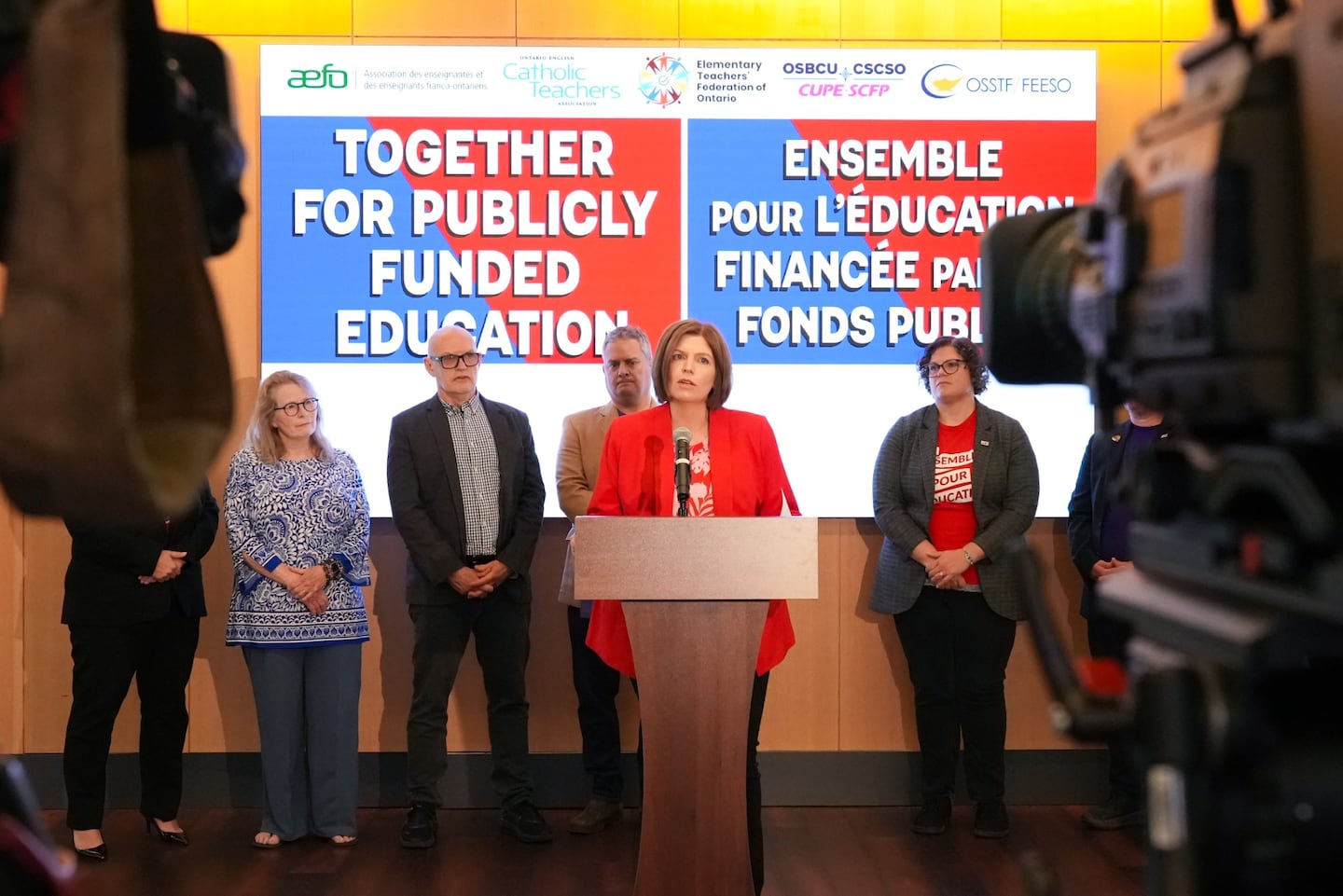
This morning, Ontario's five major education unions held a joint press conference and formally served the Ford government with a Notice to Bargain. Education contract negotiations are officially underway — and with existing collective agreements set to expire on August 31, both sides have less than three months to reach a deal.
The joint action involves all five major unions representing Ontario's public education system:
- ETFO (Elementary Teachers' Federation of Ontario) — approximately 83,000 members
- OSSTF/FEESO (Ontario Secondary School Teachers' Federation) — approximately 60,000 members
- OECTA (Ontario English Catholic Teachers' Association) — approximately 45,000 members
- AEFO (Association des enseignantes et des enseignants franco-ontariens) — French-language teachers
- CUPE-OSBCU (Ontario School Board Council of Unions) — representing roughly 55,000 education support workers, including administrative assistants, custodians, and early childhood educators
Under Ontario labour law, once formal notice is served, both parties must meet at the bargaining table within 15 days.
The unions have laid out an extensive list of demands, centered on the following key issues:
1. Smaller Class Sizes
ETFO President David Mastin made it clear the union will push for reduced class size caps in kindergarten and Grades 4 through 8. Currently, only Grades 1–3 have class size caps in Ontario. "The experience in Grades 1 to 3 has shown that smaller class sizes provide a more stable learning environment and better student outcomes. Students in other grades deserve the same conditions."
2. Increased Special Education Funding
Unions argue that years of underinvestment have left special education resources critically short, with students who have exceptional needs going without adequate support.
3. Meaningful Wage Increases
After several years of high inflation, teachers and education workers are demanding real pay raises — not below-inflation adjustments.
4. End Mandatory E-Learning
OSSTF President Martha Hradowy was blunt: "Mandatory online learning was not introduced as an education policy — it was introduced as a cost-saving measure. Students deserve meaningful access to in-person learning opportunities, not requirements that force them into courses that do not meet their needs."
5. Address School Violence and Staffing Shortages
Unions also highlighted rising student behavioural issues, incidents of school violence, and deepening recruitment and retention challenges for teachers and education workers.
Education Minister Paul Calandra told reporters on Tuesday that he remains "optimistic" a deal can be reached without disrupting students' education.
"I think we're going to get there. There'll be some tough negotiations, obviously, but they're always tough because there is a level of passion that the leadership frankly brings to the table."
Calandra's press secretary Emma Testani reaffirmed that optimism on Wednesday, stating that "all parties share the same goal of keeping students in the classroom, maintaining stability in our schools and supporting strong student outcomes across the province."
Then again — what government ever says it's pessimistic before negotiations even start?
For many parents, this scene feels familiar. In the fall of 2022, with contracts similarly expired and talks at a standstill, 55,000 CUPE education support workers walked off the job. The Ford government responded by invoking the Notwithstanding Clause, attempting to legislate workers back to work — a move that triggered a nationwide firestorm of criticism. The government ultimately backed down, repealed the legislation, and reached a deal with the union.
Notably, just this Monday (June 2), Canada's national education leaders issued a joint statement explicitly opposing the use of the Notwithstanding Clause in labour negotiations, calling it "an abuse of legislative power."
And on April 29 of this year, all five unions already held a province-wide Day of Action — a coordinated show of force and a preview of what could come.
Under Ontario's labour relations framework, the path to a potential strike follows a defined sequence:
- Within 15 days: Parties must begin formal negotiations
- Bargaining phase: If talks break down →
- Mediation: A third-party mediator is brought in →
- No-Board Report: If mediation fails, either party can request one from the Ministry of Labour →
- Strike Vote: Union members vote to authorize strike action →
- 17-day countdown: Once the no-board report is issued, a 17-day cooling-off period begins →
- At least 5 days' notice: The union must give five days' notice before walking out
In theory, if things go all the way to a strike, it could happen as early as late September or early October — just weeks after the new school year begins.
This round of negotiations comes with a twist that didn't exist in previous rounds: the Ford government has placed eight major school boards under provincial supervision, replacing elected trustees with provincially appointed supervisors. That means the voices of locally elected representatives — who would normally be at the bargaining table — have been sidelined.
Meanwhile, the Toronto District School Board (TDSB) announced earlier this month it's cutting over 200 administrative positions, and the York Region District School Board is also making cuts. Unions point to these as the direct result of years of provincial underfunding in education.
Realistically, a potential strike is still months away and a lot can change. But as a parent, there are a few things worth considering now:
- Monitor the negotiations: The critical window will be July through August — watch for whether talks move into mediation
- Have a backup plan: If you have school-age children, start thinking about childcare or leave arrangements for the fall, just in case
- Know your rights: If a strike does happen, understand what online resources and alternative arrangements your school board provides
This article is based on reporting from CBC News, CP24, and CityNews Toronto as of June 3, 2026. Negotiations are ongoing and the situation may change at any time.
More News
- Immigration | October 26, 2026 Express Entry's new scoring takes effect November 3: high-wage job offers worth up to 100 points
- Global Express | October 26, 2026 - Serbia's Vucic Concedes Defeat, Ending 14 Years in Power
- Finance Morning | October 26, 2026 — Shanghai Edges Up 0.19% as Banks and Oil Lead, Asia Mostly Lower
- Tech Express | October 26, 2026 - Huawei's Kirin Chips Return to Public View as Mate 90 Lights Up Landmarks
- Sports Express | October 26, 2026: Seahawks Hand Chiefs First Loss of Season
Source:View Original
Comments (0)
View More
 -42%
-42%The North Face Women's Jester Laptop Backpack — Under 60% of List, Built for Commutes and Classes! $58.49 CAD (42% Off)
 -40%
-40%ASUS Vivobook 16 Laptop — Ryzen AI 7 445 & 16" 16:10 Display, $650 Off! $999 CAD (39% Off)
 -31%
-31%Samsung 990 EVO Plus 2TB NVMe SSD — 7,250MB/s Reads, PS5-Ready! $549.99 CAD (30% Off)
 -28%
-28%Dell 27 Plus QHD Monitor S2725DSM — 27-inch 1440p at 144Hz! $219.99 CAD (28% Off)
 Maple Express
Maple Express | October 25, 2026: B.C. Conservatives win majority government, Eby steps down
 Sports Express
Sports Express | October 26, 2026: Seahawks Hand Chiefs First Loss of Season
-42%The North Face Women's Jester Laptop Backpack — Under 60% of List, Built for Commutes and Classes! $58.49 CAD (42% Off)
Amazon
-40%ASUS Vivobook 16 Laptop — Ryzen AI 7 445 & 16" 16:10 Display, $650 Off! $999 CAD (39% Off)
Best Buy
-31%Samsung 990 EVO Plus 2TB NVMe SSD — 7,250MB/s Reads, PS5-Ready! $549.99 CAD (30% Off)
Amazon
-28%Dell 27 Plus QHD Monitor S2725DSM — 27-inch 1440p at 144Hz! $219.99 CAD (28% Off)
Amazon
Maple ExpressMaple Express | October 25, 2026: B.C. Conservatives win majority government, Eby steps down
Sports Express