
Finance Weekly | A December Rate Hike Looks Locked In as Nvidia's Shake-Up Exposes AI Financing Risk
US October PPI jumped 6.5%, the fastest in nearly four years, and 87% of Fed survey respondents flag AI as a financial risk as a December hike is fully priced. China's central bank raised the FX deposit reserve requirement for the first time in five years, draining 300 billion yuan in November. Jensen Huang quit as Nvidia CEO, putting its AI financing role under scrutiny, and Korea's KOSPI slid back from 5,500. The loonie nears a 19-month low with December BoC odds at 66%.
This week global markets got two signals pointing the same way: cheap money is leaving. US producer prices rose 6.5% year on year, the fastest in nearly four years; 87% of respondents to the Federal Reserve's stability survey flag AI as a risk; and a December hike is fully priced. China's central bank raised the FX deposit reserve requirement for the first time in five years, effective November 15, while shrinking outright reverse repos to drain 300 billion yuan. Assets are reacting: Jensen Huang resigned as Nvidia CEO, its AI financier role is under scrutiny, and Korea's KOSPI slid back from 5,500. The loonie sits near a 19-month low with December BoC odds at 66%, and France and Germany are close to a deal on de Cos for the ECB. Here are this week's ten threads.
1. China's Central Bank Raises FX Reserve Requirement for the First Time in Five Years
Source: East Money
The People's Bank of China's two-percentage-point increase in the foreign-currency deposit reserve requirement ratio took effect on November 15, lifting it from 4% to 6%. The central bank announced the move on November 3, framing it as a step to strengthen foreign-currency liquidity management at financial institutions. It is the first increase in the tool in nearly five years.
The ratio is a macroprudential lever for cross-border capital flows and exchange-rate expectations. Wen Bin, chief economist at China Minsheng Bank, noted the last adjustment came on September 15, 2023, when it was cut from 6% to 4%; the previous increase dates back to December 15, 2021. In the first nine months of this year the yuan gained 4.2% against the dollar, and rose about 0.8% in October to around 6.65.
Impact and trend: Under Wen's framework, the central bank raises the ratio when the yuan appreciates too fast, draining onshore dollar liquidity to ease upward pressure, and cuts it when depreciation runs ahead. The immediate effect is to balance FX supply and demand and break the self-reinforcing expectation of a one-way rise. It works through banks' dollar positions rather than lending rates, so it reads more as a correction of a one-sided currency bet than broad monetary tightening.
Outlook and risks: The tool works through expectations, not prices. If the dollar strengthens again on Federal Reserve hikes, the currency could reverse quickly and the same mechanism would run in the other direction. For importers and exporters, two-way volatility is the baseline, and hedging discipline matters more than calling the level.
2. PBOC Drains 300 Billion Yuan in November as Outright Reverse Repos Shrink
Source: Sina Finance
In an open-market outright reverse repo tender published on November 13, the People's Bank of China said it will conduct 200 billion yuan of six-month (180-day) outright reverse repos on November 16 through a fixed-quantity, rate-based auction with multiple price awards, maturing on May 15, 2027.
With 300 billion yuan of six-month outright reverse repos maturing this month, the operation leaves a net drain of 100 billion yuan. Together with a 20 billion yuan reduction in the three-month tranche, the two tenors drain a combined 300 billion yuan in November, versus net injections of 400 billion yuan in October. DR001 averaged 1.28% in October, 10 basis points below September, and 1.30% in November through the 13th, still below the 1.39% average from June to September.
Impact and trend: Wang Qing, chief macro analyst at Oriental Gold Credit, attributed the moves to loose liquidity, saying consecutive medium-term drains help curb the downward drift in money-market rates. He noted that on October 19 the central bank governor told the Financial Street Forum the PBOC would study shifting its main open-market instrument to an overnight tenor, making the overnight repo rate the main policy rate, and that from November 2 overnight reverse repos run every business day at 1.25%.
Outlook and risks: Wang said the sustained drainage anchors expectations and stops markets from reading the framework reform as a rate cut. Dong Ximiao, chief economist at Zhaolian, expects policy to focus on framework transition and structural tools, with outright reverse repos replacing MLF as the main medium- and long-term liquidity channel and the overnight rate becoming the main policy rate.
3. Goldman Sachs Lifts China H-Shares to Overweight, Sees 15% Upside From Buybacks
Source: Stockstar
Goldman Sachs raised its rating on Chinese H-shares and Indian equities to overweight on November 14, keeping an overweight view on South Korean and Japanese stocks. The bank expects earnings growth to drive a 19% dollar-denominated return for the MSCI Asia ex-Japan index next year, even though uncertainty in artificial intelligence could amplify volatility.
In a separate report, Goldman said Chinese companies could unlock a further 15% of valuation upside if they step up buybacks and dividends, as Beijing seeks to encourage listed firms to return more cash to investors. Chinese companies have historically preferred issuing new shares to buying back stock, with issuance exceeding repurchases for most of the past two decades, and that net share creation has diluted earnings per share by roughly 15%.
Impact and trend: The backdrop is not comfortable. Goldman said return on equity at Chinese listed companies has fallen for six consecutive years, while actual EPS growth has undershot market expectations for nine straight years. Chinese equities have lagged global markets by 110 percentage points since 2020. The MSCI China price-to-earnings ratio has fallen to 9.7 times from 17 times in early 2021.
Outlook and risks: Tying the upgrade to cash returns means the bullish case rests on governance and payout policy rather than a pure re-rating. If buybacks and dividends disappoint, the 15% is only a calculation; and with profit growth still trailing expectations, whether any re-rating holds depends on companies actually handing free cash flow back to shareholders.
4. After Jensen Huang's Exit, Nvidia's Role as an AI Financier Comes Under Scrutiny
Source: CNBC
Nvidia CEO Jensen Huang stepped down on Thursday amid an espionage and adultery scandal. The company named chief financial officer Colette Kress interim CEO and has begun searching for a permanent chief executive. Huang ran Nvidia for 33 years after co-founding it. CNBC noted his departure has not produced a broad shock in credit markets, but has put Nvidia's role as a financier of AI infrastructure under scrutiny.
Goldman Sachs analyst James Schneider said in a Thursday note that the firm expects Nvidia to honor all previously announced commitments, but that going forward it may be harder to negotiate new multi-party investments among ecosystem partners at the same scale.
Impact and trend: The change comes when investors were already worried about the debt raised to fund AI infrastructure. Tech bond yields have risen and credit default swap spreads have widened, most notably among lower-rated names. On Friday, the yield on Nvidia's 4.5% bond due in 2031 stood at 5.717%, nearly 5% higher week to date, while the Nasdaq 100 closed down 1.2%. Nvidia carried $36 billion of off-balance-sheet AI cloud agreements, per its July filing.
Outlook and risks: The exposure sits with smaller companies. CoreWeave, Nebius and IREN are all in Nvidia's portfolio and their shares fell sharply on Thursday. CoreWeave's 9.75% bond due in 2031 yielded 14.79% on Friday after climbing to 16.7% the previous week. If Nvidia changes its AI financing arrangements, the compute renters that lean on its credit backstop would feel it first.
5. US Wholesale Inflation Hits 6.5% in October, Fastest in Nearly Four Years
Source: CNN
US producer prices rose 0.3% in October and 6.5% over the 12 months to October, the highest annual rate since November 2022, Bureau of Labor Statistics data showed on Friday. Core PPI, excluding gas and food, rose 0.3% on the month and 5% annually, matching a rate last seen in January 2023.
Energy costs keep rippling through supply chains. The Iran war and the resulting energy supply shock have pushed gas and diesel prices markedly higher, after September's PPI rose 1.4% on the month to reach 6.3%. Food prices climbed 1.3% in October, the fastest since July 2022. Trucking freight costs are up nearly 25% from a year earlier, and wholesale fresh and dry vegetable prices jumped 26.7% in October after 30.7% in September.
Impact and trend: PPI does not translate directly into the consumer price index, but its trajectory and category-level increases serve as a bellwether. Matt Bush, US economist at Guggenheim Investments, told CNN that a lot of pass-through has already appeared in areas such as airfares, where consumer prices have risen a lot. Diesel costs continue to lift transportation, warehousing and key inputs such as chemicals.
Outlook and risks: Companies may not be able to pass through all of their current transport and input costs quickly, leaving a tug of war between margins and shelf prices. For the Federal Reserve, the report strengthens the case for further tightening: inflation has run above the 2% target for years, and demand overheating from AI data-centre construction is pushing price pressure from supply into demand.
6. Fed Stability Report: 87% of Respondents Flag AI as a Financial Stability Risk
Source: JRJ
The Federal Reserve's semiannual Financial Stability Report, released on November 13, showed risks tied to artificial intelligence have become the most frequently cited concern among respondents: 87% flagged AI as a salient risk to the financial system, up from 50% in the May edition. The survey ran in September and October, so the views predate Nvidia's latest turmoil.
Other top concerns cluster around AI: 52% cited a sharp selloff in risk assets, 48% rising long-term interest rates, 43% cyberattacks and 43% the sustainability of fiscal debt. On November 13, US tech stocks slid, with chip and AI hardware names leading losses and the Philadelphia Semiconductor Index closing down more than 3%.
Impact and trend: The Fed said the surge in AI-related infrastructure bond issuance and investment is comparable to the broadband telecom investment cycle of the late 1990s, but the current cycle could soon surpass it. Fed data suggest debt, guarantees and leases not yet begun tied to such infrastructure could exceed $3 trillion. "Round-trip financing" may let the largest firms absorb losses in a downturn, but may also mean their downside exposure is "much larger" than on-balance-sheet liabilities suggest.
Outlook and risks: The report found valuations across many asset classes remain high, partly on AI enthusiasm, and that AI investment has been a major driver of US growth this year; an earnings surprise could trigger a market decline, tighter credit and reduced investment. Hedge fund leverage, especially among the largest funds, remains at its highest since data collection began in 2013.
7. None of 59 Canadian Cities Has a Minimum Wage That Matches Its Living Wage
Source: CBC
A series of new reports reviewed by CBC News shows Canada's minimum wages have not kept pace with the cost of living amid high food prices, rents and other necessities. Of the 59 cities and regions covered across every province, none had a provincial minimum wage equal to its calculated living wage, the hourly rate a full-time worker needs to meet basic needs.
The widest gaps were in Alberta, which has the lowest minimum wage in the country, and in parts of Nova Scotia where rental costs pushed living wages higher. Manitoba Federation of Labour data published September 28 showed Brandon had the smallest gap at just C$1: a C$17.40 living wage against a C$16.40 provincial minimum. At the other end, Montreal, Halifax, the northern peninsula of Labrador, Banff and Whitehorse each had gaps of C$12 to C$14. Halifax's living wage is C$30 an hour.
Impact and trend: Tom McDowell, a lecturer at Toronto Metropolitan University, told CBC News the minimum wage is "a political measure that is largely disconnected from the actual costs of living," and that its failure to keep up with essentials helps explain why so many households fall short on basic needs. The gap means full-time minimum-wage work does not cover basic expenses.
Outlook and risks: A living wage is defined as the hourly income needed to cover shelter, food, transport and child care, with a buffer for unexpected costs and social participation, based on actual local costs. The calculation assumes each adult works 35 hours a week and accounts for transfers and tax deductions. CBC also noted food bank usage in Canada hit record highs this year.
8. Loonie Near 19-Month Low as December Rate-Hike Odds Jump to 66%
Source: The Globe and Mail
The Canadian dollar was nearly unchanged at 1.4257 per US dollar, or 70.14 US cents, on Friday, and was headed for a weekly decline of 0.9% after touching a 19-month low of 1.4331 on Thursday. Scotiabank strategists Shaun Osborne and Eric Theoret wrote that the loonie struggled to resist the dollar's advance, with widening front-end yield spreads "punishing" the currency.
Since the start of November, Canada's two-year yield has fallen about 20 basis points further below its US equivalent to a gap of 147 basis points. Canada's economy shed jobs for a third straight month, while US inflation data bolstered expectations for Federal Reserve hikes. The dollar was on track for its strongest weekly rise in two months against major currencies.
Impact and trend: Market pricing for the Bank of Canada has shifted. Investors now see a 66% chance of a December hike, up from 40% at the start of the week as markets priced in more aggressive Fed tightening. Canada's 10-year yield rose 4.7 basis points to 3.857%, its highest in more than two weeks. October inflation data due Monday is forecast to show the annual rate accelerating slightly to 3.2%.
Outlook and risks: Trade remains the external swing factor. US Treasury Secretary Scott Bessent said he believes the United States will secure trade deals with Mexico and Canada; about 70% of Canadian exports go to the US. US crude fell 0.5% to $88.30 a barrel, set for a second straight weekly decline. With wide yield spreads and soft employment, the loonie's support now hinges on Monday's inflation data.
9. France and Germany Close In on a Deal to Put De Cos at the ECB's Helm
Source: Euronews
Two candidates have been put forward to replace Christine Lagarde as European Central Bank president, an EU official said on Friday, as EU leaders gathered in Dublin for an informal summit. Spain's El Pais reported France and Germany were finalising a deal on the central bank's top jobs, with Pablo Hernandez de Cos the favourite. The official did not name them, but Euronews has reported the contenders are de Cos and former Dutch central bank chief Klaas Knot, both confirmed by the Eurogroup last week.
European Council President Antonio Costa updated leaders on Friday morning and aims to begin consulting the European Parliament and the ECB's Governing Council at the November 26 summit. A new deadline of November 18 has been set for nominations to the other two Executive Board vacancies: chief economist and head of market operations.
Impact and trend: German Chancellor Friedrich Merz and French President Emmanuel Macron are in "intensive" talks. In Dublin, Merz said agreements were in sight but not final, and that he needed a few more days to consult coalition partners before presenting Germany's proposal next week. France leans toward de Cos, a former Bank of Spain governor seen as more moderate on monetary policy.
Outlook and risks: The horse-trading comes at a sensitive moment for ECB policy. A leadership change will shape the Governing Council's voting balance on rates just as markets bet on further tightening. If de Cos wins, how his moderate instincts square with the urgency of fighting inflation will drive expectations for the terminal rate; unfilled board posts after November 18 could also leave a gap in decision-making roles.
10. Huang's Exit Hits Korean Stocks as KOSPI Slips Back From 5,500
Source: Asia Daily
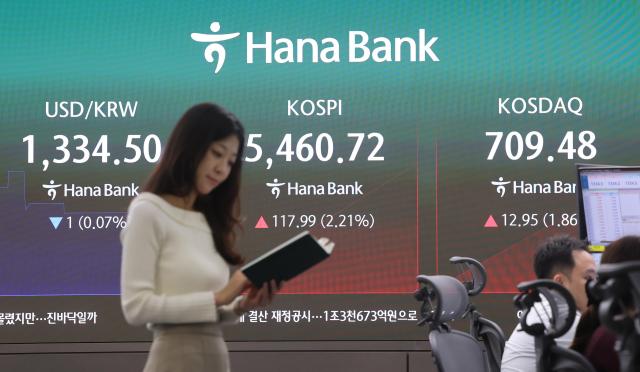
South Korean stocks swung from a strong open to a loss on November 13 after Nvidia CEO Jensen Huang's surprise resignation. The KOSPI closed at 5,290.53, down 52.20 points or 0.98%, after opening at 5,452.41, up 2.05%, and rising as much as 3.03% intraday to 5,504.44, according to the Korea Exchange.
Foreign investors sold a net 550.5 billion won (about 2.75 billion yuan) on the main board, while institutions and retail investors bought a net 21 billion and 17.2 billion won. Foreigners concentrated selling in SK Hynix, which fell 3.03%, while Samsung Electronics lost 0.96%. The KOSDAQ closed at 699.66, up 0.45%, after rising as much as 4.20% to 725.81 intraday.
Impact and trend: The shock came from Wall Street. On November 12, Nvidia's board announced Huang would step down as CEO and director effective immediately, naming CFO Colette Kress interim CEO. The three main US indexes fell overnight: the Dow lost 189.4 points or 0.36%, while the S&P 500 and Nasdaq fell 0.35% and 0.39%. Nvidia opened down as much as 13.08% before closing 4.34% lower; SK Hynix's ADR fell 3.19%, the Philadelphia Semiconductor Index 0.54%, while AMD and Broadcom rose 5.86% and 5.54%.
Outlook and risks: President Lee Jae-myung, at a capital-markets policy meeting, said KOSDAQ reform should be pushed forward to broaden the stable investment base, with delisting rules strictly applied to poorly run or weak listed companies. The won closed at 1,336.7 per dollar, up 6.0 won, while three-year bond yields rose 3.0 basis points to 3.759% and 10-year yields 6.4 basis points to 4.001%. Next week brings US retail sales, October FOMC minutes, Nvidia earnings and Anthropic's listing.
More News
- Maple Express | November 15, 2026 — Canada's climate credibility questioned as COP31 opens
- Global Express | November 15, 2026: Fifth Canadian soldier dies after base fire
- Tech Express | November 15, 2026: Astronomers Watch a Giant Planet Vanish From View for the First Time
- Sports Express | November 15, 2026: McDavid's 21-game point streak continues as Oilers blank Maple Leafs
- Maple Express | November 15, 2026: Fifth Soldier Dies After CFB Wainwright Fire
Comments (0)
View More
 -76%
Hilroy Double-Sided Dry Erase Lap Board Kit — Lined on One Side, Blank on the Other! $9.99 CAD (75% Off)
 -38%
Avery Hanging Name Badge Kit, 50 Badges — Print, Snap On, Done! $32.87 CAD (37% Off)
 -27%
Pipishell Full Motion TV Wall Mount 13–43" — Single-Stud Install, ±90° Swivel! $27.99 CAD (26% Off)
 0
Worth Buying: Seagate Portable 4TB — Plug In and Back Up, Plus a Year of Data Recovery! $269.99 CAD
Finance WeeklyFinance Weekly | A December Rate Hike Looks Locked In as Nvidia's Shake-Up Exposes AI Financing Risk
 Maple Express
 | November 15, 2026: Fifth Soldier Dies After CFB Wainwright Fire
-76%Hilroy Double-Sided Dry Erase Lap Board Kit — Lined on One Side, Blank on the Other! $9.99 CAD (75% Off)
Amazon
-38%Avery Hanging Name Badge Kit, 50 Badges — Print, Snap On, Done! $32.87 CAD (37% Off)
Amazon
-27%Pipishell Full Motion TV Wall Mount 13–43" — Single-Stud Install, ±90° Swivel! $27.99 CAD (26% Off)
Amazon
0Worth Buying: Seagate Portable 4TB — Plug In and Back Up, Plus a Year of Data Recovery! $269.99 CAD
Amazon
Finance WeeklyFinance Weekly | A December Rate Hike Looks Locked In as Nvidia's Shake-Up Exposes AI Financing Risk
Maple Express