AI Selloff Wipes Global Markets: Nikkei Loses 60,000, KOSPI Halts Trading, Taiwan Breaks 40,000 as China Vows Market Support
An AI-driven selloff swept global markets on November 6: the Nasdaq fell 5.5% overnight, Japan’s Nikkei dropped 5.96% below 60,000, South Korea’s KOSPI slid 6.02% and was halted, Taiwan’s TAIEX fell 4.51% under 40,000, the Hang Seng lost 1.27% and Shanghai fell 1.1%. China’s State Council pledged to improve capital-market stabilisation, and the Shanghai and Shenzhen bourses issued new Stock Connect risk rules. India was Asia’s only gainer as gold headed for a weekly gain above 5%.
📊 Asia Market Close
| Index | Close | Change | % Change |
|---|---|---|---|
| Shanghai Composite | 3,649.18 | -40.73 | -1.10% |
| Shenzhen Component | 11,175.78 | -295.31 | -2.57% |
| ChiNext | 2,465.23 | -101.57 | -3.96% |
| Hang Seng | 24,481.86 | -315.12 | -1.27% |
| Nikkei 225 | 57,434.77 | -3,643.13 | -5.96% |
| KOSPI | 5,059.69 | -324.11 | -6.02% |
| TAIEX | 39,701.64 | -1,873.08 | -4.51% |
Source: The Guardian
European stock markets fell sharply on November 6, following Asia and Wall Street lower. The FTSE 100 was down 207 points, or 1.9%, at 10,575 in mid-morning trade, poised for its worst day since March. Germany's Dax fell 1.9%, France's Cac 40 dropped 1.5% and Spain's Ibex lost 1.1%.
The selloff began in the US, where the Nasdaq suffered its worst day in 19 months on Thursday, slumping 5.5%. Chip stocks led the decline: memory maker SanDisk tumbled 22% and hard-drive maker Western Digital fell 17%. Wall Street's "fear index", the Vix, jumped 61% to its highest level since the early weeks of the Iran war.
After the Democrats' midterm triumph, investors fear tighter scrutiny could slow the AI industry. Susannah Streeter, chief investment strategist at Wealth Club, said worries that the build-out of data centres will slow are colliding with investor nervousness about returns on massive AI spending.
Source: Kyodo News
Tokyo stocks fell sharply on November 6, with the Nikkei index closing at 57,434.77, down 3,643.13 points or 5.96% from the previous day — the third-largest point drop on record. The index lost the 60,000 mark for the first time in about half a year and hit its lowest level since April 13.
The broader Topix fell 232.40 points, or 5.90%, to 3,707.99, with trading volume of 4.30583 billion shares. Since the midterm election picture became clear on November 4, the Nikkei has dropped more than 5,600 points over three sessions.
Overnight on Wall Street, the Dow Jones Industrial Average had plunged 1,833.06 points to 51,523.06 on November 5, after rising more than 1,500 points on November 4 on hopes that the US and Iran would end hostilities. US President Donald Trump said on social media that Democrats were to blame for the drop. Rising US crude oil futures also weighed on Tokyo.

Source: JRJ
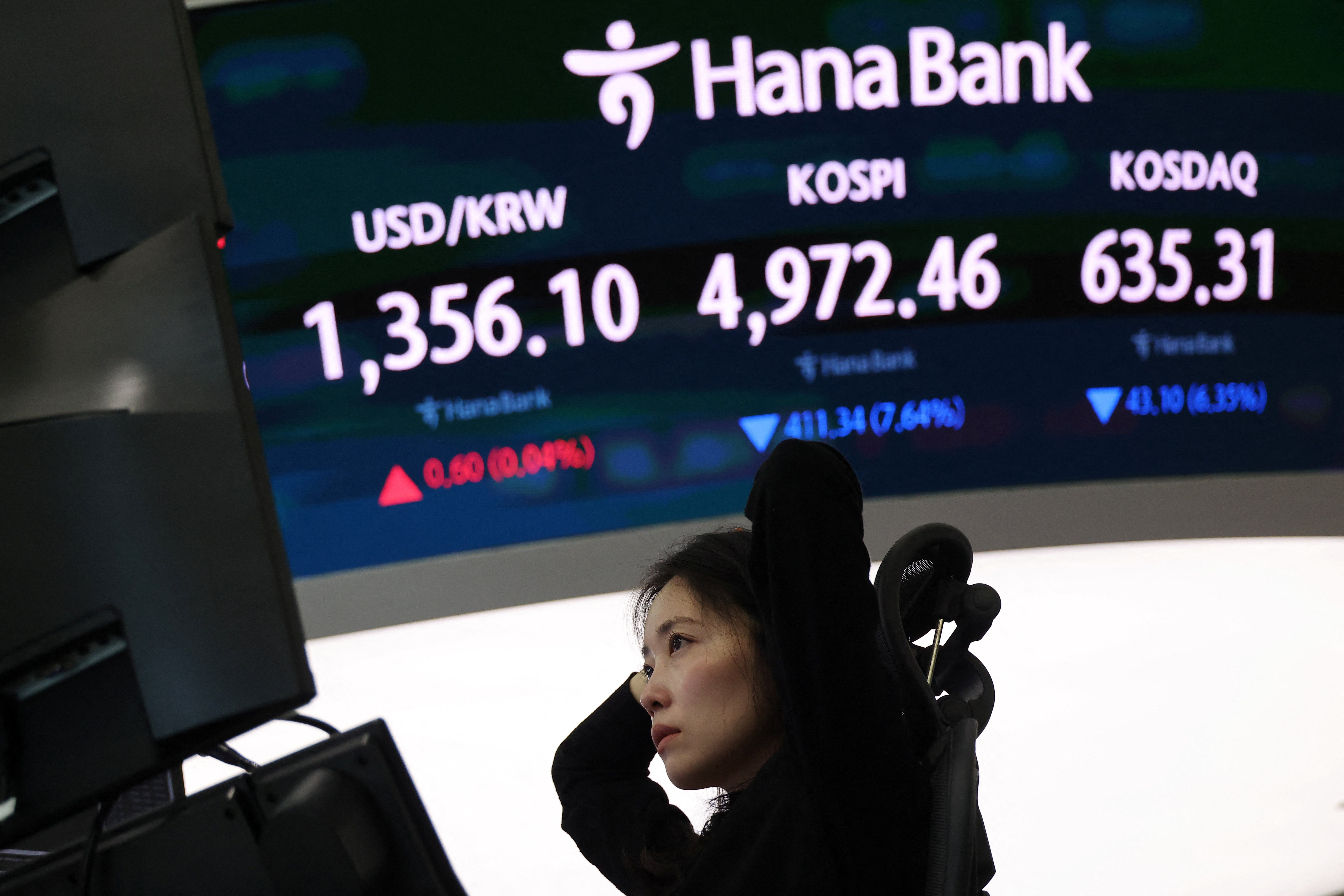
South Korea's KOSPI extended losses on November 6, falling more than 7% intraday and breaking below the 5,000 level, triggering a trading halt. SK Hynix dropped more than 11% and Samsung Electronics more than 8%.
Japan slid into a technical bear market. The Nikkei 225 sank more than 6% intraday below 57,000 — its first time there since April 13 — and was down 20% from its June peak. SoftBank Group and Kioxia each fell as much as 14% during the session.
The Democrats won both chambers of Congress in the midterms and made gains in governors' races in compute-heavy states such as Texas, prompting markets to price in the possibility of tighter approvals for AI infrastructure. UBS estimates that nearly 30% of US computing projects scheduled to be completed by 2028 are at risk of delay.
South Korean Finance Minister Lee Hyung-il told a special meeting that Seoul will closely monitor global financial market conditions and take necessary measures to prevent the stock market from overreacting relative to economic fundamentals. He also said South Korea will ensure the stable implementation of the existing Korea-US trade agreement.
Source: Lianhe Zaobao
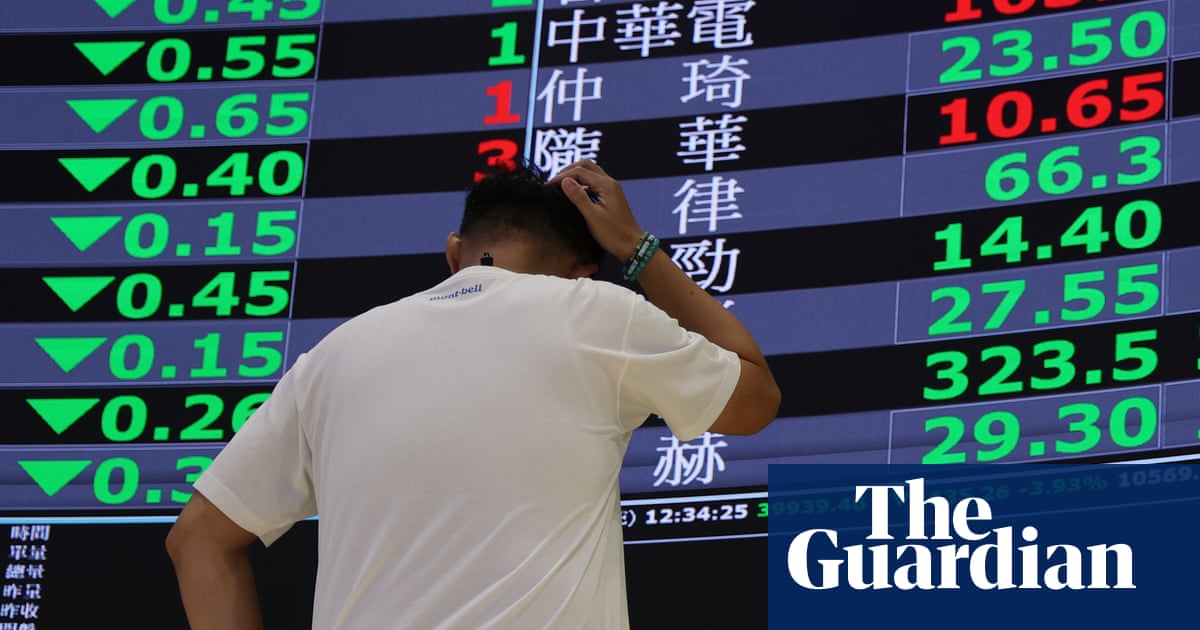
Hit by the plunge in US tech stocks, Taiwan's stock market saw panic selling on November 6, closing down 1,873 points — the fourth-largest point drop on record — at 39,701, losing the 40,000 mark. Taiwan's Ministry of Economic Affairs sought to reassure investors in the afternoon, stressing that recent economic performance, GDP growth, industrial production and trade figures all remained strong.
On the same day, the Shanghai Composite closed 1.1% lower and Hong Kong's Hang Seng fell 1.3%. Major A-share indices all declined: the Shanghai Composite dropped 1.10% to 3,649.18, the Shenzhen Component 2.57%, ChiNext 3.96% and the STAR Composite 3.24%.
For the week, however, the Shanghai Composite rose 1.39%, the Shenzhen Component 3.16% and ChiNext 2.14%, all ending six consecutive weeks of losses. The Hang Seng gained 5.1% for the week, its best weekly performance since March 2025, while the Hang Seng Tech Index rose 8.6%, its best since February 2025.
Source: RTHK News
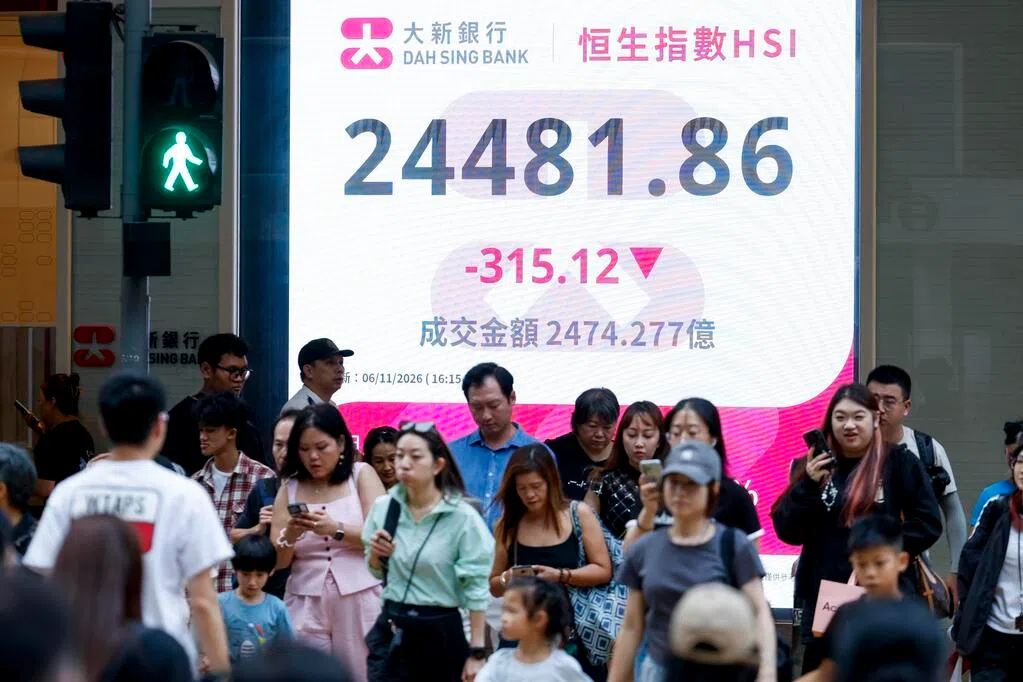
Hong Kong stocks slipped on November 6. The Hang Seng Index ended 315 points, or 1.3%, lower at 24,481 on turnover of HK$247.43 billion, but still registered a 5.1% weekly gain — its best since March 2025. The tech index fell 76 points, or 1.8%, to 4,078 but posted its best weekly gain since February 2025, advancing 8.6%, while the China Enterprises Index was 94 points, or 1.1%, lower at 8,274.
On the mainland, the blue-chip CSI 300 Index dropped 1.4% but gained 1.7% for the week, snapping a 12-week losing streak. The Shanghai Composite ended down 40 points, or 1.1%, at 3,649 on turnover of 772.63 billion yuan, also breaking a six-week losing streak to end the week 1.4% higher.
Among individual stocks, Chinese AI hardware names with heavy US exposure were hit hardest: Zhongji Innolight slumped 9.2% to a one-year low and Eoptolink Technology sank 7.3%. Some analysts said Beijing's recent support measures should provide a degree of support within a trading range, while others cautioned that China cannot completely escape the fallout from Wall Street.
Source: Sina Finance
A-shares fell broadly on November 6. The Shanghai Composite closed at 3,649.18, down 1.1%; the Shenzhen Component at 11,175.78, down 2.57%; and ChiNext at 2,465.23, down 3.96%. More than 4,700 stocks declined across the two markets.
Agriculture stocks bucked the trend, with Qiule Seed up more than 10% and Xinsai and Wanjia Deda at the daily limit. Banks extended gains, with Shanghai Rural Commercial Bank up more than 4% and China Construction Bank more than 2%, while power shares mostly rose. Computing hardware stocks tumbled: Zhongji Innolight fell 9%, Eoptolink more than 7% and TFC Optical more than 5%. CRO and semiconductor names also dropped.
Bank earnings underpinned the sector's strength: combined net profit at 42 listed banks rose 3.78% year on year in the first three quarters, with 34 posting positive growth. At midday, 10 Shanghai-listed companies announced plans to use buyback and shareholding-increase loans; since October, 21 such announcements have been disclosed in Shanghai, involving 2.7 billion yuan of lending.
Source: JRJ
China's State Council executive meeting, chaired by Premier Li Qiang, called for improving the capital market's market-stabilisation mechanism, enhancing the stock market's internal stability and promoting the steady and healthy development of the capital market, according to CCTV's Xinwen Lianbo on November 6.
The meeting also urged faster implementation of major projects and the "six networks" — water, new power grids, computing, next-generation communications, urban underground pipelines and logistics — balancing traditional infrastructure gaps with new infrastructure. It called for support for corporate equipment upgrades and investment in intangible assets, and for linking online and offline, urban and rural consumption.
On funding, the meeting required making good use of policy-based funds, ensuring timely disbursement of payments and coordinating fiscal and financial policy to shore up domestic demand. The report said the capital-market language signals that follow-up arrangements on market stability, risk prevention and the introduction of medium- and long-term capital are likely to keep advancing.
Source: 21st Century Business Herald
On November 6, the Shanghai and Shenzhen stock exchanges published revised mandatory clauses for stock connect risk disclosure statements, effective November 16, 2026. The versions issued on June 5, 2026 will be repealed at the same time.
The revisions reflect Hong Kong's switch to an uncertificated securities market regime from November 16, 2026, and arrangements to provide settlement services on half-day trading days. The exchanges adjusted risk warnings covering securities distributions and settlement on half-day trading days accordingly.
The Shenzhen exchange said the half-day settlement clauses will take effect when Hong Kong Exchanges and Clearing's clearing house begins providing that service, planned for February 5, 2027. Both exchanges require brokers to update the disclosure statements promptly, fully inform investors of the rule changes and keep records.
Source: JRJ
India was the sole exception as Asian markets tumbled. On November 6, the NSE Nifty 50 rose as much as 0.5% to a three-month high, led by software exporters and automakers. As of 10:50 am Mumbai time, no other major Asian market was higher.
Indian equities are being treated as the "anti-AI" trade. Since October 1, the Nifty has gained nearly 9% while the MSCI Asia Pacific index has fallen 11%. The rupee strengthened 0.4% against the dollar on Friday to its strongest level since early May.
Fund flows confirm the shift: global funds bought more than US$4 billion of Indian stocks in the 11 sessions through Wednesday, with preliminary data showing US$1.6 billion of net inflows on Thursday alone. Over the past five weeks, overseas investors have cut more than 130,000 short contracts on NSE index futures. Citigroup data shows about two-thirds of BSE 100 companies that have reported results posted 20% year-on-year profit growth in the September quarter.
Source: Cailian Press
Gold hovered around US$4,070 an ounce on November 6 and is on track for a weekly gain of more than 5%, its biggest since August. Prices slipped about 0.5% on the day as some investors sold bullion to cover stock market losses.
The US midterm results led markets to expect tighter fiscal spending, pushing Treasury yields to their lowest since early September. Traders are watching US nonfarm payrolls data due later on Friday for the next signal on the economy and interest rates.
The World Bank's latest report projects average gold prices of US$4,600 an ounce this year, up 33.6% from 2025, before falling 7.6% to US$4,250 in 2027 and another 5.9% to US$4,000 in 2028. It stressed that gold's fundamentals remain relatively healthy as investors and central banks continue to diversify their financial assets.
More News
- Global Express | November 6, 2026: Trump Says 'Big, Beautiful' Russia-Ukraine Deal in the Works
- Tech Express | November 6, 2026: OpenAI Launches GPT-6 Cyber With Out-of-Bounds Rate Under 1%
- Sports Express | November 6, 2026 — Ronaldo Ends His Portugal Career After 23 Years
- Maple Express | November 6, 2026 — Four pedestrians struck by SUV in Richmond Hill, children aged 7 and 1 injured
- AI Trade Retreats: Nasdaq Falls 5.52% Into Correction as Tesla and SpaceX Shed $420 Billion
Comments (0)
View More
 -33%
LEGO Pokémon Eevee 72151 — 587 Pieces, Poseable Ears & Tail, Display-Ready! $56.98 CAD (33% Off)
 -45%
Ninja Air Fryer Pro 4-in-1 Air Fryer 4.7L — Fits 5lb of Wings, 75% Less Oil! $99.99 CAD (44% Off)
 0
[Worth Buying] Charmin Ultra Soft 12 Family Mega XL Rolls (= 84 Regular Rolls) — 35% Coupon on the Page, Under $3 a Roll
 -34%
Utopia Bedding Queen Pillows, Set of 2 — Gusseted Hotel Style That Won't Pancake, $44.59 CAD (33% Off)
 Maple Express
 | November 5, 2026 - Carney government's budget adds $142.1B in new spending
 Tech Express
 | November 6, 2026: OpenAI Launches GPT-6 Cyber With Out-of-Bounds Rate Under 1%
-33%LEGO Pokémon Eevee 72151 — 587 Pieces, Poseable Ears & Tail, Display-Ready! $56.98 CAD (33% Off)
Amazon
-45%Ninja Air Fryer Pro 4-in-1 Air Fryer 4.7L — Fits 5lb of Wings, 75% Less Oil! $99.99 CAD (44% Off)
Best Buy
0[Worth Buying] Charmin Ultra Soft 12 Family Mega XL Rolls (= 84 Regular Rolls) — 35% Coupon on the Page, Under $3 a Roll
Amazon
-34%Utopia Bedding Queen Pillows, Set of 2 — Gusseted Hotel Style That Won't Pancake, $44.59 CAD (33% Off)
Amazon
Maple ExpressMaple Express | November 5, 2026 - Carney government's budget adds $142.1B in new spending
Tech Express