
Immigration | September 21, 2026 Canada's Express Entry Draw Invites 2,000 Canadian Experience Class Candidates
This week in Canadian immigration and study news: Express Entry invited 2,000 Canadian Experience Class candidates and 576 provincial nominees; IRCC's update showed temporary residence wait times mostly rising; PEI issued 195 nomination invitations; Ottawa tightened Atlantic Immigration Program rules. On study: ILAC, Canada's largest private English-language school, filed for bankruptcy, affecting 1,300 students; the crackdown reshaped study permits; grad student numbers soared.
1. Canada's Latest Express Entry Draw Invites 2,000 Canadian Experience Class Candidates
Source: CIC News
Immigration, Refugees and Citizenship Canada (IRCC) has issued more invitations to apply (ITAs) for permanent residence through the Express Entry system. On September 15, IRCC issued 2,000 ITAs in a draw for Canadian Experience Class (CEC) candidates, with a minimum Comprehensive Ranking System (CRS) cut-off score of 519. It was the latest round in a busy year of Express Entry draws and puts CEC among the largest categories by volume this year.
IRCC records show several draws were held in September alone: 250 invitations on September 16 for senior managers with Canadian work experience (CRS 389), 2,000 for the Canadian Experience Class on September 15, and 576 for the Provincial Nominee Program (PNP) on September 14 (CRS 734). Following this latest selection, Canada has now held 55 Express Entry draws in 2026, issuing a total of 128,732 ITAs over the year.
The data also shows that Express Entry in 2026 has favoured candidates with existing ties to Canada: 18 draws for the Provincial Nominee Program, 16 for the Canadian Experience Class, and 10 for French-language proficiency. IRCC also notes that in-Canada applicants awaiting a permanent residence decision whose work permit is about to expire may apply for a Bridging Open Work Permit (BOWP) to maintain status and keep working while they wait.
2. Canada Selects 576 Provincial Nominees for Permanent Residence
Source: CIC News
On September 14, IRCC issued 576 invitations to apply (ITAs) through Express Entry to candidates who hold a provincial nomination, with a minimum CRS cut-off score of 734. Because provincial nominees receive 600 additional CRS points, cut-off scores for this type of draw are typically higher than for categories such as the Canadian Experience Class.
With this round completed, Canada has conducted 54 Express Entry draws in 2026 and issued a total of 121,732 ITAs over the year. IRCC says Express Entry selections in 2026 have continued to favour candidates with ties to Canada, especially provincial nominees and those with Canadian work experience. The Provincial Nominee Program has held 18 draws so far this year, the most of any category.
IRCC also notes that in-Canada applicants for permanent residence whose work permit expires before a decision is made on their application may apply for a Bridging Open Work Permit (BOWP), allowing them to keep working under their existing conditions, and that eligible family members may be able to apply as well.

3. IRCC Update: Temporary Residence Processing Times Mostly Rise
Source: CIC News
IRCC published its latest temporary residence processing time estimates on September 16, showing wait times are largely on the rise. Among the changes, work permit processing time for U.S. nationals increased by one week, from 2 to 3 weeks, while applications from within Canada continued to edge down, from 110 to 109 days.
For study permits, processing time rose by one week for applicants within Canada (from 7 to 8 weeks) and for Nigeria (from 9 to 10 weeks), while other featured countries saw no movement. Visitor visa times changed little, mostly rising or falling by 2 to 3 days. Super visa wait times rose in every country but Pakistan, with the U.S. posting the steepest climb, from 66 to 116 days (more than seven weeks); Pakistan fell sharply, from 132 to 95 days.
IRCC is expected to publish its next update around September 23. The department notes that processing times are estimates of how long a newly submitted application could take and are not fixed timelines, guarantees, or maximum periods. In the first seven months of 2026, IRCC reported processing 1,832,065 applications, and as of July 31 more than 394,000 applications were still awaiting a final decision.

4. Prince Edward Island Issues 195 Provincial Nomination Invitations on September 17
Source: CIC News
On September 17, the Prince Edward Island Provincial Nominee Program (PEI PNP) issued 195 invitations to apply for provincial nomination, targeting workers in priority occupations and sectors with a strong impact on the province's economy. The invitations were issued through two pathways: Labour Impact (base) and PEI Express Entry (enhanced).
The province gave priority consideration to international students who graduated from one of three designated post-secondary institutions in PEI. Candidates had to indicate in their Expression of Interest (EOI) profile that they were employed in an occupation or sector prioritized by the province and that they hold a post-secondary credential from a qualifying institution. For 2026, the PEI PNP has identified healthcare, trades, manufacturing, and "other key industries facing labour shortages" as areas of focus for skilled worker selection.
Following this round, PEI has held nine provincial immigration draws in 2026. As of September 17, the province had issued 1,229 invitations to Labour Impact and PEI Express Entry candidates this year. Those invited must submit a complete application within 30 days. PEI plans to hold one draw per month, for 12 draws in 2026, leaving three rounds after the September 17 selection.

5. Ottawa Tightens Rules for Atlantic Immigration Program Applicants
Source: CIC News
This week, CIC News reported on updated instructions to immigration officers requiring them to refuse certain permanent residence applications under the Atlantic Immigration Program (AIP). The new rules set a 90-day deadline for AIP applicants whose employment or employer ownership has changed.
Under the updated instructions, titled "Atlantic Immigration Program (AIP): Other situations" and published on the department's website on July 23, an officer must issue the applicant a procedural fairness letter (PFL) advising them of the required documents and the 90-day deadline; if the applicant does not provide the required documents within that period, the officer must refuse the PR application. Previously there was no deadline, and officers simply put the application on hold until the documents were received.
The updated instructions address three scenarios: changes in employment under the same employer, moving from one designated AIP employer to another, and a change in employer ownership. The AIP is an employer-driven pathway to permanent residence for those settling in New Brunswick, Newfoundland and Labrador, Nova Scotia, and Prince Edward Island, requiring a full-time job offer from a designated in-province employer. Processing time for AIP PR applications has stood at 26 months since June, and AIP applicants are not eligible for bridging open work permits.

6. Canada's Largest Private English-Language School, ILAC, Files for Bankruptcy, Affecting 1,300 Students
Source: Toronto Star
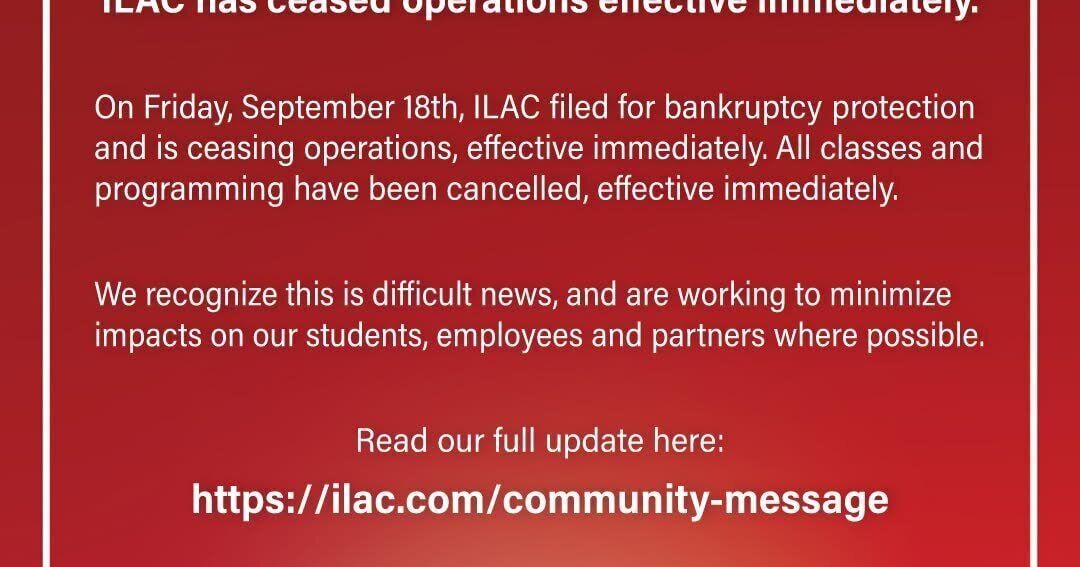
Canada's largest private English-language school, the International Language Academy of Canada (ILAC), has abruptly shut down and filed for bankruptcy protection, blindsiding more than 1,300 international students and hundreds of employees. ILAC filed for bankruptcy protection under KPMG last Friday, closing its Toronto and Vancouver campuses; the Vancouver campus operated under the banner of Tamwood International College.
According to Languages Canada, the national association that accredits and represents language schools, 1,362 on-site students were affected — 802 in Toronto and 560 in Vancouver — along with an unconfirmed number of online students. In a statement, ILAC said it "no longer has the financial resources necessary to continue operating," citing "significant regulatory changes affecting the sector." Less than a week earlier, another major international chain, EC English, closed its global operations.
Gonzalo Peralta, executive director of Languages Canada, said "the sector is in crisis," noting its membership has fallen from 220 to 148 in recent years. The association is working to move affected students into alternate programs at no extra cost, and its members have pledged to absorb 700 students. Languages Canada's 2025 annual report shows member institutions recently welcomed just 81,636 students, down nearly half from 150,112 in 2019, a decline it attributes to federal study permit caps introduced in January 2024 and unpredictable visa policies.
7. Canada's International Student Crackdown Has Changed Who Gets Study Permits
Source: immigration.ca
Canada's overhaul of its international student system has not only sharply reduced the number of foreign students entering the country but also changed the type of institution they attend. New federal data shows universities are gaining ground while colleges account for a significantly smaller share. IRCC says the proportion of international students attending universities is returning to pre-pandemic levels of around 40 per cent, and major research universities have become the leading recipients of study permits.
At the same time, the overall number of international students in Canada has fallen sharply. IRCC says there were about 691,215 study permit holders at the end of 2025, compared with 928,430 at the end of 2024 — a decline of about 29%. Canada welcomed about 61% fewer new international students in 2025 than in 2024. Among study permit holders at public institutions, colleges accounted for 54% and universities 44% in 2023; by February 28, 2026, that picture had reversed, with universities at 57% and colleges at 39%.
Policy is shifting toward "quality over quantity." IRCC has introduced measures for master's and doctoral students: those enrolling at public designated learning institutions no longer need a provincial or territorial attestation letter (PAL/TAL), and doctoral students and their accompanying family members get faster processing, with 96% of doctoral applications that do not require additional security screening finalized within an average of two days. Meanwhile, the refusal rate for new study permit applications rose from 52% in 2024 to 59% in 2025.

8. Number of New International Grad Students Soars in Canada
Source: The PIE News
Immigration, Refugees and Citizenship Canada (IRCC) says it issued 6,455 new graduate student permits in the second quarter of 2026, compared with 3,085 in the same period of 2025. The jump came even as overall applications fell slightly — 23,480 international graduate students sought a new or extended study permit in the quarter, down about 12% year over year.
Under Prime Minister Mark Carney, the government has shifted its international student focus to attracting master's and PhD students. IRCC minister Lena Metlege Diab told a meeting in Halifax in January, "We recognise that we need them here to grow our economy." Canada imposed a cap on international study permits in 2024, when then-minister Marc Miller argued some programs were the educational equivalent of "puppy mills."
IRCC spokesperson Melissa Zeroual said the new policy is reflected in this year's approvals: "The number of study permits issued to master's and doctoral students represented 12% of the total in 2025 — and 21% so far this year." UBC said international graduate applications rose 15% in 2026, including a 30% increase for doctoral programs, with strong interest from the United States, India, Nigeria, and Iran. Robert Asselin, head of the U15 group of Canada's top research universities, called the growth "great news" and credited Carney's efforts to build international partnerships with boosting Canada's attractiveness.

More News
- Maple Express Noon | September 21, 2026: Carney and Ford condemn Belleville synagogue shooting
- Global Express | September 21, 2026 Trump threatens to 'blow up' Iran as Tehran warns of 'painful strikes'
- Finance Morning | September 21, 2026: Asia Stocks Rise on US-China Talks Optimism; ByteDance Buys Beijing Land for 8.7 Billion Yuan
- Tech Express | September 21, 2026 — Nvidia's Jensen Huang Rejects "AI Doom" Warnings
- Sports Express | September 21, 2026 — Blue Jays rout Rangers 7-2 to avoid series sweep
Comments (0)
View More
 -43%
-43%HUANUO Single Monitor Arm — Fits 13-32", Gas Spring, Frees 80% Desk Space! $51.99 CAD (42% Off)
 -28%
-28%CROWNFUL Digital Kitchen Scale 11lb — #1 Best Seller with 5 Units & Tare! $15.99 CAD (27% Off)
 -13%
-13%JBL Charge 6 Waterproof Bluetooth Speaker — IP67, 24-Hour Playtime & Built-In Power Bank! $219.99 CAD (12% Off)
 -31%
-31%Nutrience Grain-Free Indoor Cat Food 5kg — Low-Fat, Canada-Made, Hairball Control! $38.84 CAD (31% Off)
 Tech Express
Tech Express | September 21, 2026 — Nvidia's Jensen Huang Rejects "AI Doom" Warnings
 Sports Express
Sports Express | September 21, 2026 — Blue Jays rout Rangers 7-2 to avoid series sweep
-43%HUANUO Single Monitor Arm — Fits 13-32", Gas Spring, Frees 80% Desk Space! $51.99 CAD (42% Off)
Amazon
-28%CROWNFUL Digital Kitchen Scale 11lb — #1 Best Seller with 5 Units & Tare! $15.99 CAD (27% Off)
Amazon
-13%JBL Charge 6 Waterproof Bluetooth Speaker — IP67, 24-Hour Playtime & Built-In Power Bank! $219.99 CAD (12% Off)
Best Buy
-31%Nutrience Grain-Free Indoor Cat Food 5kg — Low-Fat, Canada-Made, Hairball Control! $38.84 CAD (31% Off)
Amazon
Tech ExpressTech Express | September 21, 2026 — Nvidia's Jensen Huang Rejects "AI Doom" Warnings
Sports Express