
Dow Tumbles 652 Points as Oil Tops $100 and Gold Slips Below $4,000
U.S. stocks fell across the board on Oct. 23, with the Dow down 652.82 points to 52,215.16 and the S&P 500 off 0.52%. WTI crude rose 3.99% to $103.44 and gold slipped below $4,000. American Express is cutting 5% of its workforce to prepare for AI, Meta closed lower on AI spending fears and Volvo Cars plunged 24%. Bombardier unveiled a $270 million U.S. investment, Carney criticized U.S. tariffs, Washington designated helium a critical material and record jet fuel pushed holiday airfares higher.
Source: CNBC, Yahoo Finance, Fox Business, NPR, CBS News, WTOP News, FXStreet, China Finance Information Network
📊 North American Markets Today
| Index / Commodity | Close | Change | % Change |
|---|---|---|---|
| S&P 500 | 7,623.68 | -39.75 | -0.52% |
| Nasdaq | 25,955.34 | -53.52 | -0.21% |
| Dow Jones | 52,215.16 | -652.82 | -1.23% |
| TSX (Toronto) | 35,788.18 | -185.27 | -0.52% |
| CAD/USD | 1.4002 | -0.0004 | -0.03% |
| WTI Crude | 103.44 | +3.97 | +3.99% |
| Gold | 4,010.00 | -50.40 | -1.24% |
1. Dow Plunges 652 Points as Sell-Off Spreads to Defensive Sectors
Source: CNBC
U.S. stocks closed lower across the board on Friday. The Dow Jones Industrial Average fell 652.82 points, or 1.23%, to 52,215.16, while the S&P 500 slipped 0.52% to 7,623.68 and the Nasdaq Composite lost 0.21% to 25,955.34. A sell-off in tech stocks during the prior session spread on Friday into defensive areas including consumer staples, utilities and healthcare.
Oil was the day's main source of pressure. U.S. crude futures rose 3.8% to settle at $103.27 a barrel, and Brent gained 3.1% to close at $116.72, its highest settle since April. The move followed reports that the U.S. and Israel may be drawing up plans for renewed attacks on Iran, which said it is prepared to strike back.
Among individual names, Dow component American Express fell more than 3%, Caterpillar slipped about 2% and Goldman Sachs lost more than 1%. Microsoft edged higher, while Micron Technology gained nearly 3% and AMD nearly 2%. The 10-year Treasury yield stood at about 4.999%, up more than 4 basis points on the day. For the week, the S&P 500 lost 0.5%, the Nasdaq shed 0.7% and the Dow gained 0.4%.
2. American Express Cuts 5% of Workforce to 'Prepare for AI'
Source: CNBC
American Express said Friday it is eliminating about 5% of its global workforce and taking a $336 million restructuring charge. CEO Stephen Squeri disclosed the move on the company's third-quarter earnings call. The firm had almost 77,000 employees at the end of 2025.
Chief Financial Officer Christophe Le Caillec told CNBC the restructuring was meant to make Amex "leaner, more agile, and also to prepare for AI." He said the company did not want to automate processes that are not optimally structured, so it is first reducing layers and increasing spans of control to take advantage of AI in the coming quarters and years.
On results, adjusted earnings per share came in at $4.68, beating the $4.48 average estimate tracked by LSEG. Revenue rose 9% to $20.06 billion, slightly below the $20.12 billion forecast. The company raised its full-year earnings guidance to a range of $18.30 to $18.60 per share. Amex shares fell roughly 4% in afternoon trading.

3. Meta Closes Lower as AI Spending Fears Rattle Markets
Source: Yahoo Finance
Meta stock closed out Friday down roughly 1%, after plunging 7% a day earlier. Despite better-than-expected third-quarter revenue reported on Wednesday, fears of an AI bubble have resurfaced across Wall Street, with investors pulling back on semiconductor and other AI-related stocks over questions about whether massive data-center investments will pay off.
Meta raised the lower end of its capital expenditure estimate to between $135 billion and $145 billion, from $130 billion to $145 billion. The company also disclosed $825 billion in spending commitments tied to cloud capacity arrangements, energy service agreements and consumer hardware products.
Revenue hit a record $64 billion in the quarter, ahead of the $63.3 billion analysts expected. GAAP earnings per share were $3.83 versus expectations of $3.56, and would have been $7.40 without legal charges related to the company's teen mental health settlement. Meta also announced it will issue nonvoting Class C shares to all Class A stockholders, effectively a 2-for-1 split.

4. Volvo Cars Plunges 24% as China Sales Slump Bites
Source: CNBC
Volvo Cars said Friday it plans to cut 2,500 jobs, including 2,000 in Sweden, after a sharp decline in its Chinese market weighed on third-quarter earnings. The Swedish automaker reported an operating loss of 5.6 billion Swedish kronor ($563.7 million) for the quarter, down from an operating profit of 6.4 billion kronor in the previous period.
Shares ended the session 24.2% lower. CEO Håkan Samuelsson told CNBC the problem is "really a lot about the Chinese market, where the change has come faster than we thought," adding that selling global cars developed in Europe and China will no longer work and that this affects all Western players in China. He called for a more regional structure and regionally adapted cars.
Volvo Cars' revenue in China fell almost 50% year-on-year as new Chinese rivals brought "hypercompetition" and severe pricing pressure, while in the U.S. the company cited tariffs and fewer incentives to buy electric cars. The automaker, owned by China's Geely Holding, is targeting 5 billion kronor in cost cuts.

5. Bombardier Doubles Down on U.S. Investment With $270 Million Plan
Source: Fox Business
Canadian jetmaker Bombardier announced Friday that it is "expanding in America" and hiring 800 people as part of an initial $270 million investment earmarked for infrastructure growth. President Donald Trump touted the deal on Truth Social, saying companies are "coming to America, investing BILLIONS OF DOLLARS, and creating JOBS like never before."
The company said it is actively recruiting for 500 positions and plans to create another 300 jobs through footprint expansion projects, with Texas accounting for 150 of those. Hiring will also be spread across its U.S. home base in Kansas as well as Indiana and Connecticut. CEO Eric Martel cited "constructive conversations with the U.S. administration" and a "bright path forward."
The announcement follows Trump's September warning that Bombardier should no longer be allowed to sell its planes in the United States unless it manufactures them domestically. Bombardier said its U.S. activities supported 27,200 American jobs in 2025 across service and manufacturing facilities and a supply chain in which it spent $2.8 billion.

6. Carney Blasts U.S. Tariffs as 'Hurting Everyone' as Ontario Unveils C$8.7 Billion Aid
Source: China Finance Information Network (Xinhua Finance)
Canadian Prime Minister Mark Carney said on Oct. 21 that U.S. tariff policy has not only raised costs for American households but upended a trade relationship with Canada that lasted for decades. He noted that Canada's vehicle exports to the U.S. fell more than 10%, while U.S. vehicle exports to Canada dropped more than 20%, saying the tariffs weaken the industrial competitiveness of both countries and reduce choices for ordinary families.
Also on Oct. 21, Carney and Ontario Premier Doug Ford jointly announced a C$8.7 billion (about US$6.2 billion) strategic industry support plan to help workers and businesses hit by U.S. tariffs, focused on Ontario's steel, auto and critical minerals sectors.
Canada rejected U.S. allegations that Canadian officials sought to interfere in American politics ahead of the midterm elections. The U.S. embassy in Ottawa published a so-called "fact sheet" on Oct. 21 naming Industry Minister Mélanie Joly and Ford. Ford said the relationship has undergone a "permanent change" and will "never go back" regardless of the midterm outcome. The original report was published by Xinhua Finance on Oct. 22.
7. U.S. Designates Helium a Critical Material Over Chip Supply Risk
Source: WTOP News (Associated Press)
The U.S. Energy Department designated helium a critical material on Friday, citing its indispensability for making semiconductors needed for energy generation and the risk of disruption to global supply. The designation makes more federal financing available to helium producers and puts the government's monitoring of supply on a closer footing.
Helium is primarily produced as a byproduct of natural gas processing. The United States is the world's largest producer of both natural gas and helium, followed by Qatar and Russia. Iran's closure of the Strait of Hormuz during its war with Israel and the U.S. has severely curtailed Qatari exports, and Russia imposed temporary export controls on helium in April.
Energy Secretary Chris Wright said the move frees America from reliance on foreign sources of critical materials. The U.S. produced 81 million cubic meters of helium in 2025, or 43% of global supply, of which 38 million cubic meters was exported. Helium is used in wind, solar and nuclear power, space exploration, medical imaging and in semiconductor cooling, photolithography and leak detection.

8. AI Agents Are Roaming Bank Accounts, and Banks Aren't Happy
Source: CBS News
Major U.S. banks are detecting unauthorized activity from third-party AI agents operating inside customers' online accounts, according to an Axios report. Some of the largest institutions say customers have given their personal AI agents, which banks have not vetted, access to their financial accounts.
Madison Mills, senior AI reporter at Axios, told CBS News that in many cases customers are simply handing their username or password to an AI agent the bank has not vetted, which violates its terms of service. Reporting also found evidence that appeared to show agents taking actions in customer accounts that were not authorized, such as calling a bank with a complaint without first consulting the account holder.
White House AI czar David Sacks said on X that there is a clear distinction between user-authorized agents and truly unauthorized "rogue" agents that could constitute cyberattacks, adding that the activity described may violate bank terms requiring humans to log in themselves but is "in no way" a cyberattack. JPMorgan Chase CEO Jamie Dimon said on the bank's Oct. 13 earnings call that it will not let just any outside agents inside the company because it is "too risky for clients and for JPMorgan."

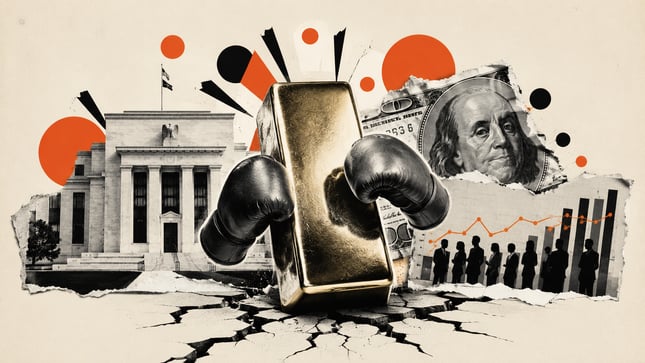
9. Gold Slips Below $4,000 as the Haven Trade Unwinds
Source: FXStreet
Gold touched a three-month low of $3,986 during Asian trading hours on Friday, then failed to hold a rebound and hovered around $4,000. The intraday high was $4,034, and the metal was on track for a weekly decline of more than 3%.
Analysts at Rabobank described Thursday as "a brutal day for markets," with the S&P 500 falling 1.2% and the Philadelphia Semiconductor index dropping to its lowest since July. The equity sell-off was mirrored by a rally in government bonds, with the 10-year Treasury yield moving back below 5% for the first time since September. Gold, however, failed to benefit from the equity slump.
Middle East tensions kept energy prices elevated, with WTI trading around $100 a barrel, and the resulting inflation pressure reinforced expectations that rates will stay higher for longer, raising the opportunity cost of holding a non-yielding asset. Some analysts suggested traders may also have sold precious metals to cover losses in equities. The Federal Reserve is widely expected to leave rates unchanged after a 25 basis point hike in September.
10. Jet Fuel Hits a Record, Holiday Airfares Soar
Source: NPR
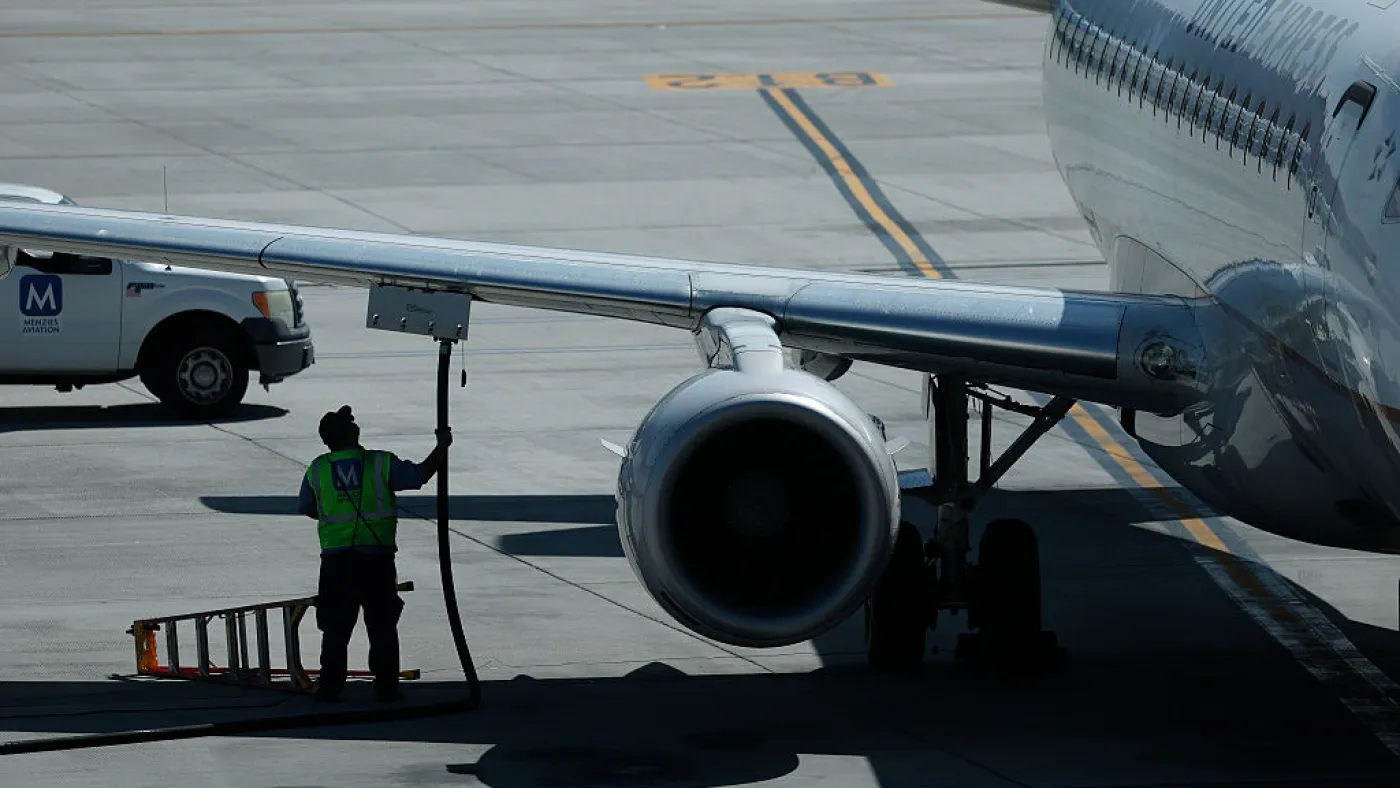
The average U.S. jet fuel price reached $4.90 a gallon on Thursday, the highest single-day average tracked by Argus and more than twice the price a year ago. Fuel is one of airlines' biggest expenses, and the cost is flowing through to ticket prices.
Hayley Berg, lead economist at travel tech company Hopper, said airfares are at "a 10-year high," with Thanksgiving fares up about 30% from last year and Christmas tickets up more than 20%. She said travel demand is "really sticky" at this time of year, with travelers unlikely to make major changes to traditional holiday trips even at higher prices. Delta Air Lines CEO Ed Bastian said on the carrier's earnings call this month that consumers have shown a "limited amount of resistance."
In Europe, Ryanair CEO Michael O'Leary said this week that airfares could rise 10% to 20% over the next 12 months, which he described as the biggest increase in history for the region. Chris Sununu, head of U.S. trade group Airlines for America, said airlines are absorbing most of the cost, but that 20% to 30% increases are being passed on to customers.
More News
- Maple Express | Oct 23, 2026: Toronto police search for three children allegedly taken by their mother
- Maple Express | October 23, 2026 — Trump says a Canada-U.S. trade deal is 'very close', but 'we have all the cards'
- Global Express | October 23, 2026: Five Wounded in West Bank Checkpoint Attack as Netanyahu Orders Full Closure
- Finance Morning: A-Shares Reverse Higher as ChiNext Gains 4.16%, Hang Seng Reclaims 23,000
- Tech Express | October 23, 2026: iPhone Duo Goes on Sale as Apple Says Stores Have Stock
Comments (0)
View More
 -22%
iSpring FP500 5-Micron Sediment Filter — For RO5004F Series Only! $70.02 CAD (22% Off)
 -33%
🎉 史新低!Gorilla Grip Bath Tub Mat 89×41 cm — #1 in Bathtub Mats, 100K+ Reviews! $26.99 CAD (33% Off)
 -48%
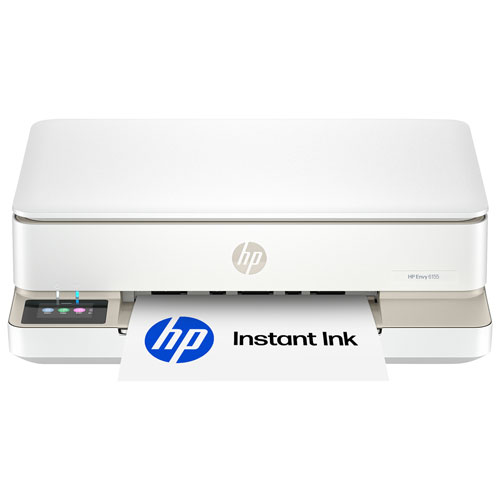
HP Envy 6155 All-in-One Inkjet Printer — Print, Scan, Copy and Fax from One Compact Machine! $99.99 CAD (47% Off)
 -17%
Zinus Green Tea Memory Foam Mattress 10" (Full) — Arrives in a Box, Sleeps Like a Mattress! $237 CAD (17% Off)
 Maple Express
 | October 23, 2026: Ontario man stunned by $27,000 flood cleanup estimate
 Global Express
 | October 23, 2026: Five Wounded in West Bank Checkpoint Attack as Netanyahu Orders Full Closure
-22%iSpring FP500 5-Micron Sediment Filter — For RO5004F Series Only! $70.02 CAD (22% Off)
Amazon
-33%🎉 史新低!Gorilla Grip Bath Tub Mat 89×41 cm — #1 in Bathtub Mats, 100K+ Reviews! $26.99 CAD (33% Off)
Amazon
-48%HP Envy 6155 All-in-One Inkjet Printer — Print, Scan, Copy and Fax from One Compact Machine! $99.99 CAD (47% Off)
Best Buy
-17%Zinus Green Tea Memory Foam Mattress 10" (Full) — Arrives in a Box, Sleeps Like a Mattress! $237 CAD (17% Off)
Amazon
Maple ExpressMaple Express | October 23, 2026: Ontario man stunned by $27,000 flood cleanup estimate
Global Express