Finance Weekly | Weak U.S. Jobs Cool October Rate Bets as Eurozone Inflation Hits a Three-Year High
Global finance this week was a sharp repricing of rate expectations. U.S. September payrolls rose just 29,000 and two senior Fed officials signalled patience, cutting October hike odds from about 70% to roughly 14%. Eurozone inflation hit a three-year high of 3.8% as energy surged, pressuring the ECB. Nvidia's intraday value topped $5.7 trillion while the Hang Seng fell below 24,000. China released its fourth 62.5-billion-yuan trade-in tranche; Canada frets over mortgage renewals.
The week's main thread in global finance was a sharp repricing of rate expectations. U.S. September payrolls rose just 29,000, and two senior Fed officials signalled patience, pushing the odds of an October hike from about 70% down to roughly 14%; with inflation still above target, the October 14 CPI is the key test. In Europe, eurozone inflation hit a three-year high of 3.8% as energy prices jumped 18.8% year over year, pressuring the ECB to tighten again at month-end. Japan and South Korea face currency weakness and sticky inflation. In markets, Nvidia's intraday market value topped $5.7 trillion while Hong Kong's Hang Seng fell below 24,000. China delivered the fourth 62.5-billion-yuan "national subsidy" tranche and widened digital-yuan cross-border links, while Canada worries about a wave of short-term mortgage renewals.
1. Two Senior Fed Officials Move Markets as October Rate-Hike Odds Plunge
Source: ifeng
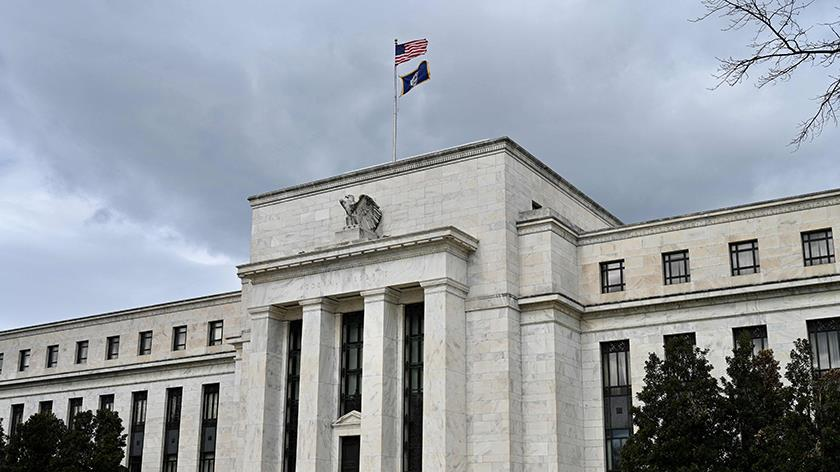
Although Fed Chair Kevin Warsh has made clear he does not want to signal a rate path through forward guidance, speeches by two senior officials this week still sharply moved investor expectations. Vice Chair Philip Jefferson and New York Fed President John Williams both said the Fed has time to further assess the economy and need not rush another hike, prompting traders to slash bets on an October increase. According to federal funds futures pricing, traders put the odds of a hike at the Oct. 27-28 meeting at about 70% before Williams spoke on Tuesday; by the end of Jefferson's remarks on Thursday the odds had fallen to about 25%; and after Friday's September jobs report showed payrolls rising just 29,000, they fell further to about 14%. On Sept. 16 the Fed raised rates 25 basis points in a unanimous vote, its first increase since 2023. Impact and trend: Goldman Sachs, Evercore ISI and JPMorgan said the two officials delivered a broadly consistent message - the Fed need not hike at every meeting and can lengthen the gap between moves to assess incoming data. The earlier rush to price in an October hike had pushed up Treasury yields and borrowing costs; this cooling now eases pressure at the short end. Outlook and risks: Divisions remain inside the Fed, with Dallas Fed President Lorie Logan arguing that 'more hikes may still be needed.' The Oct. 14 CPI is the key variable: if price pressures persist, a hike stays on the table; if inflation keeps cooling, policymakers gain more room to wait. The wait-and-see signal does not mean the hiking cycle is over.
2. Nvidia Tops $5.7 Trillion in Intraday Market Value, Stock Hits Record High
Source: Yahoo Finance
Nvidia's stock hit a new all-time intraday high on Friday, reaching $237.55 a share in early trading after opening at $236.05, eclipsing its prior record of $235.54, with the company's intraday market cap reaching $5.7 trillion. Nvidia is the 'poster child' of the AI hardware race, riding continued spending on AI infrastructure amid a global build-out. In its August second-quarter report, the company posted revenue of $96.2 billion, topping Wall Street's already lofty expectations, and gave a better-than-anticipated third-quarter outlook of $105.8 billion to $110.1 billion in sales. Impact and trend: The AI trade has faced frequent ups and downs since ChatGPT debuted in November 2022, with investors regularly questioning whether the market is in a bubble and, if so, when it will burst. Nvidia also faces questions about so-called circular investing - it invests in its own customers, who then buy more of its chips - as well as growing competition from AMD and from customers like Amazon and Google, which increasingly offer their own custom chips to third parties. Outlook and risks: Nvidia's valuation leans heavily on the durability of AI capital spending; should data-centre investment slow or the competitive landscape shift, share-price volatility could magnify.

3. U.S. Justice Department Declines to Reopen Investigation into Former Fed Chair Powell
Source: The Guardian
The U.S. justice department is not reopening a criminal investigation into former Federal Reserve chair Jerome Powell over cost overruns on the central bank's building renovation project, a department spokesperson said on Friday. Attorney General Todd Blanche told Bloomberg News that he has not ruled out continuing to look into the project's oversight and potentially acting if evidence of wrongdoing emerged. The Fed's inspector general said on Wednesday it found no grounds for a criminal referral or evidence of administrative misconduct tied to the cost overruns. But its conclusion of lax oversight drew a fresh call for Powell's resignation from Donald Trump, who has been a vociferous critic of Powell across his two presidencies. Powell has remained at the Fed as a governor since stepping down as chair in May; his successor, Kevin Warsh, said on Thursday he would hire an independent auditor to 'verify accuracy and compliance' for all of the project's costs. Impact and trend: The matter bears on the Fed's independence and credibility. At his final press conference as chair in April, Powell said he would not leave the board 'until this investigation is well and truly over, with transparency and finality.' The tension between political pressure and central-bank independence is a key variable in how markets judge U.S. monetary-policy credibility. Outlook and risks: If the justice department later reopens the probe, or Warsh's audit uncovers problems, confidence in the Fed's independence could be shaken again.

4. Eurozone Inflation Hits a Three-Year High of 3.8% as Energy Prices Pressure the ECB
Source: Euronews.com
Eurozone inflation rose to 3.8% year over year in September, the highest in three years and above economists' forecast of 3.6%; prices rose 0.6% in September alone versus August. The reading is the highest since September 2023, when inflation ran at 4.3%, and is almost double the European Central Bank's 2% target. The jump came almost entirely from one corner of the basket: energy. Energy prices rose 18.8% from a year earlier, up from 14.3% in August, and climbed 3.9% in September alone, adding roughly 1.7 percentage points to the 3.8% headline figure, with energy carrying about a 9% weight in the euro-area basket. Core inflation, stripping out energy, food, alcohol and tobacco, edged up only to 2.5% from 2.4%, in line with forecasts; services inflation rose to 3.2% from 3.0%, with services about 47% of the basket. Impact and trend: With core inflation mild and energy clearly the driver, the ECB faces a central question - is this an energy shock that will fade, or the start of broader price pressure? The ECB raised its three key rates by 25 basis points on Sept. 10, taking the deposit facility rate to 2.50%, its second increase this year. Outlook and risks: The ECB next meets on Oct. 28-29. Prediction markets assign about a 91% chance of a further hike at month-end. By country, Lithuania (6.1%), Bulgaria (5.6%) and Cyprus and Luxembourg (5.2%) led; among the four largest economies Spain was highest at 5.0%, while Italy posted the biggest monthly jump.

5. South Korea's September Inflation Stays Elevated, Reinforcing the BOK's Tightening Bias
Source: Sina Finance
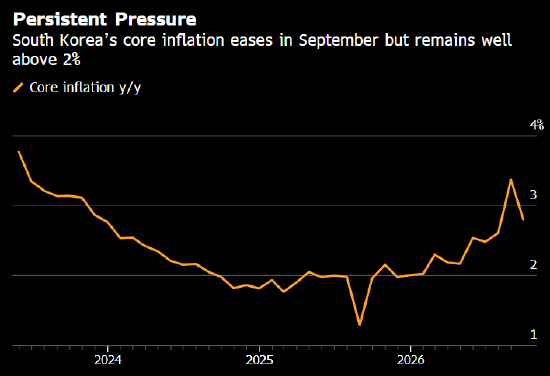
South Korea's consumer prices rose 2.9% year over year in September, down from 3.1% in August and in line with the median economist estimate. Stripping out volatile food and energy prices, core inflation was 2.8%, down from 3.4% in August and also in line with expectations. This shows that, beyond high energy costs, core price pressure remains elevated. The Bank of Korea raised rates in both July and August, lifting its benchmark rate to 3%. Policymakers have warned that strong growth, sticky inflation and rising home prices may require further hikes. The BOK's August projection for the next six months put the median rate at 3.25%, implying one more hike; governor Shin Hyun-song said the forecast suggests a more gradual pace of tightening ahead. Impact and trend: With global energy prices rising and major central banks reassessing their rate paths, South Korea is one of the few advanced economies still hiking. Core inflation has eased but remains above the 2% target, indicating policy must stay restrictive. Outlook and risks: The latest inflation data may further reinforce the BOK's tightening bias. If inflation proves sticky or home prices keep climbing, the odds of one more hike this year rise; but weakening global demand and export pressures could also cap its room to tighten.
6. Hang Seng Falls Below 24,000, Its Biggest One-Day Drop in Nearly Six Months
Source: 21st Century Business Herald
On Oct. 2, Hong Kong's main indices opened lower and slid, with the Hang Seng Index and Hang Seng Tech Index each falling more than 3% at one point intraday. By the close the Hang Seng had lost the 24,000 level, down 2.6% - its biggest one-day drop in nearly six months - while the Hang Seng Tech Index fell 2.26%, touching a new low of 4,111 intraday, down nearly 25% this year and close to 40% over the past 12 months. Most tech names fell: Li Auto dropped more than 5%, while Bilibili, Kuaishou, Xiaomi, XPeng and JD Health fell about 4%, NetEase and Baidu more than 3%, and Alibaba and Meituan more than 2%. That day, Huanchuang Technology - billed as the first listed 'high-precision AI spatial positioning' firm - plunged from the open, closing down more than 47% with a market value of HK$10.9 billion, shedding HK$9.87 billion, after listing on the HKEX the previous day with a first-day gain of more than 260%. Impact and trend: Hong Kong stocks are under short-term pressure, in resonance with swings in global rate expectations and a pullback in richly valued tech shares. The sharp retreat of a newly listed stock the day after its debut also reflects how sentiment-driven money chases and dumps concept stocks. Outlook and risks: With the Hang Seng Tech Index down nearly 25% this year, valuations sit in a low zone, but stabilisation still depends on global liquidity expectations and improvement in mainland economic data.
7. Fourth 62.5-Billion-Yuan 'National Subsidy' Tranche Released; Full 250-Billion-Yuan Trade-In Fund Now Allocated
Source: 21st Century Business Herald
Data from the National Bureau of Statistics showed China's September manufacturing PMI at 50.1%, up 0.3 percentage points from August and back in expansion territory for a second straight month; the non-manufacturing and composite PMIs also returned to expansion, at 50.2% and 50.7% respectively, both up 1.2 percentage points from August. Recently, the National Development and Reform Commission, together with the Ministry of Finance, allocated this year's fourth tranche of 62.5 billion yuan in ultra-long special treasury bonds to support consumer goods trade-ins, completing the full-year 250-billion-yuan trade-in fund. In addition, six banks - ICBC, Agricultural Bank of China, Bank of China, China Construction Bank, Bank of Communications and Postal Savings Bank - said on Sept. 30 they would implement a mortgage interest-subsidy policy, offering subsidised loans to eligible customers on a 'no-application, automatic' basis. The People's Bank of China will conduct 1.2 trillion yuan of three-month outright reverse repos on Oct. 8; with 1 trillion yuan of that tenor maturing this month, the operation will add a net 200 billion yuan. Impact and trend: Fiscal and monetary levers are being pulled together, aimed at stabilising consumption, housing and liquidity. With the trade-in funds fully allocated, durable-goods consumption may get support in the fourth quarter; the mortgage subsidy and the PMI's return to expansion signal a marginal stabilisation of the economy. Outlook and risks: The effect depends on the speed of implementation and the recovery of household confidence. External-demand swings and property remain the main uncertainties.
8. Digital Yuan Cross-Border Connectivity Expands Steadily
Source: CCTV
Xinhua reported on Oct. 1 that, according to the Digital Yuan International Operations Centre, after an initial 26 financial institutions signed up, another 39 domestic and overseas institutions had applied by the end of September to become direct participants in the 'CBETS' cross-border settlement platform. So far this year, the centre has kept improving the CBETS service and steadily widening its cooperation - supporting two-way links with foreign monetary authorities' payment systems and central-bank digital currency systems, as well as direct access by overseas financial institutions. Through this underlying platform, digital-yuan cross-border services cover both trade and people-to-people exchanges. For cross-border trade, CBETS launched a new settlement and investment-financing service, CBETS LIFT; for people movement, the overseas version of the Digital Yuan App allows wallets to be opened with phone numbers from more than 210 countries and regions, enabling overseas visitors to China to pay across online and offline scenarios after topping up. Impact and trend: Under the central-bank payment-system interconnection model, CBETS has linked with Hong Kong's Faster Payment System and Laos' national payment network, and is piloting digital-yuan cross-border payments in Singapore. The digital yuan is extending from retail payments into cross-border trade settlement and corporate financing - a digital path for renminbi internationalisation. Outlook and risks: Expansion of the cross-border network depends on overseas institutions' willingness to join and on regulatory coordination; near-term coverage remains relatively limited.
9. The Hidden Risk of a Wave of Short-Term Mortgage Renewals in Canada
Source: Toronto Star
More Canadians took out shorter-term mortgages in hopes that rates would fall by renewal time. Now rates are rising, and that has the chief economist of the Canada Mortgage and Housing Corp. (CMHC) concerned. When rates began falling in 2024, more Canadians turned to shorter fixed-rate mortgages - of less than five years - as the Bank of Canada cut its policy rate to 2.25% from a post-pandemic peak of 5%. But in recent weeks, fixed rates have jumped by about 25 basis points due to surging energy costs and the AI data-centre boom. The U.S. Federal Reserve has already hiked, and the Bank of Canada has warned it may have to raise its policy rate if oil prices stay high, which would immediately lift variable rates. CMHC data show a meaningful increase in fixed-rate mortgages of less than five years, and growing interest in variable mortgages in recent months. Impact and trend: CMHC chief economist Aled ab Iorwerth says borrowers who renew more frequently are more exposed to 'interest-rate risk,' prone to payment shocks that can lead to affordability struggles and even distressed home sales, and he fears a ripple effect on the Canadian economy. TD Economics data show the 10-year U.S. Treasury yield rose 80 basis points between late February and the first week of September, partly on inflation concerns from the Middle East conflict, with AI data-centre borrowing and reduced foreign central-bank demand also structural drivers. Outlook and risks: As fixed rates rise, borrowers are turning to variable mortgages - as of Friday, the best five-year fixed rate was 4.34% versus the best five-year variable at 3.4%, a spread of about 94 basis points, per Ratehub.ca. Fixed or variable is becoming a dilemma for Canadian homeowners.

10. Carney Names AI Council to Turn Canada's Research Strength into Economic Power
Source: Energi.Media
Canada has a new artificial intelligence council that will advise Ottawa on expanding AI adoption, growing Canadian technology companies and gaining more control over the computing infrastructure the country needs. Prime Minister Mark Carney announced the council on Oct. 2; it will advise on the government's AI for All strategy, launched in June, which aims to make Canadian businesses more competitive while protecting Canadians and strengthening the country's control over AI. 'Prosperity and sovereignty in the age of AI belong to nations that can build, adopt, and govern AI on their own terms,' Carney said. Canada has strong AI research, but when it announced the strategy on June 4 the government said Canada is among the slowest countries to adopt AI at scale, warning that slow adoption could push researchers and startups abroad and leave important parts of the AI industry under foreign control. The strategy sets targets including lifting business adoption from about 12% to 60% by 2034, and nearly C$200 billion in additional economic growth and up to 250,000 new jobs through AI adoption by 2031. Impact and trend: The plan also includes free AI training and support for small and medium-sized businesses, help for Canadian AI firms to finance and sell internationally, and a public AI supercomputer with investment in domestic computing and cloud infrastructure. Clean electricity is described as an advantage, but available power for large-scale AI expansion is currently limited; energy and natural resources are among the priority sectors. Outlook and risks: The announcement gives no council budget, meeting schedule or timetable for publishing recommendations, so results will depend on what Ottawa actually buys and how well it works. Canada's reliance on foreign computing providers and overseas chip manufacturing remains a weakness.

More News
- Global Express | October 4, 2026 — Houthis Claim Strike on Saudi Aramco Site as Yemen Fighting Escalates
- Tech Express | October 4, 2026 — Apple Offers Free Replacements for Affected iPhone 18 Pro Max Units
- Sports Express | October 4, 2026 — Rasmussen's Near No-Hitter Lifts Rays Past Yankees 1-0
- Maple Express | October 4, 2026 — Debris From Missing Ontario Air Ambulance Found Off U.S. Coast; Six Still Missing
- Maple Express | October 3, 2026 — Ontario Air Ambulance Jet With Six Aboard Missing Off U.S. Coast
Comments (0)
View More
 -33%
-33%Dreame H12 FlexReach Wet Dry Vacuum — Vacuum & Mop in One Pass! $269.99 CAD (33% Off)
 -46%
-46%Keurig K-Mini Go Single-Serve Coffee Maker — Fits Anywhere! $64.99 CAD (46% Off)
 -30%
-30%Energizer MAX AA Alkaline Batteries (12-Pack) — About $0.82 a Battery! $9.82 CAD (30% Off)
 -62%
-62%DOLAER USB4 90° Right-Angle USB-C Adapter (3-Pack) — 40Gbps & 240W Charging! $24.99 CAD (62% Off)
 Sports Express
Sports Express | October 4, 2026 — Rasmussen's Near No-Hitter Lifts Rays Past Yankees 1-0
 Tech Express
Tech Express | October 4, 2026 — Apple Offers Free Replacements for Affected iPhone 18 Pro Max Units
-33%Dreame H12 FlexReach Wet Dry Vacuum — Vacuum & Mop in One Pass! $269.99 CAD (33% Off)
Amazon
-46%Keurig K-Mini Go Single-Serve Coffee Maker — Fits Anywhere! $64.99 CAD (46% Off)
Amazon
-30%Energizer MAX AA Alkaline Batteries (12-Pack) — About $0.82 a Battery! $9.82 CAD (30% Off)
Amazon
-62%DOLAER USB4 90° Right-Angle USB-C Adapter (3-Pack) — 40Gbps & 240W Charging! $24.99 CAD (62% Off)
Best Buy
Sports ExpressSports Express | October 4, 2026 — Rasmussen's Near No-Hitter Lifts Rays Past Yankees 1-0
Tech Express