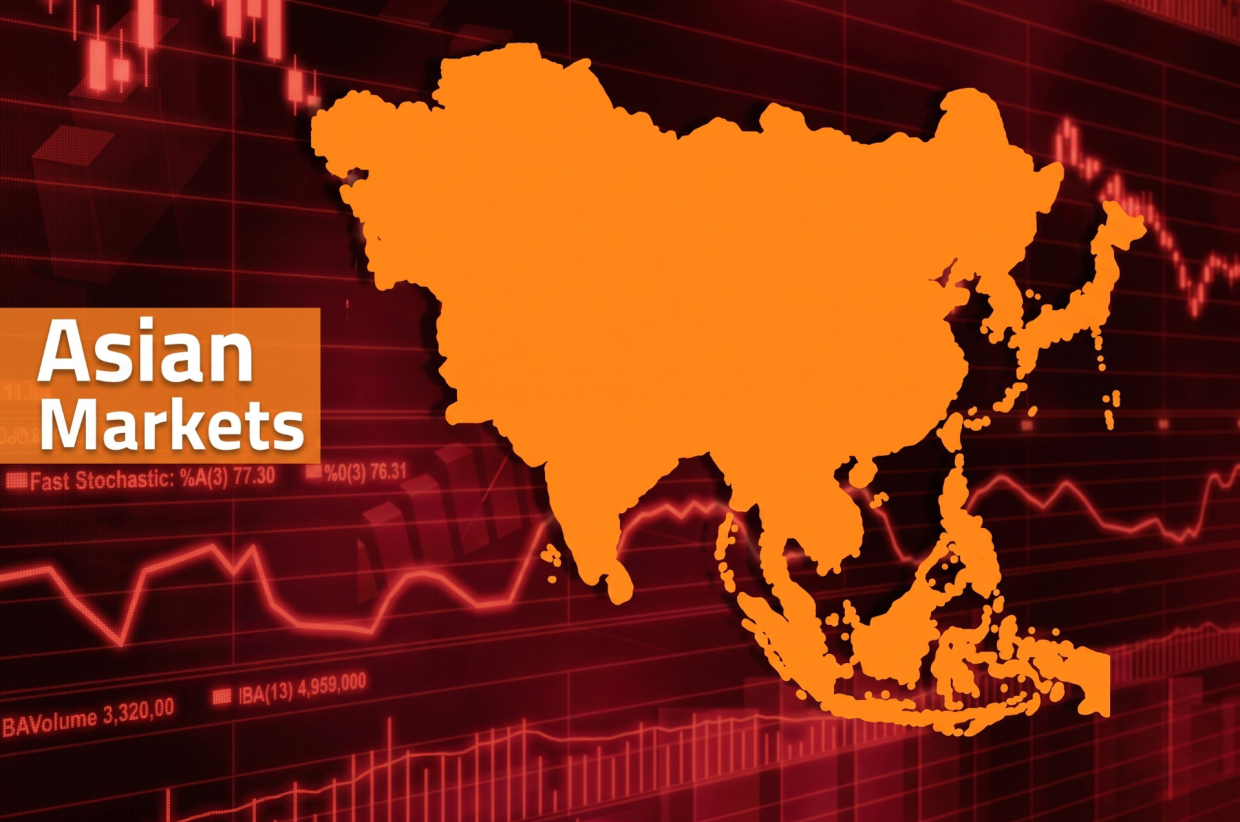
Finance Morning: Asia Stocks Slide, KOSPI Down 3.73%; China Leaves LPR Unchanged for 17th Month
Asia stocks fell on Oct 20: KOSPI dropped 3.73% to a six-month low, the Nikkei lost 1.30% and the Hang Seng 1.32%, while Shanghai rose 0.51%. China kept its LPR unchanged for a 17th month and will run daily overnight reverse repos from Oct 21 to Nov 2, capped at 1 trillion yuan a day. China Data Group launched in Xiong'an, MIIT is drafting a smart manufacturing policy, and Li Auto confirmed a UK entry in autumn 2027. HK set T+1 settlement for H2 2028.
Sources: The Star / Kyodo News / Sohu / Sina Finance / 21jingji / investingLive
📊 Asia Market Close
| Index | Close | Change | Change % |
|---|---|---|---|
| Shanghai Composite | 3735.37 | +19.09 | +0.51% |
| Shenzhen Component | 11801.29 | -1.21 | -0.01% |
| ChiNext | 2739.20 | -7.09 | -0.26% |
| Hang Seng | 23867.74 | -319.09 | -1.32% |
| Nikkei 225 | 64075.42 | -841.28 | -1.30% |
| KOSPI | 5552.74 | -215.27 | -3.73% |
| TAIEX | 46292.93 | -818.37 | -1.74% |
Asia-Pacific markets were broadly weaker on Tuesday, with Korea and Taiwan leading losses while the Shanghai Composite bucked the trend.
1. Asian shares slide as oil and geopolitics weigh on sentiment
Source: The Star
Asian stocks retreated broadly on Tuesday while oil rose, as geopolitical risks rattled sentiment ahead of key results from AI bellwether companies. The dollar held firm against the euro as riots in France fuelled demand for safe-haven assets.
Crude prices resumed their climb as markets weighed an executive order from US President Donald Trump that waived some sanctions and tariffs on Russian energy; Trump said on Saturday he has yet to announce a final decision. The MSCI Asia ex-Japan index fell 0.93%.
Attention now turns to earnings: Meta reports on Wednesday, with Tesla, Lam Research and Texas Instruments due later in the week. Goldman Sachs expects five AI hyperscalers to lift combined capital expenditure to about $1.2 trillion next year. Chris Weston, head of research at Pepperstone, wrote that the market is happy to cover shorts and unwind defensive trades, but that is very different from having the conviction to rebuild aggressive exposure to AI. Brent crude rose 0.21% to $109.78 a barrel, US WTI gained 0.15% to $103.82, and spot gold fell 0.51% to $4,118.71 an ounce.
2. KOSPI plunges 3.73% to a more than six-month low
Source: Sohu
South Korean stocks fell more than 3% on October 20 to their lowest level in over six months, as chip shares weakened on concerns tied to the global AI investment boom. After two straight sessions of gains, the KOSPI dropped 215.27 points, or 3.73%, to close at 5,552.74, its lowest close since April 7.
Lee Kyoung-min, an analyst at Daishin Securities, said: "The recent rebound has limited durability because concerns over credit and profitability surrounding AI investment have not been fully resolved."
3. Nikkei falls 1.30% as chip stocks retreat
Source: Kyodo News
Tokyo stocks extended losses on October 20, with the Nikkei index closing at 64,075.42, down 841.28 points, or 1.30%, from the previous session. Questions over the growth prospects of the AI market continued to hit semiconductor-related shares, while investors worried that high US crude futures prices would squeeze corporate profits.
The TOPIX fell 58.27 points to 4,009.21, down 1.43%, with 2.14872 billion shares traded. Worries about the profitability of AI-related businesses persisted after concerns emerged over the finances of CoreWeave, a US startup that provides high-performance data centres for AI developers. On the PRIME market, 76% of stocks declined.
Oil prices had reached a near one-month high a day earlier as tensions in the Middle East heightened concerns about crude supply. With some listed companies set to begin reporting interim results next week, many investors stayed on the sidelines.

4. China leaves LPR unchanged for a 17th month, plans daily overnight repos
Source: investingLive
China kept its benchmark lending rates on hold on Tuesday, leaving the one-year loan prime rate at 3.0% and the five-year rate at 3.5%, extending the hold to 17 months. The decision was widely expected after stronger-than-forecast third-quarter growth reduced pressure for easing. The LPR remains the benchmark for most loans and mortgages, though the seven-day reverse repo rate now serves as the central bank's main policy signal.
The bigger policy story came from China's money markets. The People's Bank of China said it will conduct daily overnight reverse repo operations from October 21 to November 2, capped at 1 trillion yuan a day, a day after Governor Pan Gongsheng said the central bank would study making the overnight rate its main policy rate. The rate attached to the operations has not yet been confirmed and will be closely watched for signs of whether a lower policy anchor is coming.
The PBOC also set its daily yuan reference rate at the strongest level since February 2, 2023, signalling comfort with a firmer yuan. MUFG said this week that improving Chinese activity offers a more supportive backdrop for the currency, though it cautioned that weak household demand and a deepening property slump could limit the gains.

5. China's industry ministry is drafting a new smart manufacturing policy
Source: Sina Finance
At a State Council Information Office press conference on the afternoon of October 20, Wang Weiming, chief engineer of the Ministry of Industry and Information Technology (MIIT), said the ministry is studying and drafting policies for a new generation of smart manufacturing, planning a batch of strategic, leading and breakthrough major engineering projects, and will study expanding pilot programmes to open up value-added telecom services.
Wang said the national conference on advanced manufacturing held in September set the new generation of smart manufacturing as the main direction. He said the key is deep integration of AI technology across the entire manufacturing chain, improving equipment and systems' ability to sense, decide and act autonomously. Specific directions include cultivating smart factories in tiers, and supporting companies in developing intelligent industrial machine tools, robots, inspection equipment and control equipment.
Xie Cun, MIIT spokesperson and head of its information and communications administration, said the ministry will stabilise investment by launching a broadband quality improvement programme, promoting gigabit upgrades and the rollout of 10-gigabit networks, and expanding computing facilities. It will also make forward-looking arrangements for 6G technology, push pilot cities for integrated 5G and industrial internet applications, and support qualified companies applying for commercial trials of satellite internet-of-things services.
6. China Data Group established in Xiong'an
Source: 21jingji
China Data Group Co., Ltd. was established in Xiong'an New Area, Hebei province, on October 20. The group is a central state-owned enterprise whose main business is the development and use of data resources, with its headquarters in Xiong'an, according to the company.
The group was set up to advance the development and use of data resources, unlock the value of data as a production factor, support AI development and grow the data industry ecosystem. It will work under the guidance of relevant authorities to strengthen central-local coordination and deepen industrial collaboration.
7. Hong Kong sets T+1 settlement timetable for the second half of 2028
Source: Sina Finance
Late on October 16, Hong Kong Exchanges and Clearing (HKEX) published its consultation conclusions on shortening the settlement cycle, announcing that it will implement T+1 settlement in the second half of 2028, subject to market readiness and regulatory approval. The move means the T+2 regime in place since 1992 will give way to a faster cycle.
The consultation received 109 non-duplicate responses from brokers, custodians, investment managers, industry associations, technology vendors and investors. HKEX chief executive Bonnie Chan said market participants unanimously recognised the strategic importance of moving to T+1 and that the shorter cycle would further enhance the attractiveness and global connectivity of the Hong Kong market.
Under the timetable, market participants will develop and prepare systems in the second half of 2027 and complete testing in the first half of 2028, with HKEX expecting them to be ready by September 2028. The new cycle will not apply to primary market cash trades such as IPOs and will not cover mainland securities traded via Stock Connect; Stock Connect will continue to follow Hong Kong's settlement arrangements and move to T+1 in step.
8. Li Auto confirms UK entry in autumn 2027
Source: Sina Finance
Li Auto confirmed at the Paris Motor Show that it will enter the UK market in autumn 2027 with a new model, according to auto media AutoCar on October 20. The company will launch its i6 battery-electric model in Europe, starting in Norway and the Netherlands in spring 2027.
Another model will follow in the UK, aimed at family buyers and offered with both battery-electric and range-extender powertrains. Nestor Wu, who heads Li Auto's international business, said: "Family users in different markets have different needs. This is an area we have focused on and succeeded in in China, and we believe the same strategy applies to the UK."
For European buyers, Li Auto adjusted details of the i6, fitting locally sourced air springs to improve dynamic handling, whereas Chinese consumers prefer a softer, more comfortable suspension setup.
9. Silver halves from its peak, with analysts unconvinced on a bottom
Source: 21jingji
Silver has become this year's biggest "grey rhino". Spot prices first surged 70% in a month to a peak of $121.647 an ounce, then entered a long correction, falling as low as $54.744 and now hovering around $56-57. That is roughly half the peak, and the year-to-date move has swung from a 70% gain to a 20% decline.
Mike McGlone, senior commodity strategist at Bloomberg Intelligence, expects silver to trade mostly between $50 and $84 an ounce over the next few years, with $50 the first key support. Stefan Gleason, chief executive of precious metals dealer Money Metals Exchange, noted that silver is more sensitive than gold to the macroeconomic cycle, and its persistent weakness may be an early signal of hidden macroeconomic risk.
Some banks see more upside ahead. Citi analysts said silver could rise to $75 an ounce in the near term and to about $90 in six to 12 months. High oil prices are part of the backdrop: global benchmark crude is up 70% this year amid Middle East conflict, and US diesel at the pump was last quoted at $6.30 a gallon, up 78% from the end of last year.
10. JPMorgan's Dimon says he is prepared for a 40% stock market plunge
Source: Sina Finance
JPMorgan Chase chief executive Jamie Dimon said on October 19 that the bank is prepared for extreme scenarios such as a 40% plunge in stock markets, while stressing that this is not a forecast of when a recession will hit.
Dimon said JPMorgan analyses various risks in depth to ensure it can withstand any path for interest rates and inflation, so that it can keep serving clients in bad times. He said the bank aims to be honest about uncertainty and to turn risk into an affordable cost using capital and liquidity.
More News
- Global Express | October 20, 2026 — Drone Strikes Across Sudan Kill More Than 160 in Days
- Tech Express | October 20, 2026 — DeepSeek Joins Huawei Chip Design, Eyes Ascend 950DT Pretraining by Year-End
- Sports Express | October 20, 2026 — Rays Rout Guardians 7-3 to Reach World Series
- Maple Express | October 20, 2026 — Alberta Referendum: 76.4% Choose to Stay in Canada
- Canada's inflation hits 3.1% as Bank of Canada faces a tough call on Oct. 28
Comments (0)
View More
 -29%
Command Bath Organizer — Damage-Free Mounting, No Drilling! $18.15 CAD (29% Off)
 -45%
Webber Naturals Lutein 20mg, 45 Softgels — Eye Support for Under 25 Cents a Day! $11.05 CAD (44% Off)
 -31%
Herschel Kaslo Tech Backpack — 100% Recycled, Slides Over a Carry-On Handle! $111.99 CAD (30% Off)
 -31%
Herschel Settlement Hip Pack 2L — Wear It on the Hip or Across the Chest! $34.99 CAD (30% Off)
Finance MorningFinance Morning: Asia Stocks Slide, KOSPI Down 3.73%; China Leaves LPR Unchanged for 17th Month
 Tech Express
 | October 20, 2026 — DeepSeek Joins Huawei Chip Design, Eyes Ascend 950DT Pretraining by Year-End
-29%Command Bath Organizer — Damage-Free Mounting, No Drilling! $18.15 CAD (29% Off)
Amazon
-45%Webber Naturals Lutein 20mg, 45 Softgels — Eye Support for Under 25 Cents a Day! $11.05 CAD (44% Off)
Amazon
-31%Herschel Kaslo Tech Backpack — 100% Recycled, Slides Over a Carry-On Handle! $111.99 CAD (30% Off)
Amazon
-31%Herschel Settlement Hip Pack 2L — Wear It on the Hip or Across the Chest! $34.99 CAD (30% Off)
Amazon
Finance MorningFinance Morning: Asia Stocks Slide, KOSPI Down 3.73%; China Leaves LPR Unchanged for 17th Month
Tech Express