Finance Evening | September 25, 2026 — Tesla Starts Semi Deliveries; U.S. and China Reach Trade-Talk Consensus
Sept 25 finance evening: Tesla begins Semi deliveries; Fed Chair Warsh's regime change takes shape at 127 days but balance-sheet cuts stall; the 10-year Treasury yield hit 5.208%, a 19-year high; U.S. consumer sentiment fell to 48.1, a record second-low; China and the U.S. reached consensus in their eighth trade talks; Novo and Lilly battle over GLP-1s; Meta's Muse tops 3.4M downloads; bitcoin ETFs turn positive; eurozone September PMI hits 53.1; Starbucks closes 250 stores.
📊 Today's North American Markets
| Index | Close | Change | % Change |
|---|---|---|---|
| S&P 500 | 7,743.41 | +39.28 | +0.51% |
| Nasdaq | 27,068.72 | +129.34 | +0.48% |
| Dow Jones | 51,828.62 | +478.64 | +0.93% |
| Toronto TSX | 35,800.89 | +94.43 | +0.26% |
| USD/CAD | 1.4141 | +0.0005 | +0.04% |
| WTI Crude | 92.44 | -2.17 | -2.29% |
| Gold | 4,320.50 | +22.50 | +0.52% |
🇺🇸 US Stocks
Tesla Begins Delivering Its Semi Electric Trucks
Source: Fox Business
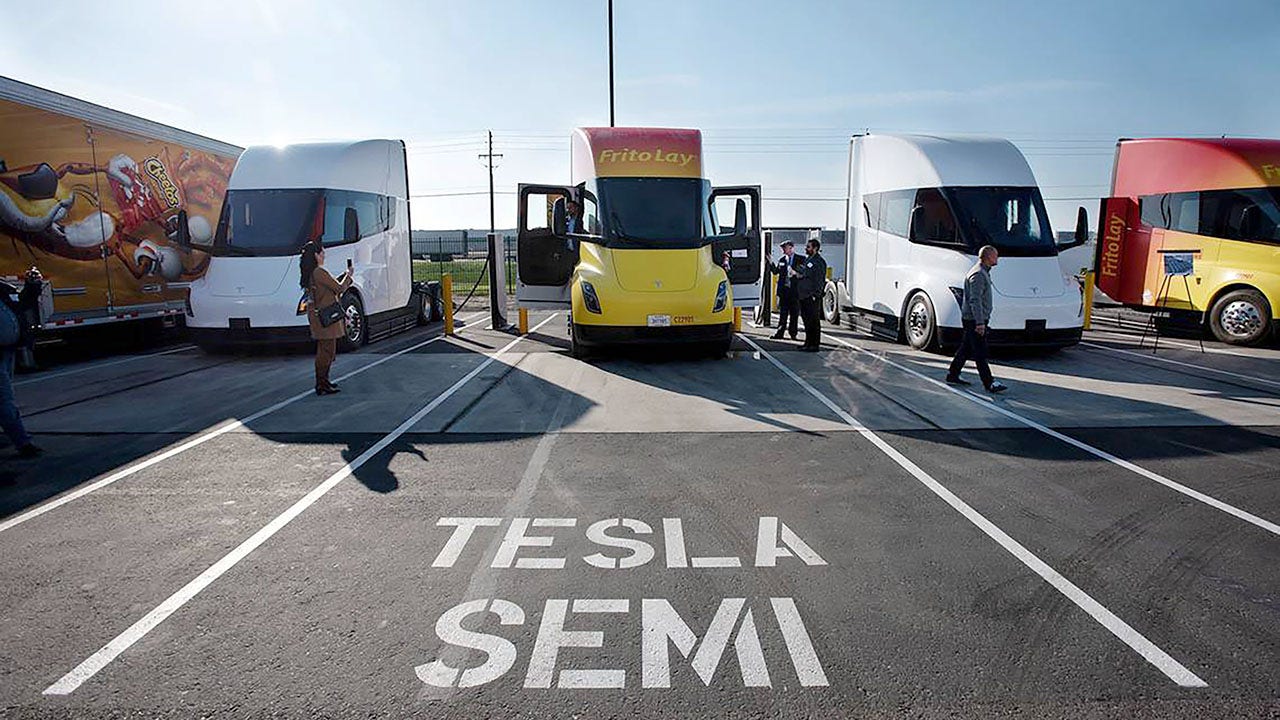
Tesla announced on Thursday that it has begun delivering its Semi trucks to customers this week, with the first customers taking delivery at the company's plant in Sparks, Nevada. It comes roughly nine years after CEO Elon Musk first unveiled plans to develop the long-haul freight truck. Tesla hopes the Semi will open a new market for a brand long known for electric sedans and SUVs by giving commercial freight haulers an electric option.
At a webcast event held late Thursday at the plant, Tesla did not disclose its production volume or pricing plans for the Semi, but reiterated plans to build 50,000 Semis a year at the Nevada facility. Musk did not attend, but said in a recorded video message: "I'd recommend placing more orders if you haven't already, but the waiting list is already pretty significant." Several companies that have purchased the Semi — including PepsiCo, DHL and U.S. Foods — attended and were invited on stage.
The long-range variant of the Semi offers 500 miles on a single charge; Dan Priestly, Tesla's director of Semi truck engineering, called those "500 real-world miles. Our customers have validated it." The standard version has a range of 325 miles. Tesla and Musk first unveiled the Semi in 2017 and planned to start production in 2019, but it faced supply-chain delays. The first Semis were delivered to U.S. customers including PepsiCo in late 2022, though those trucks came off lower-volume pilot lines; the first truck rolled off the high-volume line in April. According to the nonprofit Catalyst Mobility, Tesla has also received a new order for 2,500 Semis from a coalition of major cargo-owning shipping companies including Microsoft and PepsiCo — nearly double the existing fleet of electric Class 8 trucks. Swedish freight technology company Einride also announced a deal last week to add 500 Semis.
Novo Bets on Its Next Chapter as Eli Lilly Widens Its GLP-1 Lead
Source: CNBC
Danish drugmaker Novo Nordisk this week laid out an ambitious strategy to reignite growth beyond its top-selling Wegovy and Ozempic injections, which face patent expirations in key markets in the early 2030s. At its Capital Markets Day on Monday the company promised a pipeline of potential blockbuster products, including drugs that would diversify beyond its core obesity and diabetes area. But Wall Street isn't convinced: investors pummeled the stock, underwhelmed by growth targets that matched industry averages rather than outpacing them, and skeptical of the lack of clarity around a near-term turnaround plan.
Meanwhile rival Eli Lilly keeps chipping away at Novo's market share, including in the emerging obesity pill space. Novo hopes to keep its early lead in the oral weight-loss market after the successful launch of the Wegovy pill, months ahead of Lilly's rival pill Foundayo. Novo CEO Mike Doustdar told CNBC on Tuesday that early adoption suggests patients may have been waiting for an alternative to injections. Lilly CEO Dave Ricks said in a Monday CNBC interview that Foundayo is slowly gaining ground in the U.S., with one-third of new GLP-1 pill patients taking Lilly's drug and its share of the oral market growing "week by week."
Lilly is also claiming an early lead in the newly established Medicare market for obesity drugs after the federal program began covering those treatments in July. Ricks said 700,000 seniors have started GLP-1s under Medicare and 70% of them are on Lilly's drugs. Lilly said in August it held about a 61% share of the U.S. GLP-1 space in the second quarter, versus roughly 39% for Novo.

Meta's Muse AI App Surges as the Company Puts Its Muscle Behind It
Source: TechCrunch
Meta's AI app Muse is surging, fueled by the company's promotion of the app at its annual Meta Connect developer conference this week and strong early reviews praising its polished design and capable underlying AI model. Sensor Tower estimates Muse had surpassed 2.5 million downloads since its September 8 launch at the start of the week; it has now amassed more than 3.4 million. The install figures are only current as of Thursday estimates, which can lag real-world adoption, so they don't yet capture the full impact of the Meta Connect push.
At the event Meta announced a range of upcoming features for the app, including video chat with the Muse avatar, support for computer use on the Mac, a dedicated email address, more partners and connectors, and plans for smart glasses integrations. Other intelligence firms show similarly strong traction with wide variation: Apptopia puts total downloads at 4.3 million, including 2.6 million on iOS, while Appfigures sees roughly 2.3 million as of Thursday, almost evenly split between iOS and Android.
Sensor Tower also found daily active users climbed 27% on Wednesday after Meta Connect wrapped. Muse was already off to a strong start before the conference, reaching an estimated 2.8 million downloads in its first two weeks and averaging 55% day-over-day download growth from September 8 to 17, versus 24% for ChatGPT in its first 10 days. Muse climbed to the top of the U.S. App Store on September 18 and has stayed there, and topped the Google Play Store on September 19. Muse is currently available only in the U.S. and Canada.

🌎 Canada / North American Economy
US Consumer Sentiment Falls to Its Second-Lowest Level on Record
Source: CNN
U.S. consumer sentiment fell to its second-lowest level on record in September as high gas prices further soured Americans' views of the economy. The University of Michigan's consumer sentiment index dipped to 48.1, a 7% decline from August and a nearly 13% drop from a year ago, according to data released Friday.
The survey dates back to 1952, meaning Americans are feeling worse now than during wars, the 1970s oil crisis, 9/11, the Great Recession, the Covid-19 pandemic and the inflation surge afterward. The four lowest-ever readings all occurred within the past six months, with the record set in May. The final September reading did mark a slight improvement from preliminary readings.
"The overall interviews reveal broad agreement across the political spectrum that the outlook for the economy has weakened since the beginning of the year," said Joanne Hsu, director of the university's Surveys of Consumers. She noted Republican sentiment is now 20% lower than January 2026, with Democrats down 13% over the same period. Gus Faucher, chief economist at The PNC Financial Services Group, told CNN the biggest factor is higher gasoline and diesel prices that people see every day at the pump. The survey also showed year-ahead inflation expectations shot up to 4.6% from 4% in August — the highest since June — versus 3.4% before the Middle East conflict. Long-run expectations moved up to 3.4%. The Federal Reserve hiked rates earlier this month for the first time in three years.

🏦 Macro & Central Banks
127 Days In, Warsh's Regime Change at the Fed Takes Shape — and Meets Resistance
Source: CNBC
Federal Reserve Chairman Kevin Warsh likes to measure his tenure in days, and 127 days in, his promise of regime change is taking shape. He is moving fast on some easy and very visible items directly in his control, but is constrained from making bigger changes by the state of the economy and by his colleagues on the Fed.
Warsh has quickly put his stamp on how the Fed communicates. Some changes look cosmetic — shortening the news conference after rate-setting meetings, and seating reporters alphabetically by news organization — but they hide a more profound shift: the way he thinks about and communicates monetary policy marks a sharp break from his predecessors. He has not yet been able to act on one key priority, cutting the Fed's balance sheet (now $6.7 trillion), in part because inflation is more pressing. He has also constrained himself on other priorities by appointing five task forces to examine Fed practices, due to report back early next year.
Last week's unanimous quarter-point rate increase — the first since 2023 — will likely be the highlight of Warsh's early tenure and answered critics' concerns about his independence from President Donald Trump. Warsh seems likely to support additional hikes if inflation stays a problem. Markets are sending a strong signal: the 2-year Treasury yield traded nearly a full percentage point above the effective federal funds rate on Wednesday, the largest spread since 2023, while the Fed's preferred PCE inflation gauge ran at 3.7% in July and has been above the central bank's 2% target for more than 5½ years. Markets now put the probability of an October hike at 70%.

10-Year Treasury Yield Hits 19-Year High — and Some Investors See a Buying Opportunity
Source: CNBC
It often doesn't feel like good news when a U.S. economic indicator matches a level last seen in 2007. But 10-year Treasury notes offering the highest yield since that year could be good news for investors looking to buy bonds. Elevated inflation — especially higher oil prices — combined with expectations that the Fed will hike at least once more this year helped drive the 10-year yield to 5.208% on Thursday, the highest since June 2007, before the global financial crisis. Yields remained elevated on Friday.
Higher long-term bond yields are often seen as a headwind for stocks because they correlate with higher borrowing costs for consumers and companies, which can slow the economy and hurt those seeking mortgages or other loans. "As the 10-year yield goes up, borrowing costs for mortgages also go up almost in lockstep with it," said Dominic J. Pappalardo, chief multi-asset strategist at Morningstar Wealth, adding that auto loans and "really, kind of any consumer financing or borrowing rates are pretty closely linked to the 10-year Treasury yield."
On the flip side, rising yields present an opportunity for bond investors. "Higher interest rates benefit savers and investors just as much as they're harming spenders," said Steve Laipply, global co-head of iShares Fixed Income ETFs for BlackRock, who said longer-term bonds in particular let investors lock in attractive levels — what he calls a "generational income opportunity." Professionals nonetheless caution against making major money moves based on short-term market conditions.

China, US Reach Multiple Consensus Points in Eighth Round of Trade Talks
Source: East Money
Chinese Commerce Ministry spokesperson He Yadong responded to questions about the eighth round of China-U.S. trade talks held in New York. He said the two teams recently held the round, and guided by the important consensus of the two heads of state and the principles of mutual respect, peaceful coexistence and win-win cooperation, held candid, in-depth and constructive exchanges on issues of common concern — including implementing existing consensus, reciprocal tariff arrangements, establishing a trade council and an investment council, and extending the joint arrangement from the Kuala Lumpur talks — reaching multiple consensus points.
He said Vice Premier He Lifeng and Treasury Secretary Bessent, as the lead figures for each side, held their first dialogue on artificial intelligence under the China-U.S. trade consultation mechanism. Going forward, China will maintain close communication with the U.S. on follow-up work under that mechanism.
The same evening bulletin also noted that, effective 24:00 on September 24, China's gasoline and diesel (standard products) prices were raised by 395 yuan and 385 yuan per tonne, respectively. Based on the current pricing mechanism, the prices should have risen by 830 yuan and 800 yuan per tonne; to cushion the impact of rising international oil prices, the state continued its adjustment measures, so the actual increases were 395 yuan and 385 yuan.
Eurozone September PMI Rises to 53.1, Highest Since April 2023
Source: Sina Finance
A new S&P Global survey shows eurozone private-sector business activity picked up markedly in September, with the composite PMI rising to 53.1 from 52.0 in August, the highest since April 2023. Services and manufacturing expanded together, and new orders grew faster, showing the eurozone economy remains resilient despite rising energy prices and intensifying geopolitical risk. The survey also showed input costs and output prices both rose at a clearly faster pace.
By component, the September composite PMI was above the 50 mark for a third straight month. The services PMI rose to 53.0 from 51.6, a 10-month high, while the manufacturing output index rose to 53.4 from 53.3, a 55-month high, with the manufacturing PMI holding at 52.7. Among major economies, Germany expanded for a third straight month at its fastest pace in nearly a year, while France ended 10 straight months of contraction and returned to growth. New orders rose for a third month at the fastest pace since May 2022.
Several institutions say the eurozone now shows strengthening growth momentum alongside rekindled inflation pressure. Chris Williamson, chief business economist at S&P Global Market Intelligence, said the economy has shown resilience, while Carsten Brzeski, global head of macro at ING, cautioned against judging a full improvement from strong PMI alone. MUFG expects the ECB to raise its deposit rate to 3.00% from 2.50%. Since the start of September, international oil and gas prices have surged, with Brent crude briefly topping $130 a barrel, up more than 35% from the start of the month.
🛢️ Commodities & FX
Bitcoin ETFs Have Erased a $5.8 Billion Hole
Source: CoinDesk
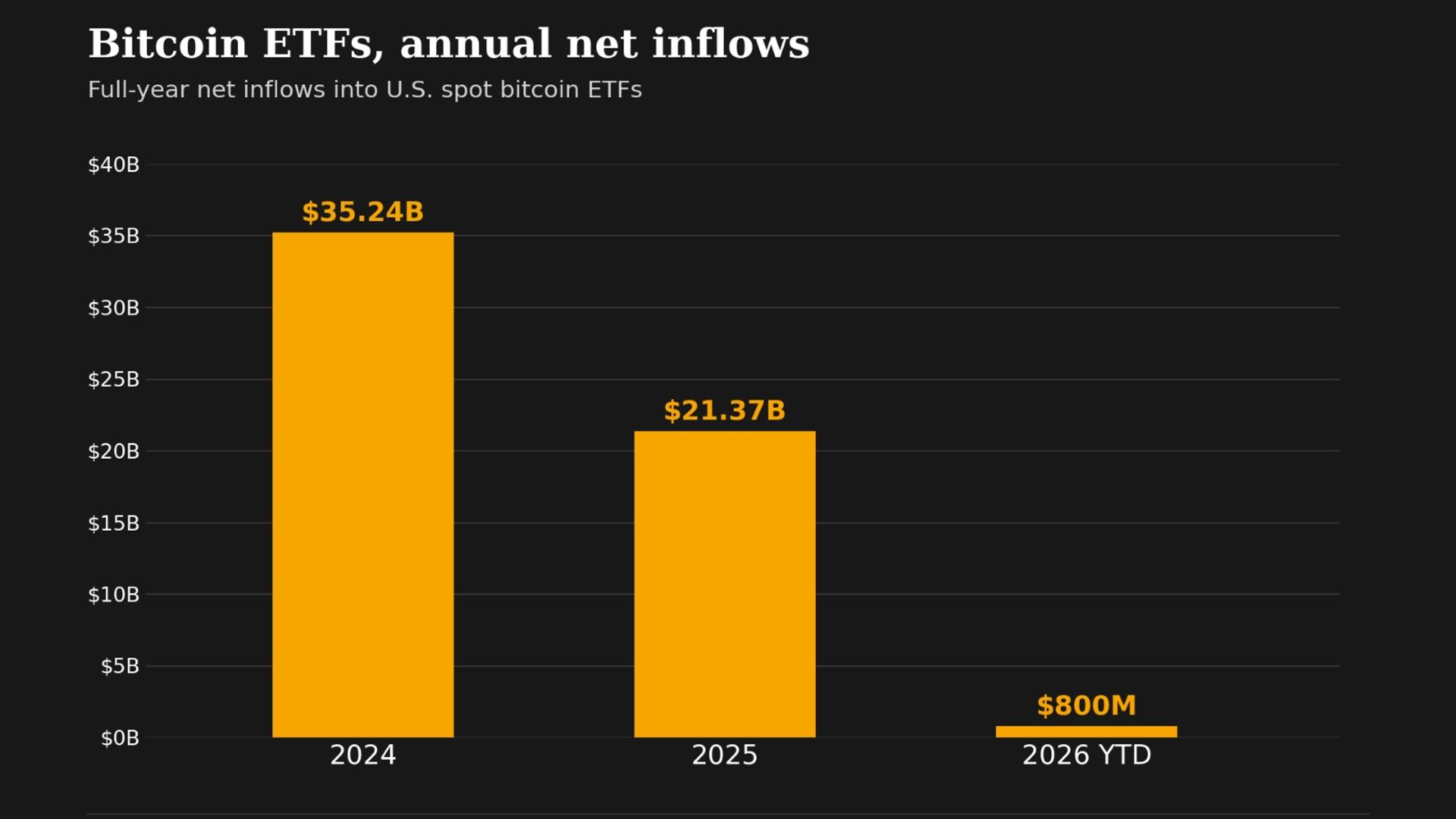
Bitcoin investors have done it. They have poured billions into U.S.-listed spot bitcoin ETFs in recent weeks, and those ETFs now sit on nearly $800 million in net inflows for the year, according to data source SoSoValue — a 180-degree turn from the red ink earlier this year.
How bad did it get? On July 13, the same ETFs were down $5.8 billion for the year, the low point, according to data analyzed by CoinDesk. The turnaround lines up with bitcoin's price recovery to $85,000 from under $58,000 in early June. That rise, combined with the ETF inflows, has convinced some analysts a new bull run is already underway.
Nearly $4 billion of the inflows have come since U.S. Treasury Secretary Scott Bessent's August announcement of increased bond purchases, a liquidity-management tool rolled out as bond yields surged to multi-year highs. Still, there is work to do for the bulls: at $800 million, the yearly net inflows are far smaller than the $35.2 billion in 2024 and $21.4 billion in 2025. The ETFs have pulled in money for six straight days, even as bitcoin's rally stalled above $85,000 since Tuesday. In six days they attracted $2.84 billion — impressive, but less than the only two other six-day streaks on record: February 22–29, 2024 ($2.35 billion) and November 6–13, 2024 ($4.73 billion).
💰 Personal Finance & Consumer
Starbucks to Close 250 North American Stores, Six in the Sacramento Area
Source: Abridged by PBS KVIE
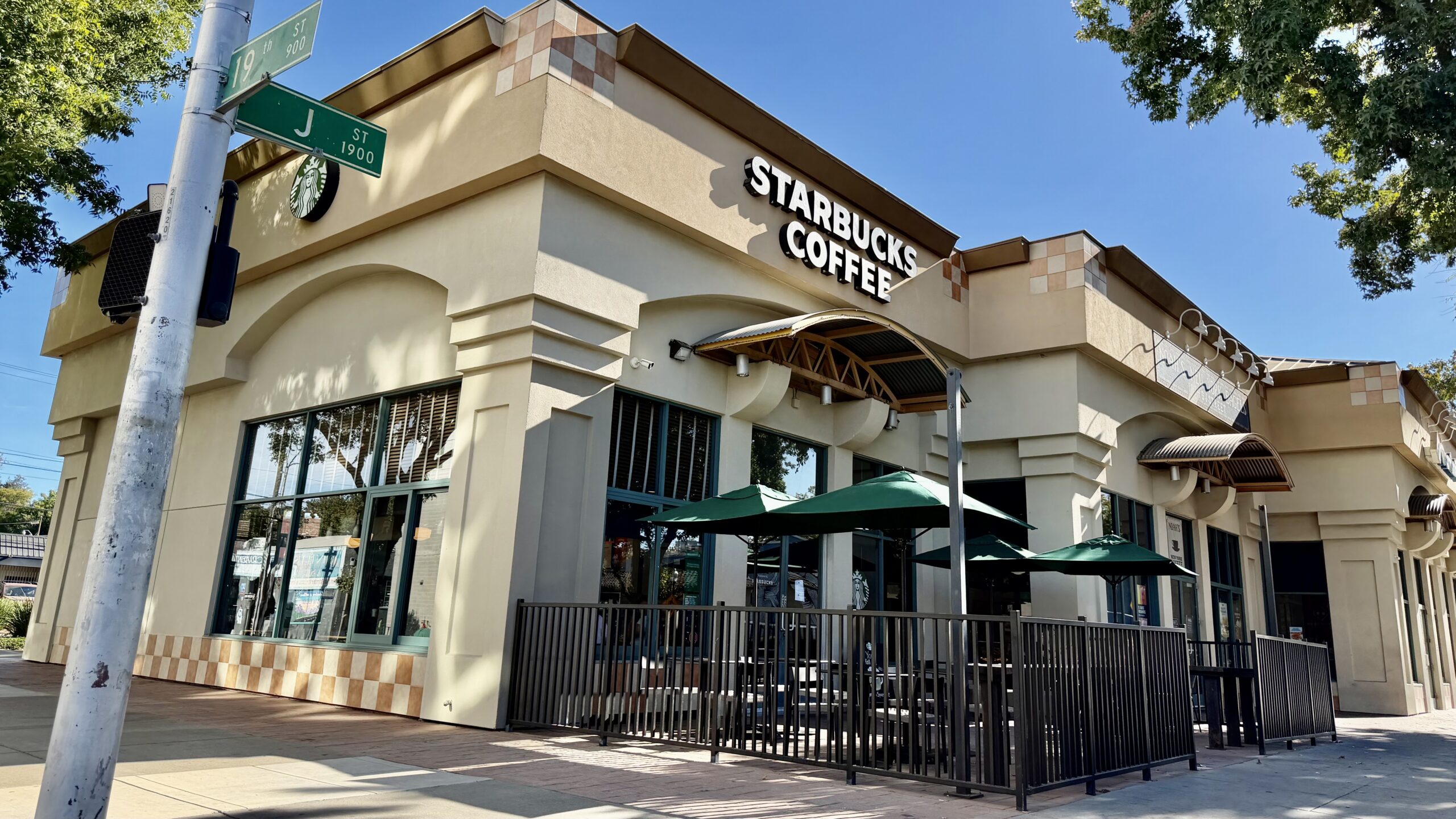
Starbucks is closing six coffee shops across the Sacramento region, part of a nationwide culling of 250 stores. The 250 stores mark just over 1% of Starbucks' 18,000 across North America, and some — such as the midtown Sacramento location — had been around for decades. Affected stores include Midtown Sacramento (1901 J St.), Arden Arcade (2648 Watt Ave.), North Natomas (3511 Truxel Road), South Sacramento (8240 Calvine Road and 8341 Elk Grove Florin Road) and Roseville (10441 Fairway Drive); some will close as soon as Saturday.
"Wait, what? This place is always busy. And they just found out yesterday? I'm very disappointed," customer Taylor Rath said Friday. "I don't think they should do this at all." Employees were informed Thursday; some will be transferred to other Starbucks cafés but won't know until Saturday. Baristas at the midtown location were told they'd receive 60 hours pay as part of a severance package if not transferred.
It's the second mass closing in two years, after Brian Niccol was named CEO in 2024. Roughly a year ago Starbucks closed 627 coffee shops nationwide, including eight in the Sacramento area, and laid off roughly 900 non-retail employees. The company has been trying to draw customers back with its "Back to Starbucks" plan, redesigning more than 1,000 coffeehouses since late 2025 while also continuing to open new locations. More than 700 Starbucks stores have unionized, and they have yet to reach a master contract with the corporation.
More News
- Maple Express | September 25, 2026 Nine Islamic Schools on High Alert After Threatening Emails
- Maple Express | September 25, 2026 Toronto homicide unit to give update on bodies found in burning vehicles
- Global Express | September 25, 2026 — Danish Intelligence Warns Russia Could Strike a NATO Country Within Months
- Finance Morning: PBOC Maps Next Monetary Policy Steps; Hong Kong Tech Stocks Slide
- Tech Express | September 25, 2026 — Google's Gemini 3.8 Live Debuts a Real-Time 'Live Avatar'
Comments (0)
View More
 -41%
-41%Acer 27" 1080p IPS Monitor SB273Y — 120Hz Refresh Rate with a Frameless Bezel! $119.99 CAD (40% Off)
 -63%
-63%Purina Tidy Cats Breeze Multi-Cat Pads (8 Pack) — One Pad a Week, Even With Two Cats! $25.24 CAD (63% Off)
 -51%
-51%Brother MFC-J1260W Wireless Colour Inkjet All-in-One — Print, Copy & Scan at Half Price! $69.99 CAD (50% Off)
 -36%
-36%Boon Griffle Baby Bath Mat — Soft Suction Grip & Hang-to-Dry Hook! $38.16 CAD (36% Off)
 Tech Express
Tech Express | September 25, 2026 — Google's Gemini 3.8 Live Debuts a Real-Time 'Live Avatar'
 Maple Express
Maple Express | September 25, 2026: Two rushed to trauma centre after King West assault in Toronto
-41%Acer 27" 1080p IPS Monitor SB273Y — 120Hz Refresh Rate with a Frameless Bezel! $119.99 CAD (40% Off)
Best Buy
-63%Purina Tidy Cats Breeze Multi-Cat Pads (8 Pack) — One Pad a Week, Even With Two Cats! $25.24 CAD (63% Off)
Amazon
-51%Brother MFC-J1260W Wireless Colour Inkjet All-in-One — Print, Copy & Scan at Half Price! $69.99 CAD (50% Off)
Amazon
-36%Boon Griffle Baby Bath Mat — Soft Suction Grip & Hang-to-Dry Hook! $38.16 CAD (36% Off)
Amazon
Tech ExpressTech Express | September 25, 2026 — Google's Gemini 3.8 Live Debuts a Real-Time 'Live Avatar'
Maple Express