Finance Morning: Chinese Assets Rally, Hang Seng Tech Jumps 5.55%, Korea Halts Trading Twice
Nov 5: Asia split after the US midterms. Chinese assets rose - Shanghai Composite +0.10% at 3,689.91, Shenzhen Component +1.19%, Hang Seng +3.67%, Hang Seng Tech +5.55% (biggest one-day gain this year). Japan, Korea and Taiwan fell on AI/chip weakness: Nikkei -1.79%, KOSPI -5.28% with both Korean markets halted, TAIEX -3.2%. Gold jewellery topped 1,200 yuan per gram, VW recalled over 580,000 cars in China, PBOC buyback relending applications exceeded 200 billion yuan, oil fell over 8%.
Sources: Sina Finance, 21st Century Business Herald, Southern Finance, The Paper, Kyodo News, JRJ, CNA
📊 Asian Markets Today
| Index | Close | Change | % Change |
|---|---|---|---|
| Shanghai Composite | 3,689.91 | +3.74 | +0.10% |
| Shenzhen Component | 11,471.09 | +135.40 | +1.19% |
| ChiNext | 2,566.80 | +22.07 | +0.87% |
| Hang Seng | 24,796.98 | +877.48 | +3.67% |
| Nikkei 225 | 61,077.90 | -1,110.73 | -1.79% |
| KOSPI | 5,383.80 | -300.00 | -5.28% |
| TAIEX | 41,574.72 | -1,374.19 | -3.20% |
Asia split sharply today: mainland China and Hong Kong advanced, while Japan, Korea and Taiwan fell as AI and semiconductor shares came under pressure.
1. A-shares extend gains as Chinese assets rally
Source: Sina Finance
A-shares extended their advance on November 5. Semiconductors opened lower but surged, photovoltaic names climbed, and precious metals, motorcycles, internet, aviation, petrochemicals and construction machinery rose. Communication equipment pared losses, while oil and gas, coal, energy equipment and shipping declined.
Fund managers offered their read on the outlook. Guotai Fund said marginal changes favorable to the ChiNext index are appearing at the macro, valuation and regulatory levels, and that rebound conditions are building, with attention on the Fed's December stance and its 2027 policy path. China Merchants Fund said technology valuations look attractive after the earlier slump, the oscillating recovery is likely to continue, and growth-style tech has the better elasticity. Caitong Fund said risk appetite is recovering as selling pressure is digested and liquidity improves, but the shift from "policy bottom" to "market bottom" still needs confirmation from turnover and sustained inflows.
Chinese assets rose broadly. The Hang Seng Index opened up 1.66% and the Hang Seng Tech Index up 1.43%, with Xiaomi, Li Auto, Trip.com, Meituan, Tencent, NetEase, Alibaba and Baidu all higher. On November 4 in the US, the Dow rose 3.03% to 53,356.12, the Nasdaq gained 1.44% to 25,736.51 and the S&P 500 added 1.58% to 7,688.62. The Nasdaq Golden Dragon China Index climbed 3.49%, with Autohome up more than 12%, Hesai over 8%, Kingsoft Cloud over 6% and Alibaba 5%.
2. Gold jewellery prices in China top 1,200 yuan per gram
Source: 21st Century Business Herald
On November 5, price comparisons showed several major gold jewellery brands raised their domestic pure-gold retail prices from the previous day, all above 1,200 yuan per gram.
Bullion has been highly volatile. In early November spot gold broke down, touching a low of $3,874 an ounce, before rebounding quickly. On November 5 spot gold briefly approached $4,150 an ounce, up more than $80 intraday, before paring gains to 1.46% at $4,119.12 as of 14:08 Beijing time.

3. Volkswagen recalls more than 580,000 cars in China as Europe cuts jobs
Source: Southern Finance
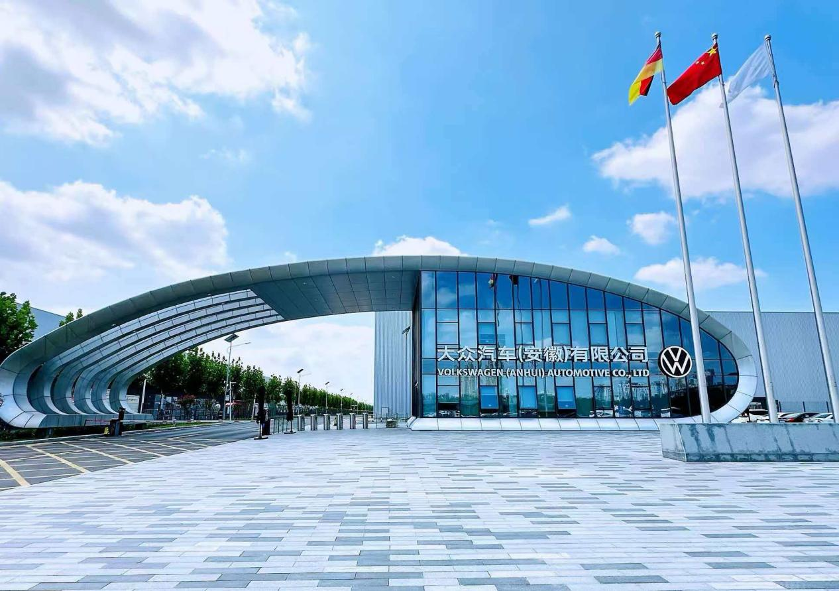
On November 4, Volkswagen (China), SAIC Volkswagen and FAW-Volkswagen filed recall plans with the State Administration for Market Regulation covering imported Golf and Tiguan, plus domestically built Teramont, Teramont X, Viloran, Audi Q6, Talagon and Audi Q3 models — more than 580,000 vehicles in total.
The recall is due to bolts fixing the subframe and the right side of the steering gear, which may corrode and break after prolonged exposure to moisture and road de-icing salt, limiting steering function. Volkswagen will replace the bolts free of charge. FAW-Volkswagen's Audi Q3 alone accounts for 388,258 units built between June 2018 and September 2025; SAIC Volkswagen's Teramont adds 116,864, Audi Q6 20,369, FAW-Volkswagen's Talagon 29,264, and imported Golf and Tiguan 22,036.
The same day's results showed Volkswagen Group revenue of about 233.4 billion euros in the first nine months, with operating profit of just 71 million euros and a net loss after tax of 2.72 billion euros. Third-quarter global deliveries fell 14.3% year on year, with China down nearly 40%. Results included about 8 billion euros of impairments and restructuring costs; excluding them, the operating margin was 3.8%. CFO Arno Antlitz said a 3.8% margin is not enough in the long run. Volkswagen plans to cut 120,000 jobs by 2030, with restructuring costs of about 31 billion euros. Supplier Schaeffler said the same day it will cut 3,460 jobs in Europe, 2,660 of them in Germany, and close five plants.
4. Hang Seng Tech jumps 5.55%, its biggest one-day gain this year
Source: The Paper
Hong Kong's three main indices opened higher and kept climbing on November 5. The Hang Seng Index rose 3.67% to 24,796.98, the Hang Seng Tech Index surged 5.55% to 4,154.29 for its largest single-day gain this year, and the Hang Seng China Enterprises Index added 3.87% to 8,369.08.
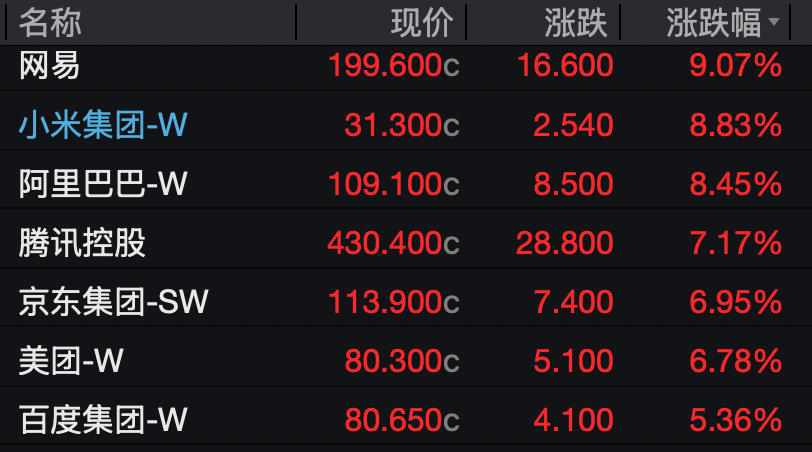
Tech led. NetEase rose 9.1%, Xiaomi 8.83%, Alibaba 8.45%, Tencent 7.17%, JD.com 6.95%, Meituan 6.78% and Baidu 5.36%. Drugmakers extended gains: Tianchen Biotech rose 10.26%, Sino Biopharmaceutical 9.22%, BeiGene 7.34% and Akeso 6.48%. Sino Biopharmaceutical said after the November 4 close that it had signed an out-licensing deal with Boehringer Ingelheim for next-generation oncology therapies covering six preclinical programs.
Divergence was stark. AI hardware fell against the trend, with Montage down 6.63% and GigaDevice 5.06%; optical communications and PCB names also slipped, including YOFC down 12.48% and Kingboard Laminates down 12.43%. Gold miners gained: Laopu Gold rose 8.32%, Zhaojin Mining 5.85% and Zijin Gold International 4.87%, all hitting two-week highs, as spot gold broke through both $4,000 and $4,100 an ounce, up about 7% from its recent low.
5. Nikkei falls 1.79%, diverging from Wall Street
Source: Kyodo News
Tokyo's Nikkei stock index fell sharply again on November 5, losing 1,110.73 points to close at 61,077.90, slipping below the 62,000 mark for the first time in about three months, a drop of 1.79%.
After Democrats won back both chambers of Congress in the US midterms, investors grew more wary that AI development will face regulation, and semiconductors led the decline. AI names such as SoftBank Group were sold, while chip stocks including Kioxia and Advantest fell sharply. Overnight the Dow had jumped 1,569.40 points to 53,356.12, leaving Japanese and US shares moving in opposite directions.
Still, expectations that lower crude prices will ease inflation supported domestic-demand shares, with more than 70% of Prime Market issues rising, and the Nikkei was up more than 400 points early in the session. The TOPIX gained 45.01 points to 3,940.39, up 1.16%, with 3.95805 billion shares traded.
6. Korea's KOSPI falls 5.28% as both markets trigger circuit breakers
Source: JRJ
Worries that the US midterm result will tighten regulation of AI data centres hammered Korean stocks on November 5, with both the KOSPI and KOSDAQ triggering market stabilisation mechanisms the same day as semiconductor and AI infrastructure shares slumped.
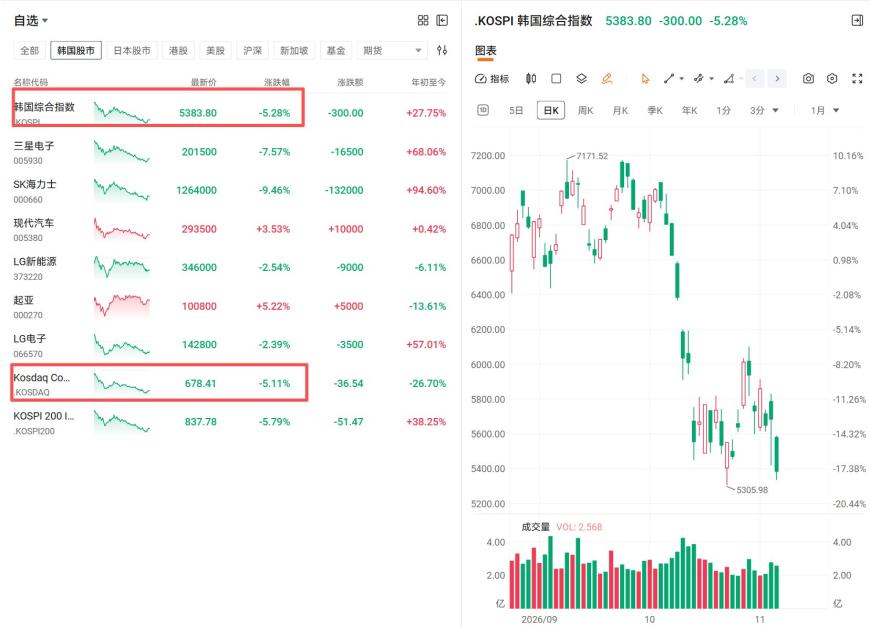
The KOSPI closed down 5.28% at 5,383.8 and the KOSDAQ fell 5.11%. SK Hynix dropped 9.46% and Samsung Electronics 7.57%.
The market fears that a big Democratic win could tighten approvals for data centres, grid connections and power costs, delaying some AI data-centre projects, weighing on hyperscalers' capex plans and pushing down demand expectations for HBM and DRAM. Some analysts said construction delays could postpone cloud revenue recognition for big tech and increase financing pressure on highly leveraged AI infrastructure firms. Others argued that even with Congress, Democrats can hardly reverse the overall direction of US AI investment, so the real impact may be limited.
7. Taiwan stocks plunge 1,374 points, losing the 42,000 level
Source: CNA
Taiwan stocks opened lower and slid on November 5, with the index touching 41,513.57 intraday, down 1,435.34 points, before closing 1,374.19 points lower at 41,574.72, a decline of 3.2%. The index lost the 42,000 mark and hit its lowest since July 31, with turnover of NT$926.024 billion.
TSMC came under heavier selling late in the session and closed at NT$2,240, down NT$20. MediaTek fell NT$255 to NT$3,460, Delta Electronics dropped 7.38% to NT$1,130, and Hon Hai slipped NT$5 to NT$235. Only finance, textiles, cement and rubber were relatively resilient.
The fall came as investors worried that US AI data-centre build-outs could be affected, after the Philadelphia Semiconductor Index tumbled.
8. Democrats retake Congress; markets fall first, then rebound
Source: China.com
US Democrats won back control of both the House and Senate in the midterms, also taking Republican strongholds including Texas, South Carolina and Kansas — a result that surprised most institutions.
The impact cuts both ways. On one hand, Trump's tax cuts and large fiscal expansion may be blocked, which is positive for Treasuries as federal borrowing pressure eases. On the other, divided government also limits Democrats' room for more aggressive policies, producing gridlock. Markets panicked at first: US equity futures fell, S&P 500 futures dropped nearly 1% and Nasdaq futures more than 2%, while Korea's KOSPI fell as much as 4%. Investors soon recognised that Trump still holds the presidential veto, and sentiment recovered.
In bonds, five-year Treasury yields fell 9 basis points and the 10-year 7 basis points, cooling the curve across maturities. Experts cautioned that gridlock does not necessarily mean fiscal contraction, since Trump still has negotiating leverage on defence spending and healthcare policy, leaving the fiscal outlook uncertain.
9. Applications for buyback and shareholder-purchase relending top 200 billion yuan
Source: Sina Finance
The People's Bank of China said on November 4 that banks had submitted applications for more than 200 billion yuan of relending quotas for share buybacks and major-shareholder purchases, following a November 2 symposium. The central bank also cut the relending rate by 0.25 percentage point to 1%, effective November 4.
The facility covers 21 national banks and five systemically important city commercial banks, with a 100% support ratio and a one-year term that can be extended as needed. Banks may add a modest spread on the relending rate and are encouraged to speed up lending. Regulators asked institutions to stick to market-based pricing, referencing AAA-rated corporate bond yields of roughly 1.5% to 1.7%.
At the November 2 symposium, the PBOC, the financial regulator and the securities regulator urged banks to fully use the combined 800 billion yuan quota of the two capital-market support tools, and proposed turning the relending programme from a temporary arrangement into a long-term institutional one. The facility was created in October 2024. In April 2025, new buyback and shareholder-purchase loans reached nearly 32 billion yuan, and in July 2026 more than 26 billion yuan, both period highs.
10. Oil slumps more than 8%; Indonesia to keep tight coal and nickel quotas
Source: JRJ
Traders bet that a big Democratic win will bring the Iran war to an earlier end, and crude sank overnight: January Brent fell 8.67% to $94.62 a barrel and December WTI dropped 8.29% to $88.12.
Earlier, House Democratic Leader Hakeem Jeffries said he would push legislation to end the Republican administration's tariffs and the Iran war. The US president said the election loss was largely caused by the conflict with Iran, but that he would make the same decision again.
In commodities, Indonesia is expected to keep tight control of work plans and budgets (RKAB) production quotas for coal, nickel and other major minerals to avoid oversupply and prevent international prices from falling. The energy minister said nickel prices are falling because of oversupply. Government data show nickel output has reached 113% of this year's target, while downstream nickel-iron processing and absorption is only 66% complete.
Compiled from public media reports. Not investment advice.
More News
- Global Express | November 5, 2026: Hong Kong Activist Joshua Wong Sentenced to 10 Years
- Tech Express | November 5, 2026: Switch 2 Sales Plunge 41% as Memory Costs Bite
- Sports Express | November 5, 2026: Cristiano Ronaldo retires from international football
- Maple Express | November 5, 2026 — Canadian astronaut heads outside ISS again to finish solar array work
- Democrats Sweep Congress: Dow Soars 1,569 Points, TSX Jumps 809
Comments (0)
View More
 -48%
Brother MFC-J1410DW Colour Inkjet All-in-One — Auto Duplex & Cloud Touchscreen, $119.99 CAD (48% Off)
 -17%
Bentgo Kids Prints Lunch Box (Fairies) — 5 Leak-Proof Compartments, 60K+ Reviews! $34.99 CAD (17% Off)
 -38%
Oral-B Pro Limited Rechargeable Toothbrush (Pink) — Real Oral-B Motor, No App Gimmicks! $74.99 CAD (38% Off)
 -38%
🎉 史新低!AstroAI 27" 2-in-1 Snow Brush & Ice Scraper — #1 in Snow Brushes! $17.99 CAD (38% Off)
 Sports Express
 | November 5, 2026: Cristiano Ronaldo retires from international football
 Finance Evening
Democrats Sweep Congress: Dow Soars 1,569 Points, TSX Jumps 809
-48%Brother MFC-J1410DW Colour Inkjet All-in-One — Auto Duplex & Cloud Touchscreen, $119.99 CAD (48% Off)
Amazon
-17%Bentgo Kids Prints Lunch Box (Fairies) — 5 Leak-Proof Compartments, 60K+ Reviews! $34.99 CAD (17% Off)
Amazon
-38%Oral-B Pro Limited Rechargeable Toothbrush (Pink) — Real Oral-B Motor, No App Gimmicks! $74.99 CAD (38% Off)
Amazon
-38%🎉 史新低!AstroAI 27" 2-in-1 Snow Brush & Ice Scraper — #1 in Snow Brushes! $17.99 CAD (38% Off)
Amazon
Sports ExpressSports Express | November 5, 2026: Cristiano Ronaldo retires from international football
Finance Evening