
Canada's inflation hits 3.1% as Bank of Canada faces a tough call on Oct. 28
Canada's September CPI rose to 3.1% year over year, with gasoline up 27.8% and prices excluding fuel up 2.2%. The BoC's business survey showed collapsed trade talks weighing on sentiment and one-year inflation expectations at 3.7%, leaving the Oct. 28 rate decision a close call. AI stocks lifted the Nasdaq 1.11% and chip names added nearly $250 billion; Morgan Stanley raised its Amazon target to $350. China's Q3 GDP grew 4.5% on exports. Brent settled at $109.55.
Source: CBC
📊 North American Markets Today
| Index | Close | Change | % Change |
|---|---|---|---|
| S&P 500 | 7,690.73 | +31.29 | +0.41% |
| Nasdaq | 26,430.89 | +290.85 | +1.11% |
| Dow Jones | 51,966.03 | -36.38 | -0.07% |
| TSX Composite | 35,928.63 | -247.92 | -0.69% |
| USD/CAD | 1.4107 | -0.0030 | -0.21% |
| WTI Crude | 98.24 | -0.30 | -0.30% |
| Gold | 4,160.30 | +0.20 | 0.00% |
1. Canada's inflation rises to 3.1% in September as gasoline jumps 27.8%
Statistics Canada reported Monday that the consumer price index rose 3.1 per cent year over year in September and 0.1 per cent month over month. The agency said the war in the Middle East pushed benchmark oil prices to their highest level since May, driving the increase, while a switch to cheaper winter gasoline blends provided some relief. Pump prices were up 27.8 per cent year over year, following a 22.8 per cent annualized increase in August.
Excluding gasoline, consumer prices rose 2.2 per cent year over year. Grocery prices rose 1.7 per cent, down from 2.8 per cent in August and the smallest yearly increase since May 2024, though Statistics Canada noted grocery prices are still up 33.0 per cent since September 2020. Shelter costs rose 1.8 per cent, up from 1.5 per cent. The Bank of Canada's core inflation measures eased slightly on a monthly basis.
CIBC chief economist Avery Shenfeld told CBC News that "we have inflation in gasoline prices, which every Canadian already knew, but we don't have a lot of inflation anywhere else," adding that underlying trend measures sit around 2 per cent once gasoline is stripped out. According to Kalibrate pump data, the national average for regular gasoline was $1.824 a litre as of Friday, up nearly 33 per cent from a year earlier, while diesel is up nearly 80 per cent.
The data lands ahead of the Bank of Canada's Oct. 28 rate announcement. Governor Tiff Macklem told reporters in Bangkok on Saturday that if oil stays around US$100 a barrel, inflation should gradually drift up from the current 3 per cent, and that the central bank must judge whether inflation will return to its 2 per cent target on its own or whether rates must rise to nudge it back. The Bank's Business Outlook Survey, also published Monday, showed firms expect inflation to average 3.7 per cent over the coming year. Oxford Economics' Michael Davenport called the reading "a tad softer" than expected but still expects the Bank to raise its policy rate 50 basis points to a neutral 2.75 per cent by January; RBC's Abbey Xu expects the Bank to hold through the rest of 2026. Statistics Canada previously reported a loss of 68,000 jobs in September, with unemployment holding around 6.5 per cent.
2. BoC survey: collapsed trade talks weigh on business outlook, inflation expectations rise
The Bank of Canada's third-quarter Business Outlook Survey, released Monday, suggested business sentiment improved on average from the second quarter, though concerns about rising costs and the war in the Middle East persisted. About three-quarters of the interviews were conducted before Canada-U.S. trade talks broke down at the end of August and new Canadian counter-tariffs were announced.
The Bank said that after the talks collapsed, firms cited new U.S. tariffs on some goods and Canadian counter-tariffs as factors weighing on their outlooks. "The tariffs are also dampening business sentiment, weakening outlooks for exports and investment, and putting upward pressure on costs and prices," it said. The survey was conducted through in-person, video and phone interviews between Aug. 6 and Sept. 2.
Roughly half of firms planned to keep passing some or all cost increases on to customers, with several citing somewhat improved demand and efforts to make up for past margin compression, while more companies than in the previous quarter said competitive pressures limit their ability to raise prices. Business investment intentions eased slightly but remained robust. A separate survey of consumer expectations, also mostly conducted before the trade talks broke down, found long-term inflation expectations rose to match short-term ones, and that consumers reported better financial health than in the prior quarter.

3. Stellantis Canada workers vote 97.3% in favour of strike mandate
Unifor said Monday that 97.3 per cent of members who participated in a vote over the weekend are in favour of authorizing a strike at Stellantis if needed. The union represents more than 9,000 Stellantis workers in Canada.
Bargaining is at an impasse after the automaker announced plans to sell its Brampton assembly plant to Roshel, a defence contractor. More than 2,000 workers were laid off from the plant when it stopped operations in 2023. Stellantis has argued that keeping the plant no longer made sense for its business, but that a sale could support future workers.
Unifor National President Lana Payne said in a statement that members understand how difficult negotiations have been and gave an overwhelming mandate to their bargaining committee. "Our members are united in their determination to reach a fair agreement with Stellantis that protects jobs for Canadian autoworkers," she said. The union said a strike remains a last resort and that it hopes to reach a deal, but that "we will not back down and accept a deal that weakens Stellantis' footprint within Canada's auto industry due to broken commitments."

4. AI stocks lift Nasdaq 1.11% while the Dow slips
AI stocks bounced back on Wall Street Monday, recovering some of last week's steep losses, but the rest of the market and global equities remained shaky. The S&P 500 rose 0.41 per cent to 7,690.73, coming off its worst week since June; the tech-heavy Nasdaq composite gained 1.11 per cent to 26,430.89; and the Dow Jones Industrial Average swung between gains and losses before closing down 36.38 points, or 0.07 per cent, at 51,966.03.
European indexes slid more than 1 per cent following violent protests in France over the rising cost of living and poor school conditions, which could force the government to increase spending and put further pressure on bond markets, pushing yields higher worldwide. The yield on the 10-year U.S. Treasury rose to 5.14 per cent from 5.09 per cent late Friday; it topped 5.30 per cent earlier this month, its highest level since 2002.
Nvidia added 1.4 per cent and was one of the strongest forces lifting the S&P 500. SpaceX rose 1.3 per cent to US$147.96 after founder Elon Musk pledged Monday to give one share of SpaceX to "every kid in America" next year, following Anthropic's weekend announcement that it will commit 5 per cent of its IPO shares to a new "public benefit" fund. CoreWeave jumped more than 7 per cent in the morning before flipping to a 3.5 per cent loss and closing down 0.4 per cent, after a 25.2 per cent drop last week. Cleveland-Cliffs rallied 16.3 per cent on a bigger-than-expected quarterly profit. FactSet reports analysts expect overall S&P 500 earnings growth of 29 per cent from the prior summer.
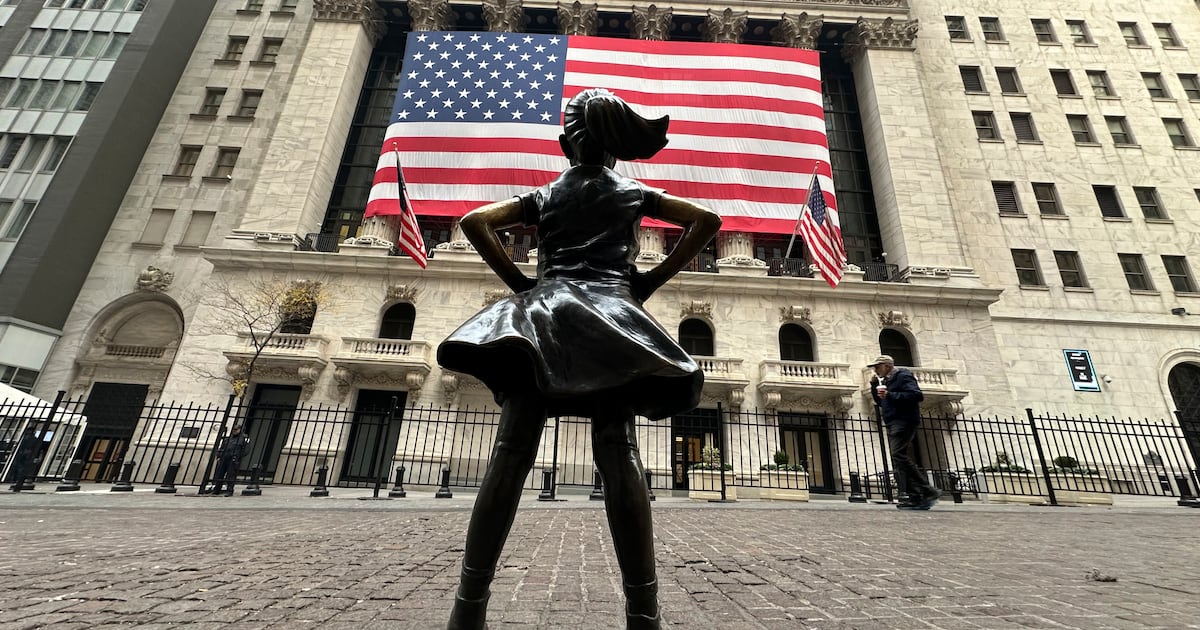
5. Chip stocks add nearly $250 billion in a single session
Chip stocks, which helped drag Wall Street lower last week, led Monday's rebound. A Yahoo Finance basket of 60 chip-related stocks recovered nearly $250 billion in market value, with gains spanning memory makers, chip designers and equipment suppliers. Micron and Intel each gained more than 2 per cent, SanDisk rose nearly 5 per cent, and AMD, Nvidia and Western Digital joined the rally.
The rebound was narrow: nearly 90 per cent of the chip basket rose, while roughly 70 per cent of S&P 500 stocks fell. The pattern of indexes rising while most stocks decline extends this year's AI-led market. Attention now turns to this week's earnings, with Meta Platforms and Lam Research both reporting Wednesday.

6. Amazon named Morgan Stanley top pick, price target raised to $350
Amazon stock rose as much as 5 per cent Monday after Morgan Stanley named it a top pick and raised its price target to $350 from $335, outlining five catalysts. The new target implies about 40 per cent upside from Friday's close of $250; the firm set a bear case of $220 and a bull case of $410, a roughly 3:1 risk-reward ratio.
Analyst Brian Nowak kept his Overweight rating. The five catalysts are: faster AWS growth, with the firm now expecting AWS revenue to grow 47 per cent in 2027 and 42 per cent in 2028, up from 41 per cent and 37 per cent, after Nvidia disclosed that AWS is expected to buy and deploy about 2 million of its GPUs over those two years; bigger AWS profits, with operating margins of 42 per cent in 2027 and 44 per cent in 2028, supporting about $16.50 in earnings per share in 2028; more visibility into Bedrock, Amazon's AI model service, which could lift the stock's valuation from about 15 times 2028 earnings; AI shopping, as shopping agents spread; and robotics, where Morgan Stanley estimates every 10 per cent of Amazon's global units moving through robotics-enabled fulfillment centers could save $2 billion to $4 billion a year.
The firm also lifted its capital spending forecast for Amazon to $355 billion in 2027 and $365 billion in 2028. Amazon stock is up about 11 per cent this year but sits roughly 10 per cent below its early August high. The company reports third-quarter results Oct. 29 after the bell.

7. China's third-quarter GDP grows 4.5% as exports power ahead
China's National Bureau of Statistics reported Monday that GDP grew 4.5 per cent year over year in the third quarter, up from 4.3 per cent in the second quarter and better than economists had expected. Growth over the first nine months reached 4.6 per cent, putting Beijing on track to hit its 2026 target of 4.5 per cent to 5 per cent without extra stimulus.
The breakdown was uneven: industrial production rose 5.5 per cent in September, up from 5.2 per cent in August, while retail sales increased just 1.1 per cent after 0.4 per cent the prior month. Fixed-asset investment fell 7.2 per cent over the first nine months, property investment tumbled 20.6 per cent, and infrastructure spending remained weak. Data last week showed China's exports surged by more than a third in September, lifted by shipments of electronics related to AI.
Duncan Wrigley, chief China economist at Pantheon Macroeconomics, said September's industrial output rise was partly due to coalmines resuming operations after safety inspections prompted by a major accident, while manufacturing output grew 6.0 per cent year over year on stronger export demand for electronics, AI-related equipment and autos. ABN Amro analysts said the pickup mainly reflects export strength from the global AI and tech boom, more than offsetting drags from the Iran conflict and weak domestic demand.

8. Pan Gongsheng unveils liquidity tool for non-bank redemptions and yuan reforms
The 2026 Financial Street Forum opened in Beijing on Oct. 19, where People's Bank of China Governor Pan Gongsheng announced several policy steps. The PBOC will work with the National Financial Regulatory Administration and the China Securities Regulatory Commission to set up a liquidity support tool for large redemptions by non-bank institutions, aimed at building a bond market stabilization mechanism and forming a new macroprudential tool. The central bank will also expand the range of institutions eligible for its Standing Lending Facility to include locally incorporated foreign bank legal entities, achieving full coverage of domestic deposit-taking institutions.
On the bond market, the PBOC will push forward with connectivity between the interbank and exchange bond markets to make cross-market issuance and trading easier. On foreign exchange, it will pilot measures to further facilitate yuan purchases and sales by overseas financial institutions in the onshore FX market, with a view to further opening the market based on pilot results. The PBOC will also join the Ministry of Science and Technology and nine other departments in issuing guidelines on financial support for building international science and technology innovation centers in Beijing (Beijing-Tianjin-Hebei), Shanghai (Yangtze River Delta) and the Guangdong-Hong Kong-Macao Greater Bay Area, promoting relending, the bond market's "tech board" and cross-border investment and financing policies in those regions.
On the exchange rate, Pan stressed that China runs a managed floating regime based on market supply and demand and adjusted with reference to a basket of currencies, and has not conducted routine FX intervention since 2017, using macroprudential tools in specific scenarios and direct intervention only in extreme cases to correct herd behavior and self-reinforcing irrational expectations. He noted that global FX trading averages nearly US$10 trillion a day in 2025, while yuan FX trading exceeds US$800 billion a day, about 80 per cent of it offshore. The yuan is now China's top settlement currency for external receipts and payments, the world's second-largest trade financing currency and third-largest payment currency; by SWIFT data it accounts for 3 to 4 per cent of international payments, ranking fifth globally.
On artificial intelligence, Pan said the PBOC will closely track and assess AI's macroeconomic impact, improve financing support for AI companies with a focus on core technology innovation and "AI Plus" initiatives, and steadily advance the use of AI in finance.
9. Brent settles at $109.55 as Houthi and Ukrainian attacks disrupt supply
Brent crude churned near five-month highs Monday, settling at US$109.55 a barrel, down 31 cents or 0.3 per cent, after touching US$110.70 earlier. Iran-backed Houthi militants claimed attacks on Riyadh's King Khalid International Airport, Abha International Airport near Yemen, Saudi Aramco facilities in Yanbu on the Red Sea coast, the Shaybah oilfield and Saudi naval forces. CNBC said it could not verify the claims, and Saudi Arabia has not issued a public statement confirming them.
Saudi Arabia postponed until next year its four-day Future Investment Initiative conference, which had been scheduled for next week. About 10 days earlier, a Houthi strike on King Khalid International Airport killed at least 12 people and left hundreds injured. On the supply side, fires broke out at an oil terminal and depot in St. Petersburg after Ukraine launched a massive wave of drone strikes on Sunday; the terminal exports about 120,000 barrels a day of refined products, mostly fuel oil, according to Kpler, with the extent of damage not immediately known.
Prices pulled back from session highs as traders weighed possibly higher Russian supplies after U.S. sanctions relief on Friday. Ukraine briefly paused strikes on Russian energy facilities after President Donald Trump declared on Oct. 11 that Kyiv and Moscow had agreed to a truce, but Russia continued to strike Ukrainian energy infrastructure and President Volodymyr Zelenskyy said last week that Kyiv would resume strikes in retaliation. Separately, the UK Maritime Trade Operations Centre reported that two tankers were attacked off Saudi Arabia on Friday: a small boat fired a rocket-propelled grenade at an unidentified tanker 78 nautical miles northeast of Al Jubayl, and another vessel, the ST3, was hit by an unknown projectile.

10. Mortgage renewal? Start four months early and look past the rate
For many Canadian homeowners, the rate in a renewal letter is already an increase, but mortgage professionals say the worst move is signing whatever arrives in the mail. Kola Ifabumuyi, a certified mortgage planner with Mortgage Architects, suggests starting about four months before the renewal date, or earlier for self-employed borrowers or anyone whose income has changed: gather the mortgage statement and renewal offer, check how many years remain on the amortization, and decide what monthly payment is affordable. Anyone considering switching lenders should also start pulling together income documents. Client life plans, he said, matter as much as the rate.
Steven Biderman, a certified mortgage broker with Mortgage Outlet, warns borrowers to understand when the new rate takes effect and whether accepting means giving up the benefit of their current rate before the term ends. Staying with the existing lender is usually simplest, especially if income has fallen and a new approval is undesirable, but that convenience may come at the cost of a higher rate. Switching requires approval from the new lender and may involve appraisal, legal, registration and discharge fees, so borrowers should ask whether any are covered; switching at the end of a term generally avoids an early-break penalty. Eligible uninsured borrowers switching between federally regulated lenders avoid the usual stress test if they do not increase the loan or extend the amortization period.
Ifabumuyi's example: on a $500,000 mortgage with 20 years left, the monthly payment at 4.5 per cent is $3,152.03 versus $3,702.50 at a 6.5 per cent stress-test rate, cutting the monthly approval hurdle by $550.47. A five-year fixed rate of 4.5 per cent instead of 4.79 per cent saves $4,629 in payments over five years. He also suggests bringing a written competing offer and asking the current lender to match it, for example noting that its five-year fixed is 4.79 per cent while a comparable offer sits at 4.5 per cent and requesting a written response by a set date. If the first answer is no, ask the mortgage retention team to review it and leave enough time to switch.
More News
- Maple Express | October 19, 2026 — A Year After Ontario Resident Eli Wood Vanished, Mother Says 'None of Us Are Going to Give Up'
- Maple Express | October 19, 2026: Commons mourns four soldiers killed in Wainwright fire
- Immigration | October 19, 2026 Express Entry overhaul: points for 186 high-wage occupations, LMIAs no longer required
- Global Express | October 19, 2026 — Four Canadian Soldiers Killed in Base Fire That Moved a Kilometre in a Minute
- Finance Morning | Financial Street Forum Opens With New PBOC and CSRC Steps as Q3 GDP Grows 4.5%
Comments (0)
View More
 0
Worth Buying: Sonos Era 100 — Real Stereo at This Size, Plus Bluetooth and Line-In! $289 CAD
 -55%
Bravely Default II for Nintendo Switch — Classic Turn-Based RPG! $35.99 CAD (55% Off)
 -24%
GREENIES PILL POCKETS 30-Count — Hide the Pill in a Treat, Most Dogs Won't Notice! $16 CAD (24% Off)
 -27%
DELSEY PARIS Helium DLX Rolling Garment Bag — Suits Arrive Uncreased! $311.93 CAD (27% Off)
 Maple Express
 | October 19, 2026 — A Year After Ontario Resident Eli Wood Vanished, Mother Says 'None of Us Are Going to Give Up'
 Finance Morning
 | Financial Street Forum Opens With New PBOC and CSRC Steps as Q3 GDP Grows 4.5%
0Worth Buying: Sonos Era 100 — Real Stereo at This Size, Plus Bluetooth and Line-In! $289 CAD
Amazon
-55%Bravely Default II for Nintendo Switch — Classic Turn-Based RPG! $35.99 CAD (55% Off)
Amazon
-24%GREENIES PILL POCKETS 30-Count — Hide the Pill in a Treat, Most Dogs Won't Notice! $16 CAD (24% Off)
Amazon
-27%DELSEY PARIS Helium DLX Rolling Garment Bag — Suits Arrive Uncreased! $311.93 CAD (27% Off)
Amazon
Maple ExpressMaple Express | October 19, 2026 — A Year After Ontario Resident Eli Wood Vanished, Mother Says 'None of Us Are Going to Give Up'
Finance Morning