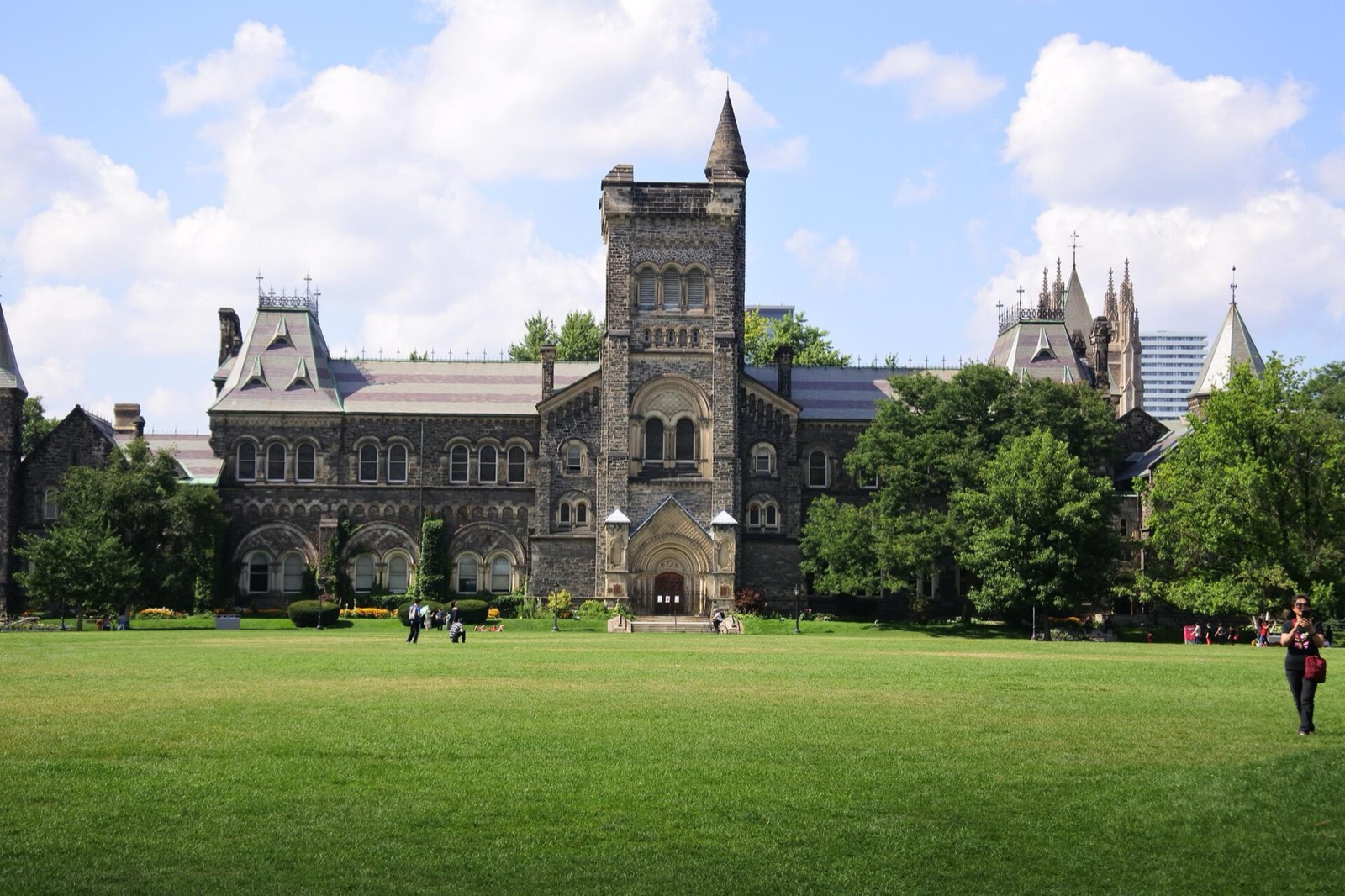
How Much Does UofT Cost: Tuition, Housing, and Scholarships
A detailed breakdown of UofT costs: domestic and international tuition, housing and living expenses, and scholarships such as the Pearson International Scholarship.
📘 This is one of the installments of the "University of Toronto Complete Guide." We organize public, verifiable basic information to help you form your own judgment. We do not promise admission, we do not provide insider information, and we do not recommend any agents.
The same classroom, two kinds of tuition
Tuition at the University of Toronto differs starkly between domestic and international students — in the same Faculty of Arts & Science, Ontario domestic students paid $6,100 in 2025-26 while international students paid $63,570, nearly ten times as much. This isn't a problem unique to UofT: Ontario domestic tuition is regulated by the provincial government and has been essentially frozen since 2019, while international tuition is set by the university itself and raised year after year. So when discussing "how much does a year at UofT cost," the first thing is to determine which rate you pay.
Tuition: domestic vs international
| 2025-26 tuition | Ontario residents | Canadian out-of-province residents | International students |
|---|---|---|---|
| Faculty of Arts & Science (incl. UTM/UTSC) | $6,100 | $7,250 | $63,570 |
| Applied Science & Engineering (engineering) | $14,180 | $16,890 | $70,060 |
| Architecture, Music, Kinesiology, Visual Studies, etc. | $6,100 | $7,250 | $63,570 |
| Business (Rotman Commerce, etc., upper-year program fee) | ~$15,900 | ~$18,930 | ~$72,260–$74,430 |
Source: University of Toronto 2025-26 Tuition Fee Report. Figures are tuition only, excluding incidental fees.
A few notes:
- There are two tiers among domestic students. Ontario residents are subsidized by the provincial government and pay lower tuition; out-of-province residents pay the "Non-Ontario Resident (NOR)" rate, usually a notch higher (see the table above).
- International tuition rises year by year. Arts & Science international tuition rose from $61,720 in 2024-25 to $63,570 in 2025-26, and has been published at $65,480 for 2026-27; engineering is $72,860 for 2026-27.
- Watch out for "program fees." Some programs (such as Rotman Commerce, computer science, and UTM's Management) are charged ordinary Arts & Science tuition in the first year, then switch to a higher "program fee" from the second or third year.
- Incidental fees are separate. Beyond tuition there are student services, athletics, health insurance, and other incidental items: about $2,041 for domestic students; international students must also buy the mandatory University Health Insurance Plan (UHIP).
The above is tuition (2025-26 and the published 2026-27). Tuition is set each year — please defer to the official rate table for the year you apply (Tuition Explorer).
Housing and living costs
Beyond tuition, housing is the second-largest item. On-campus residences are usually charged per academic year and mostly require a meal plan:
- St. George: residences with meals were roughly $22,858–$27,120 in 2025-26; University College is $16,548–$21,236 for 2026-27; Chestnut (apartment-style) is about $13,491–$16,357 (residence fee comparison).
- UTM, UTSC: on-campus options include single rooms, apartments, and townhouses, usually cheaper than downtown — UTM also has the most diverse housing options of UofT's three campuses.
Beyond housing, you should budget each year for: books and study supplies about $1,000–$1,500; meals (when not living on campus) about $4,000–$6,000; plus transportation, phone, and personal expenses. International students shouldn't forget UHIP and round-trip airfare.
Adding it all up, a first year living on campus looks roughly like this (using Arts & Science at St. George as an example, estimated):
| Item (one-year estimate) | Ontario residents | Out-of-province residents | International students |
|---|---|---|---|
| Tuition | $6,100 | $7,250 | $63,570 |
| Incidental fees + insurance | ~$2,041 | ~$2,041 | ~$2,000–$3,000 (incl. UHIP) |
| Housing + meals (on campus) | ~$22,000 | ~$22,000 | ~$22,000 |
| Books and study supplies | ~$1,200 | ~$1,200 | ~$1,200 |
| Personal expenses / transport / phone | ~$3,000 | ~$3,000 | ~$4,000 |
| Total | ~$34,000 | ~$35,000 | ~$93,000 |
(The housing and personal expenses vary from person to person; median estimates are used here.)
(The housing tier, whether you live on campus, and the cost of city life will all clearly affect the total.)
Stretched over four years, the scale becomes clearer: a domestic student in Arts & Science living on campus spends roughly $100,000–$140,000 (CAD) over four years; an international student, roughly $340,000–$380,000. This doesn't include travel, setup, or inflation.
Scholarships and financial aid
Admission Awards: you are automatically considered when applying to UofT; most require no separate application, and they are aimed at outstanding domestic and international students (admission awards).
Lester B. Pearson International Scholarship: UofT's most prestigious international student award and one of Canada's largest scholarships for international undergraduates. It covers four years of full tuition, books, incidental fees, and housing; about 37 people win it each year, with more than $12 million distributed in 2024, and winners coming from 188 countries. The key threshold is that you must be nominated by your high school (each school may nominate only 1 student per year) and simultaneously apply to UofT for undergraduate study (Pearson Scholarships).
In-Course Awards: after enrollment, you can still apply for various scholarships based on grades each year.
Financial aid (need-based):
- Domestic students: can apply for OSAP (Ontario Student Assistance Program) and UofT's UTAPS (to cover the gap beyond OSAP);
- International students: generally not eligible for OSAP and UTAPS, need to be mainly self-funded, and may look out for international-student-specific funding and on-campus Work Study.
A reminder: scholarships are highly competitive with limited places and cannot be treated as a primary source of funding. For international students especially, budget for four years on the basis of "full tuition + living costs," rather than pinning hopes on scholarships.
Common misconceptions
Misconception 1: International students can also apply for OSAP or UTAPS. They can't. OSAP and UTAPS are for domestic (OSAP-eligible) students; international students need to self-fund, and may look out for international-student-specific funding and on-campus Work Study.
Misconception 2: Once you get an offer, tuition is fixed for four years. It isn't. Tuition is set each year and may rise. However, the university has a "Fee Level Commitment" for current domestic students: annual increases during enrollment do not exceed 5%, and it guarantees coverage for the normal length of the program.
Misconception 3: Living on campus is necessarily more expensive than renting off campus. Not necessarily. Off-campus rentals downtown can be more expensive in peak season, plus you add commuting time and transport costs; living on campus is hassle-free, and on-campus housing at UTM/UTSC is especially cheap.
Misconception 4: Scholarships are "something everyone can get." Far from it. Take the best-known Pearson International Scholarship: only about 37 places each year, and it requires a high school nomination; admission awards have broader coverage, but the amounts and numbers are still limited.
Misconception 5: Looking only at tuition is enough. For international students, housing and living costs are nearly on the same scale as tuition — fixating on tuition alone easily underestimates the real outlay.
← Previous: How to get in: the application system and four application pathways | Back to the hub "University of Toronto Complete Guide" | Next: What to study →
Data notes and our boundaries
- The data in this article comes from the University of Toronto's official tuition report, student accounts, and official residence pages, with the academic year noted; tuition, residence fees, and scholarship policies may be adjusted each year, so please defer to the official figures published in the year you apply.
- We do only three things: organize basic information, cite sources, and provide a framework for judgment. We do not provide admission predictions, we do not file applications on anyone's behalf, and we do not recommend any agents.
Image credits
- University of Toronto St. George campus, Wikimedia Commons, CC BY-SA 4.0
We are rolling out a series of features on Canadian universities, high schools, and elementary schools, explaining the local education system in the same way to help you avoid detours. Please scan the QR code below to follow us on WeChat — new features will be pushed to you as soon as they're published; we also suggest adding https://dealcanada.ca to your browser bookmarks so you can come back anytime.
Last updated: 2026-09-23
More News
- Maple Express | September 23, 2026 — Sentencing hearing begins for Kenneth Law
- AI Weekly | OpenAI and Anthropic Launch a Price War as Trump Rebrands AI 'Super Intelligence'
- Global Express | September 23, 2026 Trump Meets Venezuela's Interim President in First Face-to-Face Since Maduro Seized
- Finance Morning: Musk Calls Shanghai Gigafactory a 'Gem'; Chinese Property Stocks Rally
- Tech Express | September 23, 2026 — Anthropic Releases Claude Opus 5.5, Cutting Typical Task Costs by 40%
Comments (0)
View More
 -28%
-28%Lenovo Legion 5i 15.3" Gaming Laptop — Intel Core Ultra 7 251HX, RTX 5070, 32GB DDR5 & 165Hz OLED! $2599.99 CAD (28% Off)
 -16%
-16%Samsung M5 32" FHD Smart Monitor — A Monitor That Doubles as a Smart TV! $278 CAD (16% Off)
 -27%
-27%Addtam Flat Plug Power Bar (12 Outlets) — Ultra-Thin Wall Plug & 1050J Surge Protection! $18.99 CAD (27% Off)
 -22%
-22%Rust-Oleum Decorative Color Chips (Glacier Gray, 1 lb) — Hide Flaws, Get a Showroom Finish! $39.22 CAD (22% Off)
 University Guide
How to Get Into UofT: The Application System Explained and the Four Pathways
 University Guide
Is UofT Worth It: Pros, Cons, Who It Suits, and a Comparison with McGill/UBC
-28%Lenovo Legion 5i 15.3" Gaming Laptop — Intel Core Ultra 7 251HX, RTX 5070, 32GB DDR5 & 165Hz OLED! $2599.99 CAD (28% Off)
Best Buy
-16%Samsung M5 32" FHD Smart Monitor — A Monitor That Doubles as a Smart TV! $278 CAD (16% Off)
Amazon
-27%Addtam Flat Plug Power Bar (12 Outlets) — Ultra-Thin Wall Plug & 1050J Surge Protection! $18.99 CAD (27% Off)
Amazon
-22%Rust-Oleum Decorative Color Chips (Glacier Gray, 1 lb) — Hide Flaws, Get a Showroom Finish! $39.22 CAD (22% Off)
Amazon
University GuideHow to Get Into UofT: The Application System Explained and the Four Pathways
University Guide