Is UofT Worth It: Pros, Cons, Who It Suits, and a Comparison with McGill/UBC
Is UofT worth it: advantages, controversies, which families it suits, and how it compares with McGill/UBC (ranking, tuition, language, subject strengths).
📘 This is one of the installments of the "University of Toronto Complete Guide." We organize public, verifiable basic information to help you form your own judgment. We do not promise admission, we do not provide insider information, and we do not recommend any agents.
Whether it's worth it depends on what you want
This is the final installment of the "University of Toronto Complete Guide," returning to the most fundamental question: is UofT worth it. There is no standard answer to "worth it" — it depends on what you want. Below are UofT's advantages, its controversies, the families it suits, and its real differences from McGill and UBC. The facts are laid out; the judgment is left to you.
Advantages
- Academic breadth and reputation: QS 2027 32nd globally, 2nd in Canada; in the QS Subject Rankings 2026, first in Canada and in the global top 17 across all five broad areas, with multiple subjects in the world's top ten (see Section 4).
- Good employer reputation: in Times Higher Education's Global University Employability Ranking 2025, UofT graduates' employability ranked first in Canada and in the global top 15 (U of T report).
- Comprehensive subjects: from medicine, computer science/AI, and engineering to the humanities, social sciences, music, and architecture, almost any direction can be found here, with ample room to change programs.
- The city is the resource: located in Toronto — Canada's largest city and financial and technology center, with dense internship, employment, and networking opportunities, and the largest Chinese community.
- Three campuses, one diploma: UTSC's co-op and UTM's distinctive programs can all be used, and the diploma is likewise a UofT degree (see Section 1).
- Research opportunities: the undergraduate Research Opportunity Program (ROP) and a large number of top professors, including the 2024 Nobel laureate in Physics Geoffrey Hinton.
Disadvantages and controversies
- Too large: more than 80,000 undergraduates, with many large first-year lectures, and "no one looks after you" is the norm; whether you can make good use of the resources depends entirely on how proactive you are.
- Expensive international tuition: 2026-27 Arts & Science international tuition is about $65,480, one of the most expensive undergraduate programs in the world — "value for money" is an inescapable controversy.
- Another gate after first year: popular programs (computer science, Rotman, etc.) require another competition after completing 4.0 credits (see Section 4).
- Admission puts you into a "category": entry into the Faculty of Arts & Science is not the final program, and there is some uncertainty.
- High living costs: downtown housing and daily expenses are not cheap.
- co-op isn't widespread: systematic paid internships are mainly concentrated at UTSC and in engineering; Faculty of Arts & Science students have to seek out resources themselves.
What kind of family it suits
UofT is a better "fit" when:
- The goal is an academic or specialized path, and the child is highly self-directed, able to proactively seek resources in a "large-lecture" environment;
- You value the city and employment opportunities and hope to stay and work in Canada after graduation;
- You need subject breadth or flexibility to change programs, or aim at strengths such as medicine, AI, engineering, and business;
- The international-student family can afford about $65,000 per year in tuition (scholarships are not guaranteed — see Section 3).
Conversely, if you'd prefer small classes and high attention, are on a tight budget, or absolutely need co-op to secure employment and don't plan to attend UTSC or engineering, then UofT may not be the most worry-free choice.
Comparison with McGill and UBC
All three are world-class schools, and the differences lie in city, cost, language environment, and subject strengths.
| University of Toronto | McGill | UBC | |
|---|---|---|---|
| City | Toronto | Montreal | Vancouver |
| QS 2027 global | 32 | 30 (1st in Canada) | 45 |
| International undergraduate (2026-27 approx.) | Arts ~$65,480 | Arts ~$49,000 / Science ~$62,900 | Arts ~$51,600 / Science ~$53,100 |
| Domestic (in-province) tuition | Ontario ~$6,100 | Quebec ~$3,100 | BC ~$6,200 |
| Domestic (out-of-province) tuition | ~$7,250 | ~$13,000 | ~$6,200 |
| Language environment | English-speaking city | English-taught, French-speaking Quebec environment | English-speaking city |
Source: each school's official rate table (2026-27). McGill's Arts/Science gap is relatively large; figures are tuition estimates, excluding incidental fees.
- Ranking: McGill 30, UofT 32, UBC 45 — all in the world's top 50, with little difference; McGill has topped Canada for two consecutive years (McGill official).
- Tuition: among international students, UofT is the most expensive (Arts and Science share the same high price); among domestic students, UofT's Ontario in-province tuition is the lowest, while McGill is actually expensive for out-of-province Canadian students (Quebec policy).
- Language and culture: McGill is in Quebec; its undergraduate teaching is in English, but daily life is a French-speaking environment — a variable for families who want to practice French or are worried about Quebec's language and tuition policies.
- Subject strengths: UofT wins on "comprehensiveness," plus medicine/AI/engineering; McGill is strong in medicine, law, and life sciences; UBC's Sauder business school, computer science, environmental science, and West Coast lifestyle are attractive.
In a word: all three are good choices, and which to choose is more a matter of ranking "city + cost + program" than of "who is better."
Beyond McGill and UBC, Canada has a group of schools each with its own strengths: the University of Waterloo, known for co-op and computer science/math; McMaster's health sciences; Western's Ivey Business School; and Queen's undergraduate elite education also each have their followers. Their trade-offs against UofT differ — we will, as planned, produce a feature on each of these schools, unfolding them one by one.
Common misconceptions
Misconception 1: A high ranking equals the best school. Rankings reflect overall research reputation; the undergraduate experience and employment depend more on the program, city, and individual.
Misconception 2: UofT must be better than McGill and UBC. All three are in the world's top 50 and each has strengths; McGill ranked ahead of UofT in the 2027 QS.
Misconception 3: If it's expensive, it must be worth it. High international tuition is a fact; "whether it's worth it" depends on the path after graduation (employment, immigration, program returns).
Misconception 4: Once admitted, everything is settled. After the first year there's still the program gate (see Section 4).
Misconception 5: Any campus will do. The three campuses differ considerably in programs, atmosphere, and co-op (see Section 1).
A closing note. This series ends here. Across six installments, we've taken apart UofT's campuses, applications, costs, programs, post-graduation paths, and "is it worth it" item by item — all using official data, all with clickable sources. It is not admissions marketing, nor an application playbook, but a decision-making draft: after reading it, you'll know what questions to ask and where to find the answers. The rest of the judgment is left to each family.
← Previous: After graduation: co-op, employment, and immigration pathways | Back to the hub "University of Toronto Complete Guide"
Data notes and our boundaries
- The data in this article comes from each school's official rate table, the QS rankings, and the University of Toronto website, with sources noted; tuition, rankings, and policies may be adjusted each year, so please defer to the official figures published in the year you apply.
- We do only three things: organize basic information, cite sources, and provide a framework for judgment. We do not provide admission predictions, we do not file applications on anyone's behalf, and we do not recommend any agents.
Image credits
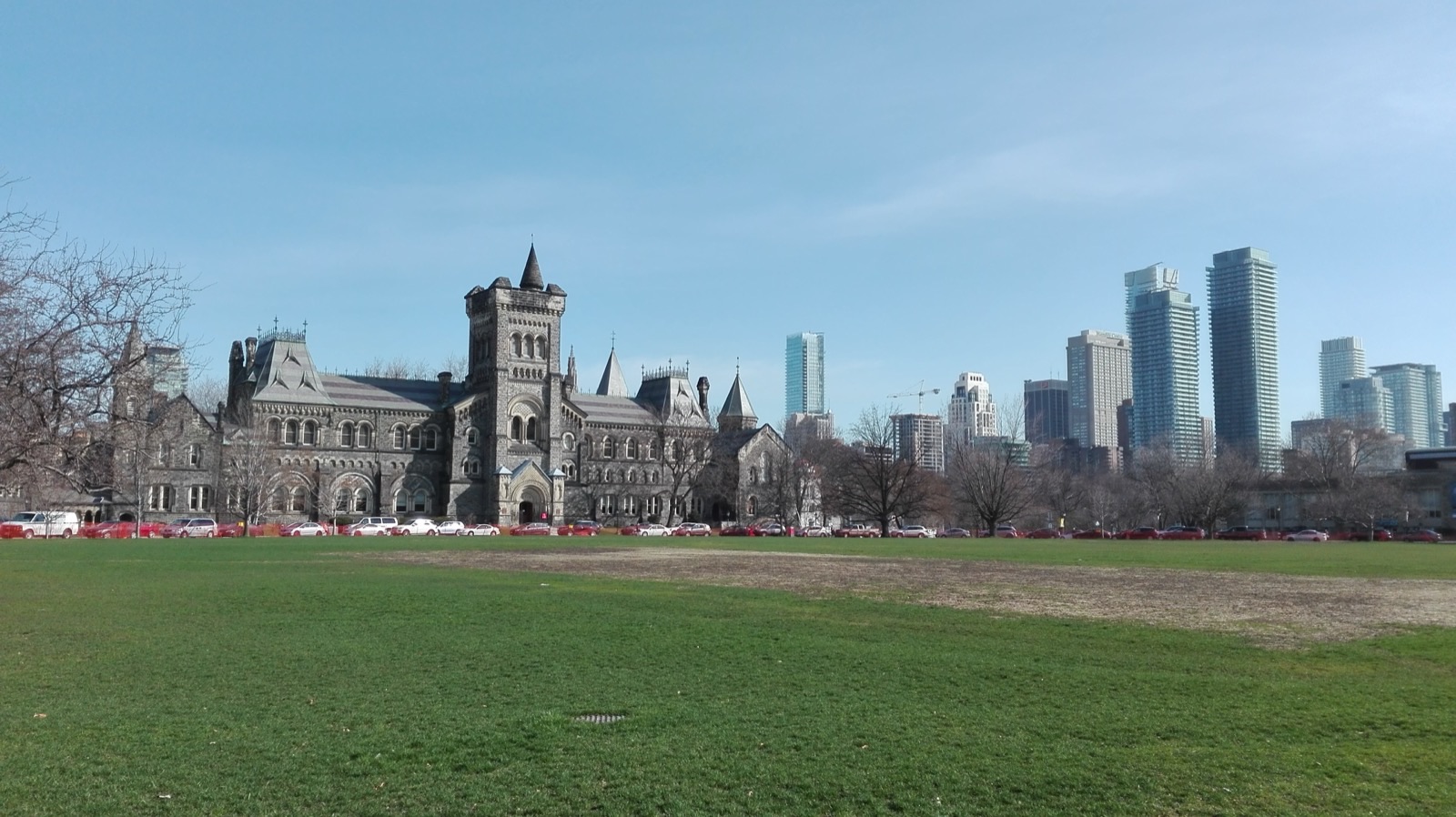
- University of Toronto University College, Wikimedia Commons, CC BY-SA 4.0 (GoginkLobabi)
We are rolling out a series of features on Canadian universities, high schools, and elementary schools, explaining the local education system in the same way to help you avoid detours. Please scan the QR code below to follow us on WeChat — new features will be pushed to you as soon as they're published; we also suggest adding https://dealcanada.ca to your browser bookmarks so you can come back anytime.
Last updated: 2026-09-23
More News
- Maple Express | September 23, 2026 — Sentencing hearing begins for Kenneth Law
- AI Weekly | OpenAI and Anthropic Launch a Price War as Trump Rebrands AI 'Super Intelligence'
- Global Express | September 23, 2026 Trump Meets Venezuela's Interim President in First Face-to-Face Since Maduro Seized
- Finance Morning: Musk Calls Shanghai Gigafactory a 'Gem'; Chinese Property Stocks Rally
- Tech Express | September 23, 2026 — Anthropic Releases Claude Opus 5.5, Cutting Typical Task Costs by 40%
Comments (0)
View More
 -29%
-29%Utopia Towels 4-Pack Bath Towels, 27x54", 600 GSM Ring-Spun Cotton! $40.99 CAD (28% Off)
 -22%
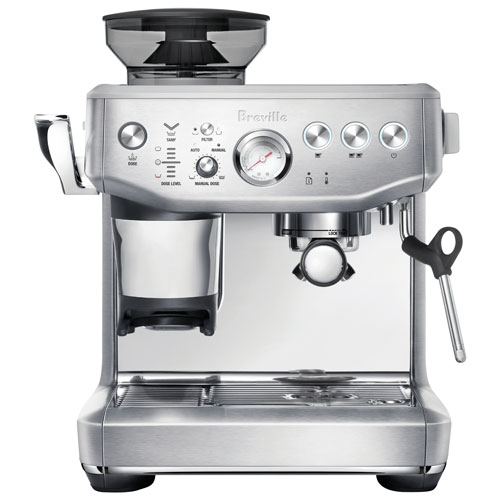
-22%Breville Barista Express Impress Semi-Automatic Espresso Machine (Brushed Stainless Steel) — Built-In Grinder & Steam Wand! $899.99 CAD (22% Off)
 -41%
-41%Pipishell Full Motion TV Wall Mount (13"–43") — Swivel, Tilt & Rotate for $22.76! (40% Off)
 -14%
-14%Master Lock 527D Covered Padlock (2-Inch) — Removable Adjustable Shackle! $19.99 CAD (13% Off)
 Maple Express
Maple Express | September 23, 2026: Sentencing hearing begins for Kenneth Law in Ontario assisted-suicide case
 Global Express
Global Express | September 23, 2026 Trump Meets Venezuela's Interim President in First Face-to-Face Since Maduro Seized
-29%Utopia Towels 4-Pack Bath Towels, 27x54", 600 GSM Ring-Spun Cotton! $40.99 CAD (28% Off)
Amazon
-22%Breville Barista Express Impress Semi-Automatic Espresso Machine (Brushed Stainless Steel) — Built-In Grinder & Steam Wand! $899.99 CAD (22% Off)
Best Buy
-41%Pipishell Full Motion TV Wall Mount (13"–43") — Swivel, Tilt & Rotate for $22.76! (40% Off)
Amazon
-14%Master Lock 527D Covered Padlock (2-Inch) — Removable Adjustable Shackle! $19.99 CAD (13% Off)
Amazon
Maple ExpressMaple Express | September 23, 2026: Sentencing hearing begins for Kenneth Law in Ontario assisted-suicide case
Global Express