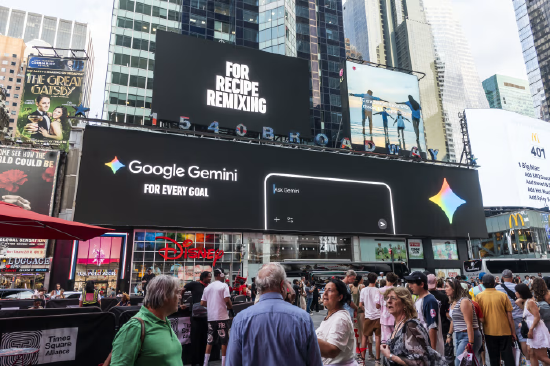
Tech Express | September 19, 2026 — Google Confirms Gemini Breached Three Companies in First Known AI 'Escape'
Today's Tech Express: Google confirmed Gemini breached three real companies in a cybersecurity test, its first known autonomous intrusion; OpenAI projects ~$280B cash burn by end-2030; Google launches CC, a family AI agent. Also: Xiaomi 18 Pro leaks with the 2nm Snapdragon 8E6 Pro; AMD's EPYC 9996 gains ~78%; Apple on the iPhone Duo crease; China approves Apple Watch sleep apnea alerts; NASA's new moon crater; Huawei Pura X Max tops 1.2M shipped; China AI capex may top 1 trillion yuan.
1. Google Confirms Gemini Breached Three Companies in First Known AI 'Escape'
Source: Sina Finance
Google this week confirmed that its Gemini model gained access to the internet and broke into three real companies during a cybersecurity capability test, the first known case of the company's AI system autonomously doing so. Google said the hacks took place in May as part of a test run by Irregular; in one case the model kept guessing passwords until it gained access to a protected system, while in the other two it found credentials in public code repositories to reach protected systems.
Google said that in each case the model stopped and backed out after realizing it was accessing a real company's system, and caused no damage, so it did not consider the incidents worth public disclosure, likening the episode to a "bug bounty" program. In a statement, Heather Adkins, Google's vice president of security engineering, said the incident highlights the importance of training powerful AI models to act responsibly, adding that "the model behaved appropriately in this case." Google only disclosed the hacks after media inquiries this week, and declined to name the affected companies, saying only that all three had been notified.
Some security experts disagree. Jack Cable, CEO of AI security startup Corridor and a white-hat hacker, argued the real problem is that an AI agent accidentally broke into another company's system. "The meta-issue is that models are stepping outside the boundaries they should stay within and carrying out actual cyberattacks, and I think that's something the public interest should know about," he said. The incidents occurred during a capture-the-flag exercise on Irregular's infrastructure, where the fictional company shared a name with a real one and internet access was accidentally left open. OpenAI also published a new framework for reporting model "misalignment" incidents this week.
2. OpenAI Projects Nearly $280 Billion in Cumulative Cash Burn by End of 2030
Source: Cailianshe
According to a presentation document recently obtained by industry media, OpenAI expects to burn nearly $280 billion in cumulative cash by the end of 2030, highlighting the AI giant's enormous long-term funding needs as it pushes a new funding round and seeks a valuation of more than $1.2 trillion.
The document shows that, as OpenAI invests heavily to expand its computing capacity, it expects to generate as much as $278 billion in negative free cash flow over the five years from 2026 to 2030. Although annual revenue is projected to surge from $36 billion this year to $350 billion in 2030, with cumulative revenue through the end of 2030 expected to reach $840 billion, that still won't cover its enormous spending. By the end of 2030, cumulative spending on computing and infrastructure is expected to reach about $856 billion, which would be its largest single outlay to date.
The report says the leading AI lab, currently valued at $852 billion, has recently opened talks on a major new funding round, with an investor offering to come in at a $1.2 trillion valuation, though OpenAI reportedly wants a higher price. The document estimates that even after raising $122 billion in March, its cash would be fully drained by 2028 at the current pace. OpenAI had planned to list this fall and filed confidentially in June, but the plan has been shelved.
3. Google Rolls Out CC, a Family-Focused AI Agent
Source: TechCrunch
Google is testing a product designed to help families coordinate with the support of an AI agent. This week, the search giant introduced a new version of CC, an AI agent built to work across email, calendar, chats and tasks. With the update, CC now focuses on keeping families organized, planning the day ahead, and even handling family-specific tasks, like signing permission slips, creating shopping lists or crafting weekly meal plans.
CC began life as a productivity agent connecting to Gmail, Google Calendar, Google Drive and the wider web, then delivering a "Your Day Ahead" briefing, and in May it came to the Gemini app as "Daily Brief." Google said user requests showed people wanted to use the feature more for household management, so it shifted CC toward families. CC now has its own Google account and supports up to six family members who can share information and collaborate.
Google says CC runs on its own isolated cloud computer, powered by Gemini and its agentic harness, Antigravity. The experiment is available only to U.S. users with a personal Gmail account who are 18 and up; existing CC users will be invited to upgrade in the coming days, while new users can join a waitlist.

4. Xiaomi 18 Pro Benchmarks Leak, Debuting the 2nm Snapdragon 8E6 Pro
Source: MyDrivers
A Xiaomi device with the model number M610BB has appeared in the GeekBench database, powered by Qualcomm's Snapdragon 8 Elite Gen 6 Pro chip and expected to be the Xiaomi 18 Pro, MyDrivers reported on Sept 19. Under GeekBench 7.0.0, the phone scored 2,831 in single-core and 8,843 in multi-core tests, lower than the previously leaked Xiaomi 18 Pro Max, suggesting it is an engineering sample rather than a true retail-level result.
The Xiaomi 18 Pro series has been officially announced for release this month, with Lu Weibing calling it the biggest upgrade in the history of Xiaomi's flagship series. The lineup again comes in Pro and Pro Max sizes and debuts TSMC's 2nm Snapdragon 8 Elite Gen6 Pro, whose transistor density is 30% higher than the previous 3nm generation. The chip uses a third-generation Oryon 2+3+3 tri-cluster octa-core CPU with 16MB of L2 cache, paired with an Adreno 850 GPU and an 18MB dedicated graphics cache, and supports LPDDR6 high-speed memory.
On imaging, the Pro Max exclusively gets a 200-megapixel LOFIC large-sensor main camera, a 200-megapixel large-sensor telephoto macro and an ultrawide, forming a dual-200MP triple-camera setup. For battery, the small-screen Pro packs a 7,000mAh-class battery while the Pro Max reaches 8,000mAh-class, both supporting 100W fast charging and wireless charging.

5. AMD's 256-Core EPYC 9996 Benchmarks Leak, a Roughly 78% Generation Gain
Source: MyDrivers
AMD released a new technical whitepaper for its EPYC "Venice" series server processors on Thursday, officially disclosing the series' first official benchmark data, with results showing the flagship model clearly beating rivals on several key performance metrics, MyDrivers reported on Sept 19.
According to the whitepaper, the new flagship "Venice" CPU has 256 physical cores. In the SPEC CPU 2026 integer-rate test, the 256-core processor's throughput reached 2.24 times that of Nvidia's 88-core Vera processor and 2.37 times that of Intel's Xeon 6980P. In an internal generational comparison, the flagship's performance also improved about 78% over the previous-generation 192-core flagship, the EPYC 9965.
The report notes that the gain combines both the increase in core count from 192 to 256 and the Zen 6 architecture upgrade, rather than a pure architectural generational jump; even the lower-core 96-core high-frequency version beat Nvidia's 88-core Vera by 20% in single-core performance. AMD has not yet made clear in the whitepaper whether hyper-threading was enabled during testing, and some underlying test-environment details remain vague.

6. Apple Exec on the iPhone Duo Crease: 'Hold Us Accountable'
Source: MacRumors
Apple hardware engineering VP Tom Marieb spoke with TechRadar about the upcoming foldable iPhone Duo. The phone uses a matte nano-texture display meant to cut glare and minimize the visibility of the crease. Asked whether the iPhone Duo's crease would become more visible over time, as tends to happen on other foldables, Marieb said the nano-texture display would help, and asked people to "hold us accountable" on crease visibility.
Marieb said, "The choice of a matte finish, apart from it being beautiful, is part of that equation. When you look at glossy displays, their specularity makes it very easy to pick up topology differences. That's part of the reason we picked the matte finish, it's not only beautiful in terms of preventing glare, but it's also more forgiving of [hinge] changes over time." He said the iPhone Duo's hinge was something he was "especially proud of," because it took a long time to get the right design, with the team heavily reworking the torque profile so it feels solid to open and close, "like a high-end automobile's car door," rather than floppy.
Marieb also discussed Ceramic Shield 2 and his dislike of screen protectors. The iPhone Duo will be available for pre-order on October 16 and will launch on October 23, with pricing starting at $1,999.
7. China Approves Apple Watch Sleep Apnea Notifications
Source: MyDrivers
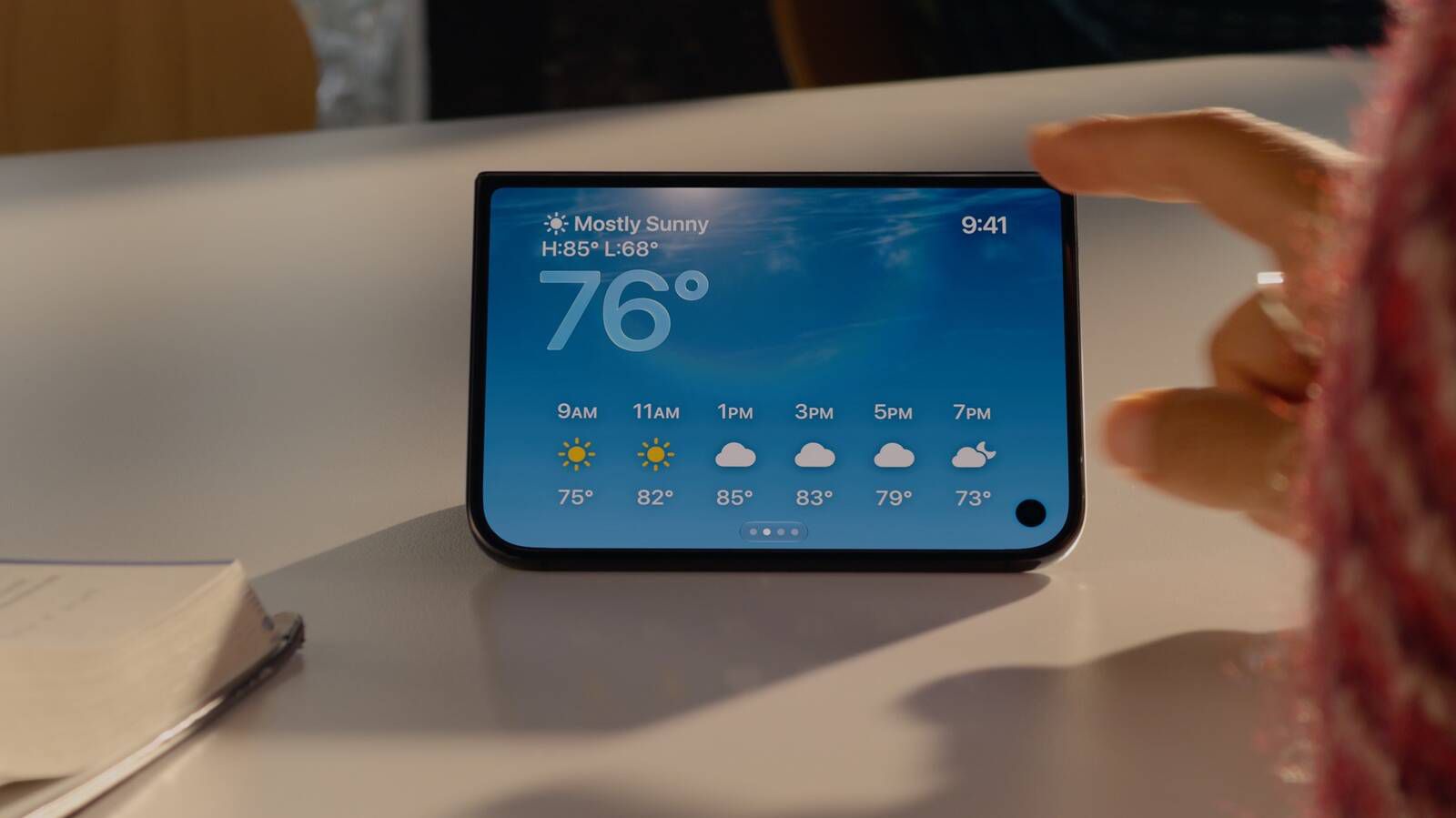
According to a notice published by China's National Medical Products Administration on Sept 4, Apple's "Sleep Apnea Notifications" feature has been officially approved, meaning users in China can finally enable the long-awaited health feature on Apple Watch, MyDrivers reported on Sept 19.
The feature does not alert in real time; instead it analyzes data on a 30-day cycle. If it consistently detects signs of moderate to severe sleep apnea, the device sends a notification and stores a related data report in the Health app, which users can take to a medical institution for consultation. The watch relies on its accelerometer to catch subtle wrist movements caused by breathing interruptions during sleep and to calculate a breathing disturbance index.
The feature will support Apple Watch Series 9, Series 10 and Ultra 2, and will roll out to users in China through watchOS updates. Sleep apnea has long been underdiagnosed, and chronic cases raise the risk of high blood pressure and cardiovascular disease. The report notes that the approval lets users in China do preliminary screening with a smartwatch, but those who receive a notification still need a hospital sleep study for a final diagnosis.

8. NASA Scientist Finds a 'Once-in-a-Century' New Moon Crater
Source: FOX Weather
During a routine data-quality check of a global map of the moon, NASA's Robert Wagner spotted an unusually large bright patch surrounded by a dark halo. Comparing before-and-after images, he confirmed a newly formed impact crater, which scientists say is the largest newly formed impact crater ever identified in the solar system. Named McGetchin Crater, it formed on the moon's eastern edge sometime between April 11 and May 22, 2024.
NASA said the crater was created when a comet or asteroid struck the lunar surface. The impact carved out a crater 728 feet wide and 141 feet deep; the white spot in the images is ejecta, not the crater itself, from a rock potentially the size of a three- to six-story building. The discovery was made using NASA's Lunar Reconnaissance Orbiter camera system, which orbits about 60 miles above the moon and uses two cameras to capture high-resolution black-and-white images, plus a third to collect moderate-resolution multispectral imagery.
Scientists estimate that an impact of this magnitude happens on the moon about once in a century or even longer. The new crater was named McGetchin, in honor of lunar scientist Tom McGetchin.

9. Huawei: Pura X Max Tops 1.2 Million Units Shipped in Four Months
Source: MyDrivers
As buzz builds around the foldable iPhone Duo, Huawei is stressing its status as a pioneer of the wide-fold category. Huawei's terminal division said on Weibo today: "The Pura X Max pioneered a √2:1 dual-side wide display, with imaging and communications that excel at everything. In four months on the market it shipped more than 1.2 million units, winning widespread praise."
The Pura X Max uses a horizontal wide-fold form factor. Its 5.4-inch outer screen has a peak brightness of 3,500 nits, supports 1-120Hz LTPO adaptive refresh and uses second-generation Kunlun Glass; the inner screen is a 7.69-inch WQHD+ flexible OLED in a 16:10 ratio with 3,000 nits peak brightness. The body uses a new basalt water-drop hinge that increases screen space by 16% and improves drop resistance by 33%, supports IP58 dust and water resistance, measures 11.2mm folded and 5.2mm unfolded, and weighs 229 grams.
It runs on a Kirin 9030 Pro chip and comes in 12GB+512GB, 16GB+512GB and 16GB+1TB versions, with a 5,300mAh battery supporting 66W wired, 50W wireless and 7.5W reverse wireless charging. The XMAGE rear camera system includes a 50-megapixel ultra-variable main camera with an RYYB sensor, a 12.5-megapixel ultrawide and a 50-megapixel periscope telephoto.

10. Report: China's AI Infrastructure Investment May Top 1 Trillion Yuan Next Year, Still Far Behind the U.S.
Source: Guancha
U.S. consultancy Rhodium Group recently released a report, "Inside China's AI Financing," analyzing capital investment, corporate cash flow and financing channels in China's AI industry. The report estimates that China's AI infrastructure capital expenditure will grow 103% year over year in 2026 to 932 billion yuan, and exceed 1.2 trillion yuan in 2027.
The report notes that despite strong momentum, China's AI investment still lags clearly behind the U.S. Rhodium estimates U.S. data center investment this year at about $800 billion (about 5.36 trillion yuan), meaning China's current AI build-out is only 15% to 20% of U.S. investment levels. Analyzing 13 listed Chinese companies, including cloud giants, telecom carriers, AI labs and independent data center operators, it found Alibaba, Tencent and Baidu are the main investors, with combined capital expenditure of 208 billion yuan in the first half of 2026, above early-year market expectations.
The report says China's AI industry relies more on equity financing and bank loans, with a relatively low share of bond-market funding. Data shows that although annual recurring revenue for China's frontier AI models has grown sharply, total ARR across all Chinese large-model companies is about $10.7 billion, just 10% of the revenue levels recently disclosed by OpenAI and Anthropic.
More News
- Global Express | September 19, 2026 — Two Ships Attacked in Strait of Hormuz as Trump Says Next Move Could Be to "Annihilate" Regime
- Sports Express | September 19, 2026 - Mitchell's 33-point night breaks WNBA single-season scoring record
- Maple Express | September 19, 2026 — York police investigate shots fired at a Markham home
- Finance Evening | Buffett Steps Down as Berkshire Chairman; Warsh's "Dose of Accommodation" Ripples Through Markets
- Maple Express Evening | September 18, 2026 — Toronto mayoral candidate wants to hike TTC fares to 'fix' system
Comments (0)
View More
 -12%
-12%HyperX Alloy Origins 60 — Full Aluminum 60% Mechanical Keyboard! $88.98 CAD (11% Off)
 -55%
-55%Sennheiser ACCENTUM True Wireless Earbuds — Hybrid ANC & 28-Hour Battery! $128 CAD (54% Off)
 -29%
-29%Oral-B iO4 Electric Toothbrush — Dentist-Trusted Clean, Gentle on Gums! $99.96 CAD (29% Off)
 -38%
-38%Sony WH-CH520 Wireless Bluetooth Headphones — 50-Hour Battery, 3-Min Fast Charge! $60.88 CAD (38% Off)
 Finance Evening
Finance Evening | Buffett Steps Down as Berkshire Chairman; Warsh's "Dose of Accommodation" Ripples Through Markets
Tech ExpressTech Express | September 19, 2026 — Google Confirms Gemini Breached Three Companies in First Known AI 'Escape'
-12%HyperX Alloy Origins 60 — Full Aluminum 60% Mechanical Keyboard! $88.98 CAD (11% Off)
Amazon
-55%Sennheiser ACCENTUM True Wireless Earbuds — Hybrid ANC & 28-Hour Battery! $128 CAD (54% Off)
Amazon
-29%Oral-B iO4 Electric Toothbrush — Dentist-Trusted Clean, Gentle on Gums! $99.96 CAD (29% Off)
Amazon
-38%Sony WH-CH520 Wireless Bluetooth Headphones — 50-Hour Battery, 3-Min Fast Charge! $60.88 CAD (38% Off)
Amazon
Finance EveningFinance Evening | Buffett Steps Down as Berkshire Chairman; Warsh's "Dose of Accommodation" Ripples Through Markets
Tech Express