
Tech Express | September 14, 2026 Apple Rolls Out iOS 27 Tonight
Apple's iOS 27 rolls out tonight, with an upgraded Siri AI that mainland China iPhones miss out on; the AI world debates whether to slow development; a Microsoft exec says AI systems only hit 20% performance; Fujitsu unveils the world's first 2nm 3D-stacked CPU; MetaX's C700 targets NVIDIA's H100; the iPhone 18 Pro is already below MSRP on Pinduoduo; Unitree launches the G1+ robot; China issues a first AI brain-computer interface standard; Mercury is shrinking 30% more than thought.
1. Apple Rolls Out iOS 27 Tonight
Apple has confirmed that iOS 27 will begin rolling out in the early hours of September 15 Beijing time, meaning users can upgrade tonight. The update does not abandon older devices — the iPhone SE (2nd generation and later) and the iPhone 11 series and later are all eligible.
Performance is a major focus. Official figures show app launch speeds improve by up to 30%, photo library loading by 70%, and AirDrop transfer efficiency by 80%, with smoother switching between cellular and Wi-Fi. The interface also refines the Liquid Glass UI and adds a transparency slider.
The upgraded Siri AI becomes a standalone conversational assistant that can recognize on-screen content, execute commands across apps, and read emails, photos, and messages to complete user requests. However, Siri AI and the full Apple Intelligence suite are limited to the iPhone 15 Pro and newer, launch in English only, and some advanced features will become paid with daily usage caps. The mainland China version of the iPhone still cannot use Siri AI.
2. AI Leaders Split Over Whether to Slow Development
The debate over whether AI development should "hit the brakes" is intensifying in the US tech world. Anthropic CEO Dario Amodei said in a CBS interview on September 13 that, in the long run, all parties should jointly set a "speed limit" for AI development, though he acknowledged this is difficult to achieve.
Amodei's stance has drawn support from OpenAI CEO Sam Altman, Google DeepMind head Demis Hassabis, and Elon Musk, who all agree AI development needs to slow down or be supervised. But there are dissenters — David Sacks, a former Trump administration AI official, questioned why OpenAI and Anthropic don't simply slow down on their own if they truly believe their models are dangerous.
President Donald Trump on the 13th opposed slowing AI development, declaring the US currently leads China in AI and saying "whoever wins AI wins." China's Foreign Ministry spokesperson Mao Ning earlier stressed that China upholds the beneficial development of AI and firmly opposes distorting facts to attack China.
3. Microsoft Exec: AI Systems Only Hit 20% Performance
Rani Borkar, corporate vice president of Microsoft Azure hardware systems and infrastructure, recently said that simply increasing memory chip capacity cannot solve AI infrastructure bottlenecks. Storage, she argued, should not be treated as a supply or component issue — it is fundamentally a system problem.
Borkar noted that as AI inference models grow larger and conversation contexts lengthen, storage and power are becoming harder limits than compute chips. Due to data transfer latency and bandwidth constraints, many AI systems only achieve about 20% of their actual performance. Her proposed solution is cross-layer "chip-to-system" co-design spanning models, compilers, chips, networking, and power.
Microsoft's in-house Maia 200 accelerator uses TSMC's 3nm process with 216GB of HBM3e memory, while reducing KV Cache demands through model compression, data science, and architecture design. Borkar stressed that Microsoft's new "effective output" metric is shifting AI infrastructure competition from stacking chips to system-level efficiency.

4. Jensen Huang on His "Parent-Style" Management
NVIDIA CEO Jensen Huang recently discussed his management style, describing himself as having a strict "Taiwanese parent" approach — criticizing nearly every piece of work employees show him — yet this high-pressure culture has produced one of the industry's lowest turnover rates.
In a May interview, Huang said Taiwanese parents always feel their children aren't good enough and criticize them every day. But he emphasized the criticism is not about punishment but improvement, and that it is followed by care, with the goal of making employees better.
The results show in the numbers: NVIDIA's fiscal 2025 overall turnover rate was just 2.5%, with roughly one in five employees having stayed at least a decade. At 63, Huang works seven days a week and says he hopes to keep working as long as possible.

5. Fujitsu Unveils World's First 2nm 3D-Stacked CPU
Japanese firm Fujitsu has announced that its homegrown next-generation CPU, FUJITSU-MONAKA, will go on sale as a standalone chip in November 2026, with global availability. The accompanying MONAKA server will launch simultaneously, serving enterprise, research, HPC, and defense sectors.
The CPU is billed as the world's first 2nm 3D-stacked processor to complete development and commercialization — its compute portion uses a 2nm process while cache and I/O use 5nm, with 3D stacking matching each module to the most suitable process. It reaches a 3.8GHz maximum clock and supports 8800MT/s DDR5 memory, halving server count and power consumption for AI inference workloads.
For AI compute, the processor has built-in matrix operation hardware acceleration and SVE2 vector instruction optimization, enabling efficient generative AI inference on the CPU alone. It also supports confidential computing with hardware-level encryption for data in use.

6. Chinese GPU Maker MetaX's C700 Targets NVIDIA H100
MetaX unveiled the latest progress on its next-generation flagship GPU, the C700, at its 2026 semi-annual results briefing. Chairman and general manager Chen Weiliang said the C700's core design and functional validation are nearly complete, with tape-out, software adaptation, customer testing, and production ramp-up next.
Built on a domestic advanced process and initiated in April 2025, the C700 delivers major gains in computing power, memory capacity, connectivity, and power efficiency, with overall performance targeting NVIDIA's H100. It adds support for low-precision FP4 compute to meet large-model inference needs.
Supply-chain independence is a core advantage — CTO Peng Li said the company has domestic solutions for wafer foundry, packaging, and large-capacity memory. The 7nm-based C600 entered mass production in May 2026 with 144GB of HBM3e. Analysts expect the C700 to enter tape-out testing in 2026 and mass production in the second half of 2027.

7. iPhone 18 Pro Already Below MSRP on Pinduoduo
The iPhone 18 Pro goes on sale this Friday with a starting price of 9,999 yuan. Although first sale is still days away, the iPhone 18 Pro on Pinduoduo's "10 billion subsidy" channel has already fallen below MSRP — the 256GB model costs 9,099 yuan, 900 yuan cheaper than Apple's official site, with 46,000 orders placed.
As this year's flagship, the iPhone 18 Pro's key upgrades include a 48MP fusion main camera with variable aperture, the A20 Pro chip, and a smaller Dynamic Island, plus new burgundy red and glacier blue colors. The main camera supports four aperture stops for the first time.
On performance, the iPhone 18 Pro debuts the 2nm A20 Pro chip with a 6-core CPU and 7-core GPU, plus hardware-accelerated ray tracing. Storage ranges from 256GB to 2TB, with the top 2TB model priced at 20,499 yuan.

8. Unitree Launches Humanoid Robot G1+
Unitree Robotics today announced a major upgrade to its humanoid robot G1, officially launching the G1+. The new model brings six upgrades across motion performance, perception and interaction, and intelligence, while retaining the G1's value positioning and strengthening neck flexibility, motor output and thermal management, vision and touch sensing, power endurance, and far-field voice interaction.
On pricing, the standard G1+ costs 95,000 yuan including tax, while the G1+EDU for research and deep development has no announced price yet. Shoulder and waist motor peak torque rises 110% with 72% lower heat, and arm motor peak torque rises 43%; a dual-degree-of-freedom neck makes head movements more natural.
For perception, the G1+ uses a dual-camera plus wide-angle monocular vision system, combined with 3D LiDAR and an abdominal wide-angle camera. The standard model weighs about 35kg and has 25 joint motor degrees of freedom.

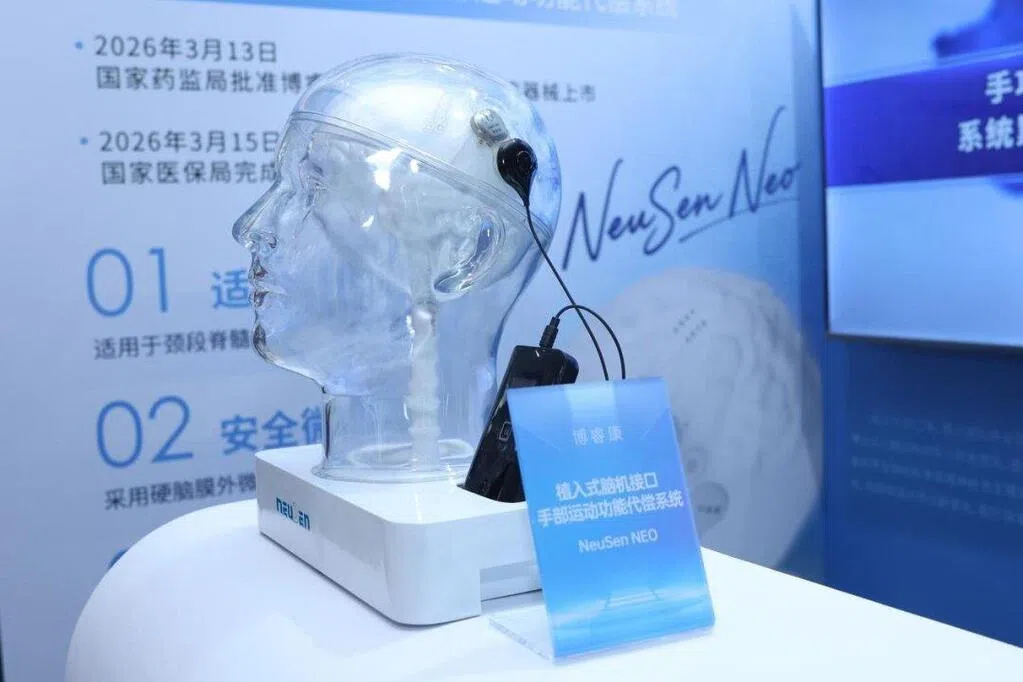
9. China Issues World's First AI Brain-Computer Interface Standard
China's National Medical Products Administration on Monday (September 14) approved and published the country's third brain-computer interface (BCI) medical device standard — and the world's first for a BCI medical device product that uses AI technology to process EEG data. The new standard takes effect on September 1 next year.
According to CCTV News, the standard systematically regulates the full process of data collection, processing, labeling, storage, and access for BCI medical devices, plus technical requirements and test methods, helping companies resolve common problems like inconsistent dataset quality control.
The regulator said a BCI medical device is like an intelligent machine that reads brain signals, needing to learn from large amounts of EEG data and train AI algorithms to accurately understand patient intent. To support innovation, the regulator used a fast-track process, giving R&D a unified "quality yardstick" for EEG datasets.
10. Study: Mercury Is Shrinking More Than Thought
A new study finds Mercury has shrunk 30% more than scientists previously estimated. The planet closest to the sun has been leaking heat into space since it formed 4.5 billion years ago; as its heavy iron core cools, the whole planet contracts, like a grape turning into a raisin.
The study shows Mercury has lost up to 14.5 miles of diameter since birth, out of a planet only about 3,000 miles wide. Lead author Gaku Nishiyama, a planetary scientist at the German Aerospace Center, said the corrected contraction amount "makes sense" to him. Constant meteor impacts have spread rubble that conceals Mercury's wrinkles, causing earlier underestimates.
The findings, published this week in Geophysical Research Letters, suggest Mercury may hold a larger metal core with fewer light elements, hinting at a catastrophic ancient collision. The ESA-JAXA BepiColombo spacecraft is expected to enter Mercury's orbit in November and scan its surface with lasers to verify the work.

More News
- Global Express | September 14, 2026 Iran War Escalates as Oil Prices Near Four-Month High
- Finance Morning: Asia Tech Stocks Fall on AI Slowdown Fears; South Korea Launches Night Trading
- Sports Express | September 14, 2026 Vikings Beat Packers 39-22 in Historic NFL Scorigami
- Maple Express | September 14, 2026 Markham reservist killed on Ukraine's front lines
- Maple Express | September 13, 2026 — Carney's Investment Summit Opens in Toronto as Protests Loom
Comments (0)
View More
 -34%
-34%Jiefeike 45L Travel Laptop Backpack — TSA-Friendly, Fits 17" Laptop! $52.99 CAD (34% Off)
 -45%
-45%LEGO Classic Creative Suitcase 10713 — 213 Bricks with Storage Case! $24.86 CAD (45% Off)
 -37%
-37%Webber Naturals Vitamin B12 5000 mcg Sublingual — Active Methylcobalamin, #1 B12 Seller! $10.78 CAD (36% Off)
 -34%
-34%LEGO Disney Lucky & Penny 101 Dalmatians — 268 Pieces! $19.97 CAD (33% Off)
 Maple Express
Maple Express | September 13, 2026 Report: Carney explores making Canada an 'associate member' of the EU
 Maple Express
Maple Express | September 14, 2026 Markham reservist killed on Ukraine's front lines
-34%Jiefeike 45L Travel Laptop Backpack — TSA-Friendly, Fits 17" Laptop! $52.99 CAD (34% Off)
Amazon
-45%LEGO Classic Creative Suitcase 10713 — 213 Bricks with Storage Case! $24.86 CAD (45% Off)
Amazon
-37%Webber Naturals Vitamin B12 5000 mcg Sublingual — Active Methylcobalamin, #1 B12 Seller! $10.78 CAD (36% Off)
Amazon
-34%LEGO Disney Lucky & Penny 101 Dalmatians — 268 Pieces! $19.97 CAD (33% Off)
Amazon
Maple ExpressMaple Express | September 13, 2026 Report: Carney explores making Canada an 'associate member' of the EU
Maple Express