
Tech Express | September 7, 2026 Huawei's Mate XT 2 tri-fold phone debuts at ¥19,999
Today's Tech Express: Huawei launches the Mate XT 2 tri-fold phone with the Kirin 9050 Pro chip; HarmonyOS 7 upgrades Xiaoyi into a system-level AI agent; Goldman Sachs stays bullish on Korean stocks amid a memory shortage; LG smart TVs found logging audio while off; US retail investors hand stock accounts to AI; Bill Gates warns on AI risk; China plans 6G; Sugon unveils a 64-thread laptop; Hubble spots a ten-sided storm at Saturn.
1. Huawei launches Mate XT 2 tri-fold phone at ¥19,999
Source: IT Home
On September 7, Huawei officially launched the Mate XT 2 Ultimate Design, its new-generation tri-fold flagship, starting at ¥19,999. The phone uses a new G-shaped folding design, measuring just 12.3mm when folded and 3.5mm unfolded. The inner display is a 10.2-inch 3K panel, while the 6.5-inch outer screen peaks at 6,500 nits.
The Mate XT 2 debuts the Kirin 9050 Pro, which Huawei calls its most powerful smartphone chip yet, delivering 42% higher performance than the Mate XTs. It is also the first tri-fold phone to support IP58/59 dust and water resistance, and it introduces a hardware-level privacy screen and ECG heart analysis.
2. HarmonyOS 7 turns Xiaoyi into a system-level AI agent
Source: MyDrivers
At its September 7 launch event, Huawei upgraded its voice assistant Xiaoyi into a system-level agent deeply integrated with HarmonyOS 7. With user permission, Xiaoyi can access more than 200 system-level data points and call on over 2,100 system capabilities, 2,000-plus HarmonyOS agents, and 500-plus partner Skills.
Built on a new Agentic self-evolving architecture, Xiaoyi can reason through tasks, plan steps, call the right tools, and then review the process to turn what it learns into reusable Skills. It is shifting from answering questions to getting things done.

3. Goldman Sachs sees memory-chip shortage worsening, stays bullish on Korean stocks
Source: MyDrivers
Goldman Sachs' chief Asia-Pacific equity strategist Timothy Moe is sticking with a 12,000-point target for the Kospi, implying nearly 80% upside from current levels. In a recent interview he said investors are underestimating how long AI will boost Korean memory-chip makers.
Moe said the global data-center buildout has created a severe memory-chip shortage that is pushing up prices, and he expects the dynamic to intensify further in 2027. He forecasts US Big Tech spending to exceed $1.2 trillion next year, well above an earlier $800 billion estimate, a positive for memory chips.

4. Edinburgh researchers propose a way to slash magnetic memory energy use
Source: Science Daily
Researchers at the University of Edinburgh have developed a new theoretical framework that could greatly reduce the energy needed to store and manipulate digital information in future magnetic memory technologies. Using optimal control theory, they designed ultrafast magnetic-field pulses that switch magnetic states with as little energy as possible.
Computer simulations suggest the method could lower switching energy by several orders of magnitude compared with DRAM, STT-MRAM, and emerging SOT-MRAM, moving future memory closer to the Landauer limit, the fundamental minimum energy for processing a single bit.

5. Investigation: LG smart TVs log audio while off and scan home networks
Source: Notebookcheck
An investigation by Gamers Nexus found LG smart TVs continuously sweep home networks to map phones and nearby devices, and can capture microphone audio even with the screen apparently off, storing it locally and uploading once reconnected to the internet.
The data feeds LG Ad Solutions, the company's targeted-advertising arm. LG says it has roughly 216 million smart TVs sold globally, and the sets also run automated content recognition to log what users watch. LG had not commented as of writing.

6. US retail investors are handing stock accounts to AI agents
Source: MyDrivers
Many US retail investors have begun letting AI fully manage their stock portfolios. Brokers including Robinhood and Webull now offer features that connect users to AI agents such as Claude and Codex, which can then buy and sell assets autonomously.
Irene Aldridge, a former quant trader now focused on AI and financial markets, called it a major breakthrough for retail investors, while cautioning users to use AI at your own risk.

7. Bill Gates again warns on AI risk, urges US and China to slow down
Source: MyDrivers
Bill Gates again raised the risks of AI in an outdoor talk at the Telluride Film Festival last Saturday. He pointed to HAL, the runaway AI in 2001: A Space Odyssey, as an example of unconstrained AI that could refuse a shutdown command.
Gates urged the US and China to slow down or keep AI's intelligence within controllable bounds. We don't understand how it thinks, and we can't control it, he said of AI systems that learn and evolve.

8. China's MIIT plans to launch 6G commercial services in due course
Source: Jiemian
China's Ministry of Industry and Information Technology (MIIT) issued the 15th Five-Year Plan for the information and communications industry, calling for moderately front-loaded infrastructure construction, upgrading networks in cities and hotspots toward dual 10-gigabit, and launching 6G commercial services when appropriate.
The plan also proposes actively piloting 10-gigabit optical networks, expanding coverage gradually, and extending 5G-Advanced networks across urban areas.
9. Sugon unveils the world's first 64-thread laptop, the N50 Pro
Source: MyDrivers
Chinese supercomputer maker Sugon has launched the N50 Pro, the first laptop with a 64-thread mobile processor, breaking the previous 32-thread ceiling for mobile platforms. The chip model was not disclosed but is widely believed to be Hygon's C86-5G series.
Official data shows the machine cut a fluid-dynamics simulation from 2.4 hours to one hour, a roughly 140% efficiency gain. It supports up to 128GB of memory and 8TB of storage.

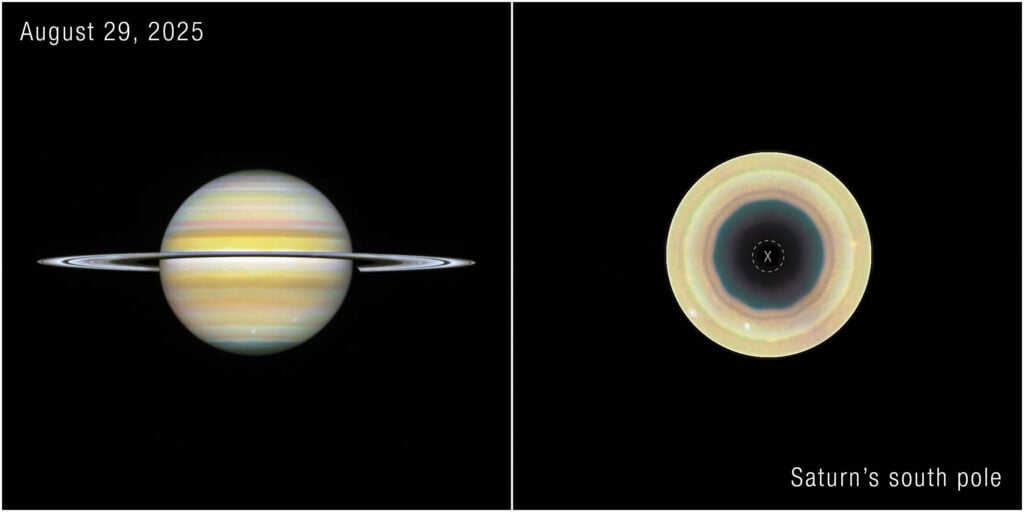
10. Hubble finds a ten-sided storm at Saturn's south pole
Source: Space Daily
Using the NASA/ESA Hubble Space Telescope, astronomers found a ten-sided storm, a decagon, encircling Saturn's south pole, roughly 104,000 miles (about 168,000 km) across. It is the geometric counterpart of the six-sided jet that has ringed Saturn's north pole for decades. The finding, led by Agustín Sánchez-Lavega of the University of the Basque Country, was published in Science Advances.
Because of Saturn's axial tilt and long orbit, its south pole was hidden from Earth for years, which is why the structure was missed. Hubble data show the decagon appears to be strengthening rather than fading.
More News
- Global Express | October 22, 2026: Two Killed at Saudi Arabia's Dammam Airport as U.S. Orders Diplomats Out
- Asia Stocks Slump: ChiNext Falls 4.37%, Hang Seng Tech Below 3,800, Oil Tops $100
- Tech Express | October 22, 2026 — Japan Launches MMX Probe in First Attempt to Land on Phobos
- Sports Express | October 22, 2026 — Forge FC Win Canadian Championship on Penalties, a First for the CPL
- Maple Express | October 22, 2026 — Final Toronto mayoral debate tonight, with nearly 30% of voters open to switching
Comments (0)
View More
 -30%
-30%NICETOWN Outdoor Mosquito Net Curtains, 2 Panels 118 x 98" — Bug-Free Patio! $44.39 CAD (30% Off)
 -51%
-51%Razer Kishi V3 Pro Mobile Gaming Controller — Full-Size Console Grips, Half Price! $109.96 CAD (50% Off)
 -34%
-34%AEGTEST HOUND-1011 Portable Radon Detector — First Reading in 6 Hours, 45-Day Standby! $66.99 CAD (33% Off)
 -41%
-41%Segway Ninebot E2 Pro E-Scooter — 35 km Range, Puncture-Proof Tyres! $399.99 CAD (40% Off)
 Finance Morning
Asia Stocks Slump: ChiNext Falls 4.37%, Hang Seng Tech Below 3,800, Oil Tops $100
 Global Express
Global Express | October 22, 2026: Two Killed at Saudi Arabia's Dammam Airport as U.S. Orders Diplomats Out
-30%NICETOWN Outdoor Mosquito Net Curtains, 2 Panels 118 x 98" — Bug-Free Patio! $44.39 CAD (30% Off)
Amazon
-51%Razer Kishi V3 Pro Mobile Gaming Controller — Full-Size Console Grips, Half Price! $109.96 CAD (50% Off)
Amazon
-34%AEGTEST HOUND-1011 Portable Radon Detector — First Reading in 6 Hours, 45-Day Standby! $66.99 CAD (33% Off)
Amazon
-41%Segway Ninebot E2 Pro E-Scooter — 35 km Range, Puncture-Proof Tyres! $399.99 CAD (40% Off)
Amazon
Finance MorningAsia Stocks Slump: ChiNext Falls 4.37%, Hang Seng Tech Below 3,800, Oil Tops $100
Global Express