
Finance Weekly | Warsh's Hawkish Debut Sends Markets Repricing for Rate Hikes
Fed Chair Warsh's hawkish Jackson Hole debut signaled inflation remains above target and opened the door to rate hikes, lifting the 2-year yield and pushing September hike odds to 55.7% as gold slid over 3%. ECB officials and the Bank of Korea also turned hawkish. China rolled out mortgage, tax and payment-license policies, while Canada's Q2 GDP grew 3.3% amid trade-war clouds.
This Week in Finance
The keyword for global markets this week was "hawkish." In his Jackson Hole debut, Fed Chair Warsh made clear that inflation remains above the 2% target and "opened the door" to rate hikes, sending the 2-year Treasury yield higher and lifting the odds of a September hike to 55.7%; spot gold slid over 3% in a day. ECB officials and the Bank of Korea also struck hawkish notes, pushing global tightening expectations higher. In China, the central bank and regulators rolled out policies on property credit, restricted-share taxes and payment licenses; Canada's Q2 GDP surprised with 3.3% growth, though the trade war clouds the outlook. Here are the week's ten big stories.
Fed's Warsh Opens the Door to Rate Hikes in Hawkish Jackson Hole Debut
来源:CNBC
Federal Reserve Chair Kevin Warsh's first appearance at the Jackson Hole symposium became this week's global turning point. He offered no traditional forward guidance, yet drew a clear hawkish line: although this summer's inflation readings were better than expected, they "do not tell me that underlying trends have meaningfully improved." The chairman — who took office in May and marked his 100th day — made prices his single overriding concern.
Bond markets reacted first. The policy-sensitive 2-year Treasury yield jumped nearly 8 basis points to 4.31%, its highest since late July. The CME FedWatch tool showed the probability of a September rate hike rising to 55.7%, about 20 percentage points higher than a day earlier. Heather Long, chief economist at Navy Federal Credit Union, said Warsh "opened the door to a Fed rate hike" that may not come in September but could arrive by October or December.
More significant was Warsh's effort to reshape the Fed's role. He advocated a "quieter Fed, more purposeful in its communications," opposed forward guidance as "hand-holding" that has "overstayed its welcome," and has launched five task forces since taking office — a sharp contrast to predecessor Jerome Powell, who hinted at rate cuts at last year's event and sparked a Wall Street rally.
The risk is that markets are still adjusting to an era without a roadmap. If inflation stays stubborn, the hike will be late rather than absent, and the repricing of stocks, bonds and currencies could stretch through the autumn.
Hawkish Shockwave: Spot Gold Slides Over 3% in a Day
来源:Sina Finance
Warsh's hawkish remarks doused a gold rally that had run for more than a month. Citing the data, he noted the PCE price index rose 3.7% over 12 months and 4.1% over six months, with the CPI also elevated — "inflation is running above the Fed's 2% target." Rate-hike pricing quickly followed: the odds of holding rates in September plunged from 64.6% to 43%, while the odds of a 25-basis-point hike jumped from 35.4% to 57%.
Spot gold fell more than 3% in a single day on Aug. 28-29, briefly dipping below $4,460. The drop came after a sharp run-up — gold had climbed more than 14% between July 16 and Aug. 27, nearing $4,700 an ounce and nearly recovering from its slide from a Jan. 29 peak of $5,405 to below $4,000.
The rally had been driven by both investment demand and central-bank buying. World Gold Council data show global physical gold ETFs added about $3 billion in July, lifting holdings to 4,068 tonnes; central banks net-bought 289 tonnes in Q2, up 62% year-on-year. China's central bank added nearly 20 tonnes in July, its 21st straight monthly increase.
Looking ahead, institutions expect the "investment-driven, central-bank-supported" structure to persist, but positioning is crowded and volatility has widened. Prediction markets now put the odds of gold hitting $5,000 this year above 60%, well ahead of institutional consensus — itself a source of short-term swings. If rate-hike expectations keep building, gold faces meaningful pullback pressure.
U.S. Stocks Flash a Rare Signal Seen Only Three Times in 156 Years
来源:Yahoo Finance
Beneath the record highs, a signal seen only three times in nearly 156 years is flashing over U.S. equities. The S&P 500's Shiller price-to-earnings ratio — the cyclically adjusted P/E, or CAPE — closed at 41.84 on Aug. 24, roughly 140% above its long-term average of 17.4 dating to 1871, and near its June 1 bull-market high of 42.84.
The Shiller P/E is prized because it uses average inflation-adjusted earnings over the prior decade rather than a single year, smoothing out recession-driven distortions. History shows the CAPE has exceeded 40 during a continuous bull market only three times: January 1999 to September 2000 (the dot-com run-up), January 2022 (just before that year's bear market), and May 2026 to the present.
The first two episodes were painful: after the dot-com bubble burst, the S&P 500 and Nasdaq fell 49% and 78% respectively; in the 2022 bear market, the Dow, S&P and Nasdaq lost about 20%, 25% and 33%. Today the S&P 500 stands at 7,711, the Dow at 53,559 and the Nasdaq at 26,402 — all near historic highs.
A high CAPE doesn't guarantee a crash, nor can it time a top. But author Sean Williams warns that history repeatedly shows extreme valuations foreshadow lower future returns. Combined with rising rate-hike expectations from Warsh's hawkish turn, high valuations become more sensitive to interest rates, and investors should stay wary of "when the music stops.

China Extends Maximum Mortgage Term to 40 Years
来源:Sina Finance
On Aug. 28, the People's Bank of China and the financial regulator jointly issued a 36-article opinion across seven chapters to overhaul property credit across the full development, construction, sales and operation cycle. The most talked-about change extends the maximum personal mortgage term from 30 to 40 years, while pushing the loan-disbursement point from "structural topping-out" to "completion filing."
The move targets the pain of homebuyers who "haven't received their home but must start repaying." Previously, loans were disbursed once a project's main structure topped out, leaving finishing work unfinished and buyers stranded if delivery was delayed. Under the new rules, loans for completed homes are disbursed after sales filing, and for pre-sales after completion filing — reinforced by escrow payments and a lead-bank system for closed-loop fund management.
For buyers, the direct effect is a lower monthly payment. On a 1-million-yuan, equal-installment loan at 3%, a 30-year term costs about 4,216 yuan a month, versus about 3,576 yuan over 40 years — roughly 640 yuan less each month — though total interest rises from about 518,000 yuan to 717,000 yuan, nearly 200,000 yuan more. The debt-to-income ceiling was also lifted from 55% to 60%, further boosting borrowing capacity.
Industry insiders say the policy supports the shift toward completed-home sales by deferring disbursement and containing default risk. For first-time buyers, lighter monthly payments must be weighed against higher total interest — and whether demand truly releases still hinges on price expectations and income confidence.

New Tax Rules Close Loopholes on Restricted-Share Transfers
来源:CCTV Finance
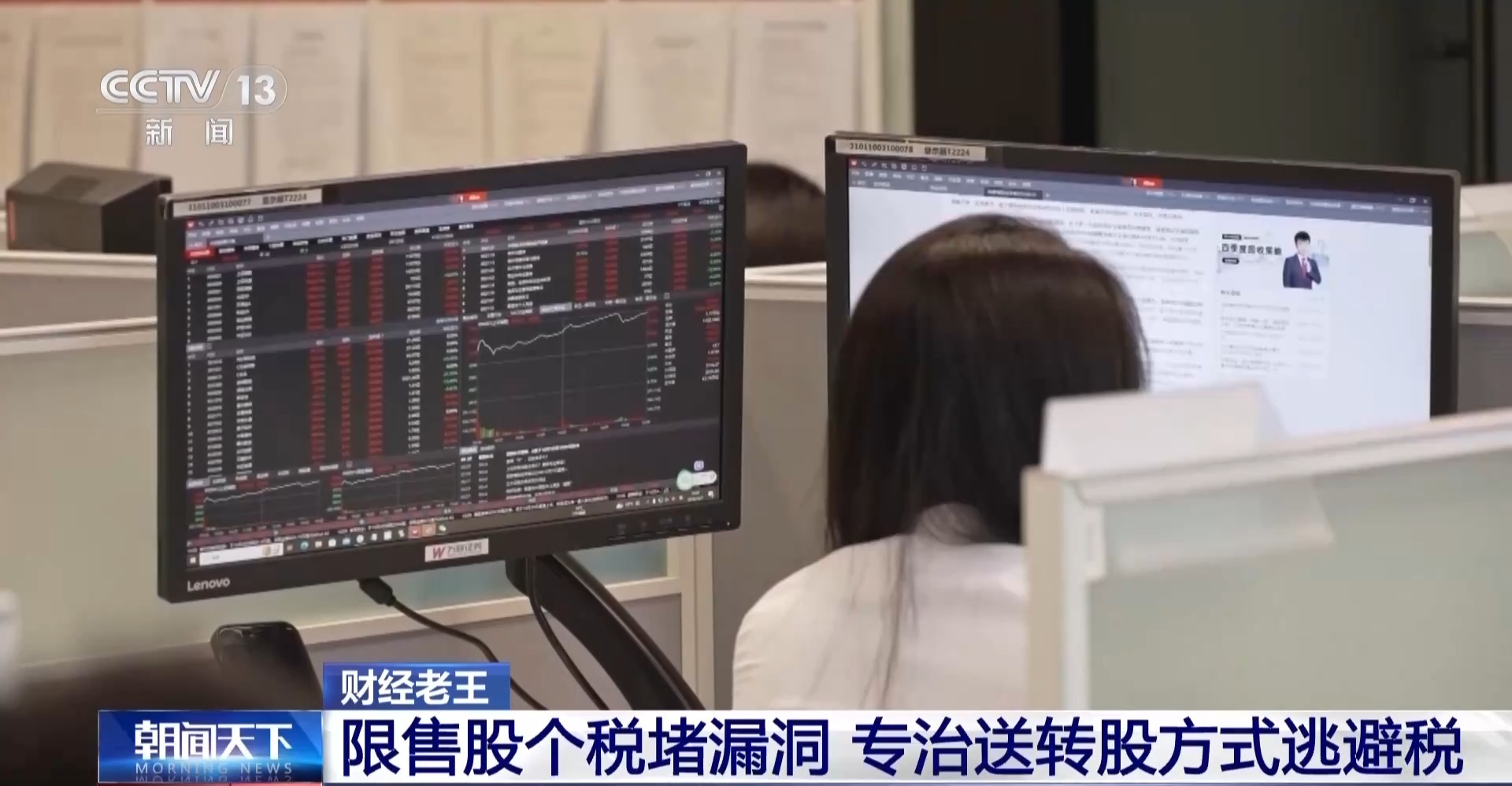
China's Ministry of Finance, tax authority and securities regulator jointly issued a notice on Aug. 28 tightening individual income tax on restricted-share transfers, targeting two long-standing loopholes. Restricted shares are typically acquired before a company lists and cannot be sold during the lock-up period — and are mostly held by major shareholders.
The first loophole was "bonus-and-transfer detours." Under the old rules, once restricted shares unlocked, any newly created bonus or converted shares no longer counted as restricted, so selling them escaped the 20% tax. Some major shareholders thus pushed large bonus issues — "one share becomes two, halving the price" — then sold the same quantity while saving heavily on tax. The second was "feigning amnesia": sellers without original cost records had costs imputed at just 15% of proceeds, sharply shrinking taxable income.
The new rules make clear that both original restricted shares and any bonus or converted shares derived from them are fully taxable; where complete cost records are unavailable, tax authorities no longer "guess" the cost and instead withhold tax on the full transfer amount, subject to later settlement filing.
Tax experts stress the rules only target tax loopholes in restricted-share transfers — ordinary investors trading shares on the secondary market are unaffected. Closing the arbitrage actually reduces unfair advantages, a genuine positive for the capital market and retail investors.
Payment-License Renewal: First 'Non-Renewal' Case Lands
来源:Sina Finance
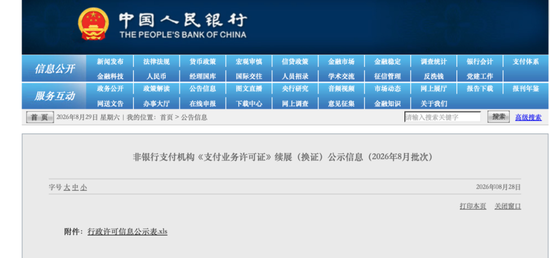
The People's Bank of China's August 2026 batch of payment-license renewals, published on Aug. 28, unusually showed two applications suspended and one denied — a clear signal that a payment license is "not a lifetime talisman."
The two suspended cases belong to listed-company affiliates: LianLian Yintong, a wholly-owned subsidiary of Hong Kong-listed LianLian Digital, focused on internet, mobile and cross-border payments; and Liandong UMF, a subsidiary of A-share-listed HyUnion Holding. Both responded the same evening that suspension is a procedural right under administrative rules, that business and customer funds are unaffected, and that they will apply to resume review as soon as possible.
The more striking case was the "non-renewal" of Chengdu Moba Payment — the first such denial since the central bank launched the long-term license swap in July 2025. The firm was fined more than 29 million yuan in July for violations in account, clearing and merchant management, and its application to change registered capital and shareholders was not approved. Analyst Wang Pengbo said its weak operating quality and governance made the cleanup expected.
Data show the shakeout is accelerating: six institutions were deregistered this year, bringing cumulative cancellations to 114, leaving just 157 operating normally. The regulatory direction is increasingly clear — maintaining compliance and focusing on genuine industrial and cross-border payment scenarios is the only sustainable path.
Canada's Trade-War Leverage — and Its Cost
来源:CBC
With the Trump administration promising 50% tariffs on Canadian goods (about $27 billion worth) in January, Canadians are asking how much leverage they actually hold. The answer is "a lot" — but economists warn most of it would hurt Canada as much as the U.S.
On resources, Canada's leverage is substantial: in 2025 it supplied 63% of U.S. oil imports, 81.3% of electricity imports, nearly 100% of natural gas and 80% of potash. Former TD chief economist Don Drummond suggests restarting export taxes or quotas on oil and gas, or restricting U.S. access to Canadian critical minerals. Financially, Canadian institutions hold about $459.6 billion in U.S. Treasuries, and 51% of the CPP fund's $864 billion is invested in the U.S. — selling those could sting Washington but would drag Canadians' retirement savings into politics.
University of Calgary economist Trevor Tombe estimates the 50% tariffs would shave about 0.4% to 0.5% off Canadian GDP; retaliation that costs more than that makes little economic sense unless it changes U.S. behavior. University of Ottawa professor Wolfgang Alschner worries that even short-term supply cutoffs signal "supplies can be turned off," prompting the U.S. to find alternatives over the long run.
Many experts therefore urge restraint — rather than emotional retaliation, focus on trade diversification and removing internal provincial barriers, which carry longer-term value.

Canada's Q2 GDP Surprises With 3.3% Growth
来源:CBC
Statistics Canada's latest data show the economy grew at an annualized 3.3% in the second quarter — well above the Bank of Canada's 2.5% forecast and just one percentage point below economist expectations. June GDP rose 0.3%, with manufacturing expanding for a third straight month.
Growth was broad-based: exports rose 3.6% on stronger auto shipments; residential investment climbed as resale activity rebounded in Ontario, B.C. and Quebec; business investment grew 2.3%, including a 16.7% jump in computers and peripherals tied to data-centre processors; and household spending rose 0.8%. Manulife macro strategist Dominique Lapointe credited "more confident consumers, a somewhat stronger labour market, and businesses regaining confidence to invest in equipment."
Crucially, the agency revised first-quarter GDP up to a slight 0.3% gain, quashing talk of a technical recession. BMO economist Doug Porter said the "so-called technical recession has been sent to the trash bin."
The forward signal is less rosy, however: preliminary July estimates show growth essentially flat, and trade-war tensions cloud the outlook. The Bank of Canada meets Sept. 2, and Porter expects it to hold rates at 2.25% until the tariff impact becomes clearer.

ECB: Economy Resilient, Inflation Threat Persists
来源:FXStreet
At this week's Jackson Hole symposium, the European Central Bank struck a tone echoing the Fed's. Martin Kocher, Governor of the Austrian National Bank and an ECB Governing Council member, said Europe's economy is "more resilient than expected" and "showing more momentum now."
But Kocher also stressed that threats still "lean towards price stability" — meaning inflation remains the primary concern. He described the ECB's posture as one of "alertness and no complacency," against a backdrop of eurozone inflation picking up again as higher energy costs keep price pressures elevated.
Like Warsh, Kocher gave no explicit rate path, but the message was clear: an economy more resilient than expected gives the central bank room to maintain — or even extend — its tightening stance, rather than pivot to easing over growth fears.
For the euro, persistent tightening expectations provide support; FXStreet data showed the euro broadly firmer against major currencies that day, led by gains against the New Zealand dollar. Yet whether Europe's "momentum" translates into sustainable growth remains the key question — if high energy prices keep eroding consumption and corporate profits, the ECB's hawkish room will be constrained. The global "inflation-first" consensus is steering the eurozone, alongside U.S. and Asian markets, into a more cautious, data-dependent policy cycle.
Bank of Korea Hikes Again, Won Hits 13-Month High
来源:Sina Finance
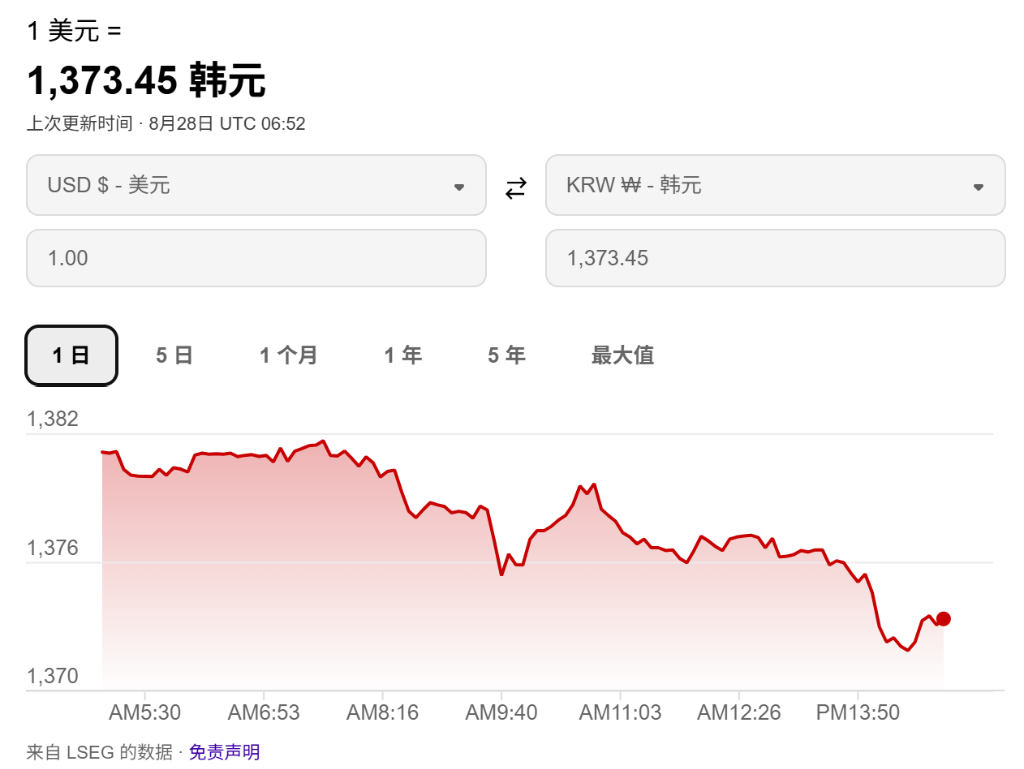
The most striking Asian story this week was the Bank of Korea's second consecutive hike. It raised the base rate by 25 basis points to 3.0% — the highest since February 2025 — sending the won to a 13-month high, with the dollar briefly falling to 1,373 won.
The hawkish stance is backed by strong fundamentals. The central bank sharply raised its 2026 growth forecast from 2.6% to 3.3%, citing robust exports and persistent AI-driven semiconductor demand. That mix of upward growth revision and inflation pressure gave the monetary authority a strong case to tighten. Governor Shin Hyun-song said further tightening is possible but that the pace would remain "gradual" to assess the real effect of prior hikes.
The won's strength is not isolated. The Australian dollar also rose to a three-month high after stronger-than-expected inflation reinforced bets on another RBA hike this year. The two currencies' synchronized gains outline a key Asia-Pacific theme: for some economies, the tightening cycle is not over, driven by both inflation and growth.
Meanwhile, Asian currencies overall remain cautious. Investors largely stayed on the sidelines ahead of Warsh's Jackson Hole speech, with the dollar index near 99.18, up about 0.4% for the week. As Fed rate-hike expectations build, pressure for "follow-on tightening" among Asia-Pacific central banks could rise, and the appreciation room for strong currencies like the won faces repricing.
More News
- AI Weekly | Anthropic Warns Models Are 'Months Away' From Self-Replication as AI Safety and Bubble Alarms Sound
- Global Express | October 14, 2026 — Houthi Missiles and Drones Pound Saudi Arabia as US Air Defenses Struggle
- Finance Morning | Huang Qifan Under Investigation; Sept Social Financing Up 7.1%; Chinese Automakers Welcome EU-China Consensus
- Tech Express | October 14, 2026 — China's First Domestic EUV Light Source Prototype Debuts, 90% Localized
- Sports Express | October 14, 2026 — Tkachuk Brothers Make NHL History as Brady's Hat Trick Is All Assisted by Matthew
Comments (0)
View More
 -26%
-26%Shark FlexStyle Air Styling & Drying System HD430C — Dryer, Curler & Brush in One! $299.99 CAD (25% Off)
 -17%
-17%Lenovo IdeaPad Duet 3 Chromebook — 11" 2K Touchscreen 2-in-1! $399.99 CAD (17% Off)
 -42%
-42%LG S60TR 5.1-Channel Soundbar System — Rear Surround Speakers Included! $348 CAD (42% Off)
 -43%
-43%HUANUO Single Monitor Wall Mount 17"–32" — Full Motion Arm, Frees Up Your Desk! $39.99 CAD (43% Off)
 Maple Express
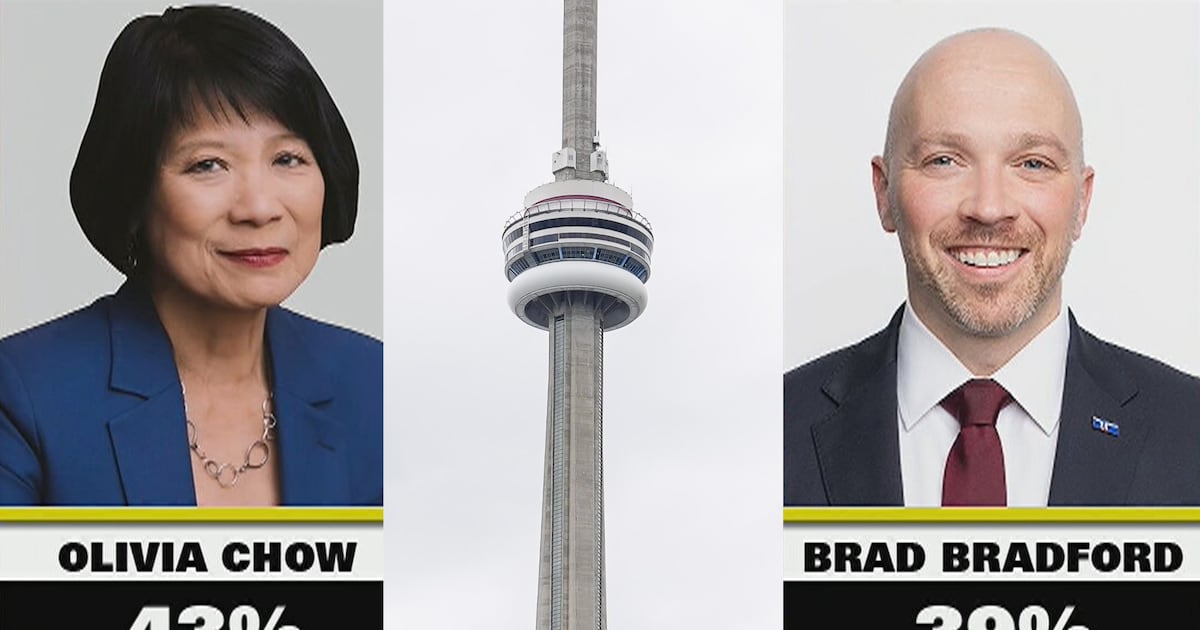
Maple Express | October 13, 2026 Toronto mayoral race tightens as Bradford cuts Chow's lead to about 3.5 points
 Tech Express
Tech Express | October 14, 2026 — China's First Domestic EUV Light Source Prototype Debuts, 90% Localized
-26%Shark FlexStyle Air Styling & Drying System HD430C — Dryer, Curler & Brush in One! $299.99 CAD (25% Off)
Amazon
-17%Lenovo IdeaPad Duet 3 Chromebook — 11" 2K Touchscreen 2-in-1! $399.99 CAD (17% Off)
Amazon
-42%LG S60TR 5.1-Channel Soundbar System — Rear Surround Speakers Included! $348 CAD (42% Off)
Amazon
-43%HUANUO Single Monitor Wall Mount 17"–32" — Full Motion Arm, Frees Up Your Desk! $39.99 CAD (43% Off)
Amazon
Maple ExpressMaple Express | October 13, 2026 Toronto mayoral race tightens as Bradford cuts Chow's lead to about 3.5 points
Tech Express