Tech Express | November 9, 2026: Apple Unveils HALO Humanoid Robot Research With 91% Success in Unseen Homes
Apple published HALO humanoid research: a Unitree G1 with a Mac mini and Qwen hit 91% success in six unfamiliar homes. Musk called the SpaceX-Anthropic $45B deal two-way. A user ran 2.8T-parameter Kimi K3 on CPUs with used Optane. HBM squeezed DRAM supply; CPU-Z shows 64GB builds down 18%. iPhone 18 Pro took China's top weekly sales spots; OPPO's Find N7 surfaced. SpaceX and Nvidia plan StarMind orbital compute in Q3 2027. Chinese models led US API volume 28 weeks. A fireball lit Tennessee.
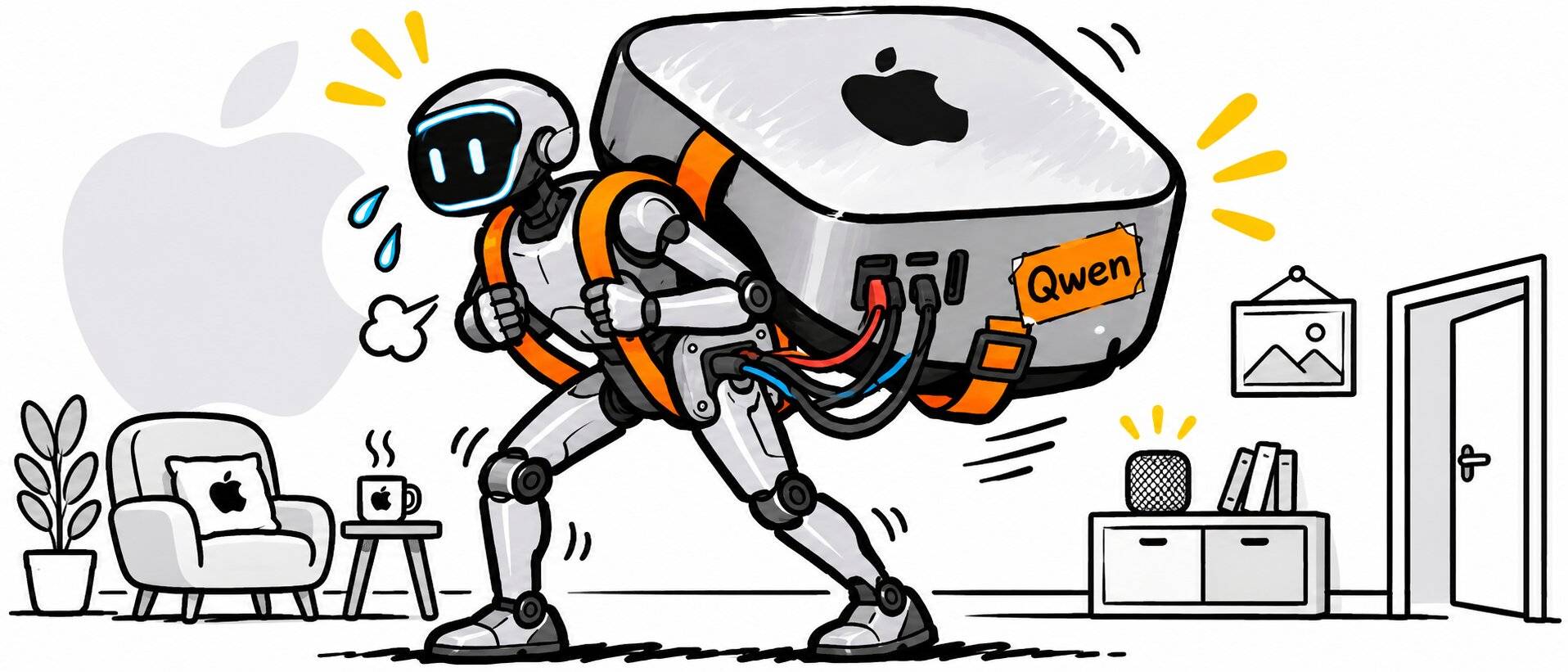
1. Apple Publishes HALO Humanoid Research: A Mac mini on Its Back, 91% Success in Unfamiliar Homes
Source: ifanr
Bloomberg reports that Apple CEO John Ternus has asked software chief Craig Federighi to speed up AI development and deliver bolder plans, rather than settling for a few Siri feature upgrades. Meanwhile, Apple's research team has published a humanoid robot study called HALO, showing embodied AI progress further along than outsiders had expected.
The system uses a Unitree G1 body carrying a Mac mini M4 Pro (64GB unified memory) as its brain, running Alibaba's open-source Qwen model, while the robot's onboard Jetson Orin NX handles 50Hz real-time control; a 120-degree wide-angle camera sits on its head, with no cables or external motion capture. In six real homes never seen or pre-scanned, it sat on chairs, walked to specified objects, squeezed through half-open doors, crawled under tables and pushed boxes, succeeding in 91% of 360 physical trials.
Training data is not collected by human teleoperation. The team generated full-body motions with a motion diffusion model, built 1,000 virtual homes with a procedural generator, rendered first-person views in Isaac Sim, and produced 163,000 paired samples totaling nearly 300 hours. Generating 50,000 samples for the "sit" skill alone took 250 H100 GPUs nine hours. Training scenes rising from 1 to 100 lifted chair-sitting success from 43% to 81%, and to 84% at 1,000 scenes.
2. Musk on the SpaceX-Anthropic Compute Deal: 'The Contract Is Two-Way'
Source: Mydrivers
Musk responded on X to a video shared by AI commentator Rohan Paul, saying the contract is two-way for both sides: if compute later becomes abundant and cheap, SpaceX would likewise face lower revenue, so neither side needs to complain about winning or losing.
The dispute began with venture capitalist Chamath Palihapitiya's analysis on the All-In podcast, who noted that the SpaceX-Anthropic compute agreement includes a clause allowing termination with 90 days' notice. He argued that if AI compute stays tight, SpaceX could exit and re-sign at two to three times the original price. The clause was already disclosed in SpaceX's IPO filing in May.
According to the filing, Anthropic pays $1.25 billion a month (about 8.35 billion yuan) for dedicated capacity in SpaceX's Colossus cluster through May 2029, a total of nearly $45 billion (about 300.592 billion yuan), with both sides able to terminate on 90 days' notice. SpaceX began leasing some data-center capacity after acquiring xAI in February; Musk says SpaceX is investing $35 billion to earn $50 billion a year, and that a data center can go live in 8-9 months versus the two and a half years rivals typically need. Anthropic has alternatives too, having signed large compute deals with Amazon, Google and Microsoft.

3. Running 2.8-Trillion-Parameter Kimi K3 on CPUs Alone, With Second-Hand Optane
Source: Mydrivers
A Reddit user ran Moonshot's 2.8-trillion-parameter Kimi K3 entirely on CPUs, powered not by top-end graphics cards but by Intel's abandoned second-generation Optane persistent memory (PMem 200). Even heavily quantized, the model needs at least 610GB of memory; building that from DDR4/DDR5 is extremely expensive, while second-hand Optane costs a fraction of ordinary memory of the same capacity.
The rig uses a 40-core third-generation Intel Xeon Scalable processor with second-generation Optane 200 series modules (launched in 2020 with the third-generation Xeon, 128GB to 512GB per module), mapped in App Direct mode as separate persistent memory regions so software can control where model tensors are stored. Optane runs hot: the user pointed two 12W turbofans at the memory slots and warned that active cooling is mandatory, since the heat can otherwise damage neighboring DIMMs or even melt the motherboard slots.
Performance is painfully slow: 0.85 tokens per second at 1-bit quantization and 0.75 tokens/s at 3-bit, meaning a 50,000-token task could take more than 13 hours. That is useless for real-time chat, but a cost-effective option for overnight offline batch jobs.

4. Even If AI Cools, Cheap Memory Isn't Coming: HBM Has Hollowed Out DRAM Capacity
Source: Mydrivers
Recent volatility in tech stocks had PC enthusiasts hoping component prices would fall. But this memory surge differs from past mining-driven cycles: it stems from a structural shift in supply. Over the past year, memory giants chasing AI data-center profits have changed production strategy entirely — fab tools are building HBM for AI, not DDR5 for personal computers.
Samsung, SK Hynix and Micron have moved most DDR4, DDR5 and graphics memory capacity to high-bandwidth memory, and Micron has nearly stopped making consumer-brand memory. The physical shift is irreversible: even if AI demand wobbles and HBM ends up in surplus, those chips cannot go into ordinary PC motherboards. Memory consultant Ben Miles notes that reconfiguring a fab line to switch product types takes at least two to three months of lag, while building new plants takes years. New chips must also pass through module makers, distributors and retailers, and pent-up demand quickly absorbs added supply. For buyers hoping for halved prices, high memory prices may be the norm for the next two to three years.

5. First Time in PC History: Memory Prices Push Configurations Backward, 64GB Share Down 18%
Source: Mydrivers
AI is devouring global DRAM capacity and driving memory prices up, forcing consumers to retreat to lower capacities. The latest CPU-Z hardware survey shows the share of 32GB and 64GB configurations fell 2.5% and 18% year on year respectively, while 16GB rebounded 12.9% and 8GB rose 5.5%. A CPU-Z developer said this is the first year-on-year decline in PC memory in history.
By share, 32GB leads CPU-Z users at 37.2%, followed by 16GB at 33%, 8GB at 11%, 64GB at just 7.3% and 24GB at 2.3%. As price per GB keeps rising, 24GB grew 19.7% against the trend, a compromise for users who want more than 16GB without paying for 32GB. DDR4 dominates at 54.5% versus DDR5 at 32.9%, with DDR4 up 6% and DDR5 down 2.9%. Among processors, the Ryzen 7 5700X, Ryzen 5 5600 and Ryzen 5 5500 gained 42.8%, 36.1% and 67.3%. Vendors are adjusting too: AMD re-released the Ryzen 7 5800X3D, board makers restarted DDR4 lines, and Intel plans to launch a refreshed Raptor Lake Next chip in 2027.

6. Android Flagships Get Pricier While iPhones Sell: iPhone 18 Pro Takes Top Two in China
Source: Mydrivers
The TOP 30 ranking for China's smartphone market in week 44 of 2026, published by blogger "RD Observation," shows the iPhone 18 Pro series taking the top two sales spots, with the Pro Max a runaway first. Apple holds four of the top five: the previous-generation iPhone 17 third, the foldable iPhone Duo fourth and the iPhone 17 Pro fifth, with six Apple models on the list overall. The highest-ranked domestic phone is Huawei's Pura X View in sixth, followed by Honor's X80 Pro Max and Huawei's Enjoy 90 Pro Max.
Rising Android flagship prices helped. Android flagships have moved upmarket this year, with Pro-level top configurations generally above 6,000-7,000 yuan and some ultra-premium models approaching 10,000 yuan. TrendForce data shows memory contract prices in the first quarter of 2026 rose nearly 200% year on year, pushing memory's share of phone bill-of-materials costs from 10-15% to 30-40%. Apple also delayed the standard model's launch, pushing budget-limited buyers toward the pricier Pro tier; third-party data shows iPhone 18 Pro sales up 12% year on year in its first three days. Replacement cycles now exceed three years on average, concentrating demand on high-end flagships bought to last.

7. OPPO's First Wide Fold Takes Shape: Find N7 Focuses on Thinness and a Crease-Free Display
Source: Mydrivers
After Huawei and Apple launched wide-fold flagships, other major vendors are following; OPPO is among the furthest along. A digital blogger says OPPO is developing its first wide-fold phone, likely under the Find N line and possibly named Find N7.
The leak says the device uses OPPO's exclusive crease-free display technology and focuses on extreme thinness, with a 200-megapixel main camera plus a multispectral sensor and a Snapdragon flagship chip made on TSMC's 2nm process. Supply-chain plans suggest OPPO may turn Find N7 into a multi-form series covering both conventional book-style folds and the new wide-fold design.
OPPO is no stranger to the category: the Find N2 from years ago, far thinner and lighter than industry norms, can be seen as the technical ancestor of today's wide folds. With Huawei and Apple having educated the market, wide folds are the fastest-growing segment of the premium foldable market, and competition is shifting from form-factor adoption to imaging, performance and thinness.

8. Musk and Jensen Huang Team Up: Vera Rubin Heads to Orbit, First Launch in Q3 2027
Source: Mydrivers
Speaking at the 33rd Barron's Investor Conference in New York, Musk said the first StarMind space-computing units, jointly designed by SpaceX and Nvidia, are scheduled to begin launching in the third quarter of 2027, with large-scale deployment in 2028-2029. The core hardware is not a typical terrestrial server but Nvidia's Vera Rubin NVL72 platform — sending a rack-scale system built for ground-based AI training straight into orbit, meaning the space data center targets large-scale AI inference and training from the start.
Energy is the driver. Musk says the ultimate bottleneck for AI compute is power: China generates about three times as much electricity as the US, and ground grids struggle to keep up with data-center demand; orbital solar panels, unaffected by day-night cycles and clouds, capture about 30% more solar energy than on the ground. Communications are being upgraded in parallel: SpaceX plans 10 laser links on next-generation Starlink V4 satellites, each above 10 terabits per second, with a longer-term network of more than 100,000 satellites at about 100 links each. Light travels about 40% faster in vacuum than in fiber.
The timeline is on paper, but heat dissipation, radiation hardening and in-orbit maintenance remain unsolved. Whether Nvidia's chips can run reliably in orbit is the first hard threshold between blueprint and scale.

9. Chinese AI Models Top US Weekly API Volume for 28 Straight Weeks, Four of Top Five
Source: Mydrivers
OpenRouter data shows global AI model API volume reached 210 trillion tokens last week (Nov 2-8), up 8.25% week on week. Chinese models accounted for 116.18 trillion tokens, up 16.71%, while US models fell 32.4% to 13.98 trillion. Chinese models have now exceeded US volume for 28 consecutive weeks.
Four of the top five are Chinese: DeepSeek V4.1 Flash 1017 ranked first for a third straight week with 56 trillion tokens, up 17%; DeepSeek V4.1 Flash was second with 17.6 trillion, up 18%; Zhipu GLM 5.3 Flash third with 13.2 trillion, down 12%; newly launched Tencent Hunyuan Hy4 entered fourth with 12.8 trillion; GPT-6 Luna was fifth, down 25%. Back in the week of March 9-15, Chinese models' 4.12 trillion tokens first surpassed the US at 2.94 trillion. OpenRouter only counts API traffic routed through its platform — vendor APIs, cloud services, private deployments and consumer apps are excluded — so the figures are not the same as global market share.

10. A Two-Inch Fragment Lit Up Tennessee: NASA Identifies the Fireball
Source: New York Post
Last Thursday night a meteor streaked across southeastern Tennessee's sky, with one witness calling it the "biggest ball of fire" they had ever seen. NASA said it was a piece of an asteroid vaporizing above Earth. The fireball was first spotted above Robbinsville, North Carolina around 7:45 p.m., traveling about 47,000 miles per hour, covering roughly 120 miles toward East Ridge, Tennessee in under 10 seconds before disintegrating 25 miles above the surface.
Witnesses on Reddit described a streak glowing blue, white and orangish yellow; one in Chattanooga heard a sound like a lighter's "poof" and said it left "the most insane tail." NASA confirmed Friday that the object was a two-inch fragment weighing less than half a pound. Its All Sky Fireball Network captured it from multiple directions with fisheye black-and-white cameras and calculated its height and speed. The agency said the fireball was not part of the Taurid meteor shower, which is typically active through November.

More News
- Global Express | November 9, 2026: Kraków Shooting Suspect Dies in Hospital, Polish Police Say
- Finance Morning | Nov 9: Nvidia Probes CEO Jensen Huang as Taiwan Leads Asia
- Sports Express | November 9, 2026 — Leafs blanked 4-0 by Devils, winless in six
- Maple Express | November 9, 2026 - Man in his 20s shot in Toronto's east end
- Maple Express Evening | Nov. 8, 2026 — York University confirms data breach affecting online forms since 2007
Comments (0)
View More
 -39%
JBL Bar 700 MK2 780W 7.1 Dolby Atmos Soundbar — Detachable Wireless Surrounds and 10" Sub Included! $799.99 CAD (38% Off)
 -36%
Samsung 24" FHD IPS Monitor — 120Hz for Just Over $100! $109.99 CAD (35% Off)
 -51%
🎉 史新低!Ring Wired Doorbell 2K (Newest Model) — Half Price with 2K Wide-Angle Video and 6x Zoom, $54.99 CAD (50% Off)
 -51%
Amazon Fire TV Stick 4K Plus — Half Price, Turns Any TV Smart! $49.99 CAD (50% Off)
 Maple Express
 Evening | Nov. 8, 2026 — York University confirms data breach affecting online forms since 2007
 Sports Express
 | November 9, 2026 — Leafs blanked 4-0 by Devils, winless in six
-39%JBL Bar 700 MK2 780W 7.1 Dolby Atmos Soundbar — Detachable Wireless Surrounds and 10" Sub Included! $799.99 CAD (38% Off)
Best Buy
-36%Samsung 24" FHD IPS Monitor — 120Hz for Just Over $100! $109.99 CAD (35% Off)
Amazon
-51%🎉 史新低!Ring Wired Doorbell 2K (Newest Model) — Half Price with 2K Wide-Angle Video and 6x Zoom, $54.99 CAD (50% Off)
Amazon
-51%Amazon Fire TV Stick 4K Plus — Half Price, Turns Any TV Smart! $49.99 CAD (50% Off)
Amazon
Maple ExpressMaple Express Evening | Nov. 8, 2026 — York University confirms data breach affecting online forms since 2007
Sports Express